
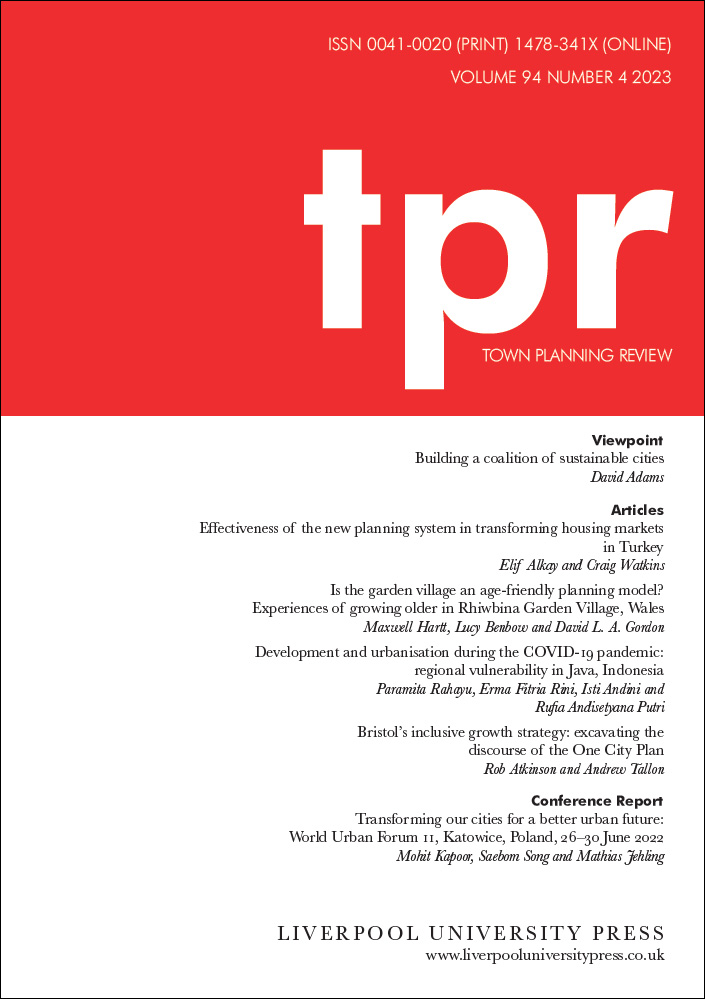
The editors of Town Planning Review (TPR) have selected the following paper as the Featured Article in TPR 94.4.
It is available to read Open Access as part of LUP Open Planning:
When asked to describe the paper and highlight its importance, the author stated the following:
Our article is an in-depth study that analyzes the relationship between regional development inequality, urbanization levels, and the spread of COVID-19 in Java, Indonesia. Numerous studies, like Granger and Charlton (2021), Ormerod and Davoudi (2021), and Dutta and Fischer (2021), have examined how cities and urban planning should react to uncertainty since the COVID-19 pandemic began in early 2020. Additionally, several studies (e.g. Molina-Torres et al., 2021; Barak et al., 2021; Viezzer and Biondi, 2021; Lee et al., 2021; and Kwok et al., 2021) have concentrated on regional-scale variables, examining the relationship between the spread of COVID-19 and regional characteristics using territorial indicators. The findings have not been verified because they vary by area. We seek to comprehend how COVID-19 dissemination relates to development and urbanization factors, as well as the function of planning in pandemic response.
By contrasting 119 cities and districts, categorized into three groups according to their percentage of confirmed cases (low, medium, and high), our results showed that more urbanized cities and districts experience more COVID cases. Cases were more prevalent in cities with developed urban infrastructure and services. Ceteris paribus, Java’s urban context lends credence to the claim made by Hamidi et al. (2020: 495) that “connectivity matters more than density.”
That smaller cities are susceptible to transmission during a pandemic is another important finding of our article. Like what is seen in larger cities, the high mobility and interactions in these smaller metropolitan centers may increase the risk of virus transmission. Therefore, we underscore the crucial role of urban and regional planning in dealing with pandemics. Proper urban and regional planning can help manage mobility and resources effectively, thereby curbing the spread of the virus and reducing the number of confirmed cases.
Overall, this study provides valuable insights into how different development aspects (economic, spatial, and human development) affect the percentage of confirmed cases in Java and highlights the need for comprehensive and integrated approaches to address such global health crises. We advocate the significance of macroeconomic and quality-of-life views being taken into account while developing development concepts. This means that efforts to address and mitigate the impact of pandemics like COVID-19 should not only focus on economic aspects but also take into account social and human development factors.
– Paramita Rahayu, Erma Fitria Rini, Isti Andini, Rufia Andisetyana Putri
Urban and Regional Planning, Faculty of Engineering, Universitas Sebelas Maret, Indonesia.

Follow us for more updates
Sign up to our mailing list
Twitter | Instagram
www.liverpooluniversitypress.co.uk
 Liverpool University Press Blog