
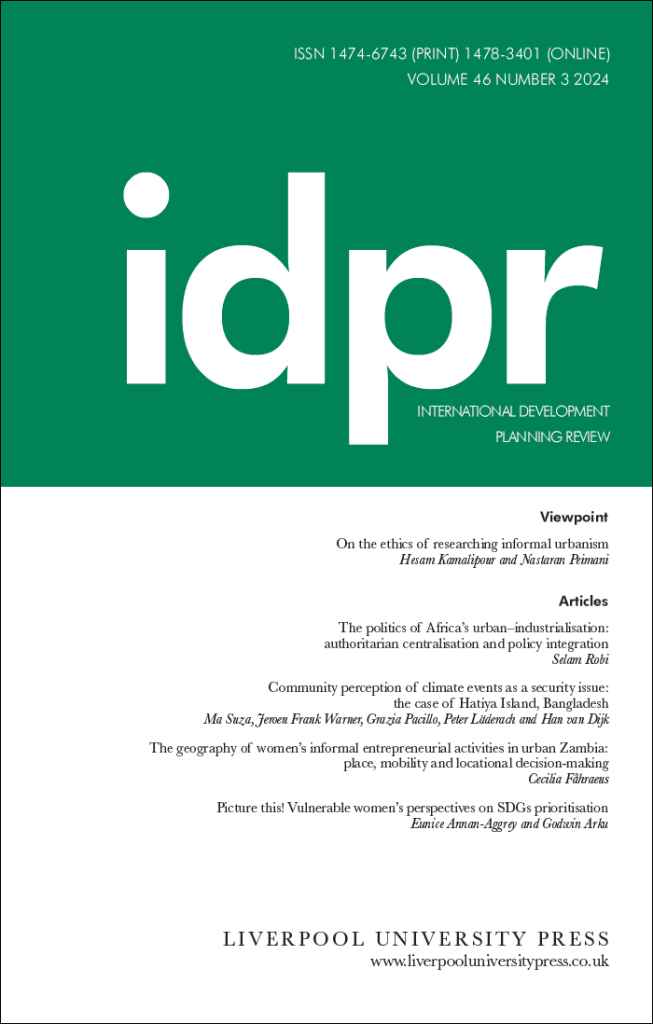
The editors of International Development Planning Review (IDPR) have selected the following paper as the Featured Article in IDPR 46.3.
It is available to read Open Access as part of LUP Open Planning:
‘The politics of Africa’s urban–industrialisation: authoritarian centralisation and policy integration‘ by Selam Robi.
When asked to describe the paper and highlight its importance, the author stated the following:
Industrial policy is back on the agenda across the world and mainstream academic (Groenewegen 2000; Chang 2002; Rodrik 2014; Stiglitz et al. 2013) and non academic (The Economist 2022) development analysts are re-engaging with the theory and practice of Industrial policy and developmentalism. In Africa, rapid export-oriented industrialisation has characterized the recent surge of industrialisation initiatives that have taken off over the past decade. This paper engages with a largely overlooked aspect of this current phase of Africa’s Industrialization- urban industrial fragmentation (UNECA, 2017, 2018) and analyses the politics driving this fragmentation in what is arguably the most successful case of accelerated and spatialized industrial policy in Africa, Ethiopia’s Industrial Parks Development Program.
Through the study of successful spatial industrial policy facilitated by developmental authoritarianism, the paper interrogates the relationship between authoritarian Industrial policy and policy integration. I introduce the concept of authoritarian centralisation (AC) to interrogate how centralisation in authoritarian developmental regimes can be detrimental to PI, at least in the context of industrialisation in Africa. Many authoritarian states implicitly or explicitly emphasise the benefits of tight control for steering economic development. This paper provides an important counter argument by elaborating on the negative effects of centralisation for PI. This constitutes the core of the paper’s original theoretical contribution.
Based on thematic analysis of over a hundred qualitative interviews with key policy actors in the urban–industrial sphere, I argue policy fragmentation in the African urban–industrial nexus is driven by processes of ‘authoritarian centralisation’ that foster adverse political conditions for PI – more specifically conceptual integration, policy coordination and infrastructural integration. The study illustrates the relationship between authoritarian centralisation and PI and discusses the ways in which authoritarianism has shaped urban policy, planning and development and its integration into industrial and economic development strategies. The paper contributes to the nascent literature on the politics of urban–industrialisation in a broader range of developmental authoritarian African states.
References
Chang H-J (2002) Kicking away the ladder – development strategy in historical perspective. Anthem Press, London
Groenewegen J (2000) Industrialisation: Industrial policy; theories, and instruments. In: Elsner W, Groenewegen J. (eds) Industrial policies after 2000. Springer, Netherlands, pp 1–22
Rodrik D (2014) Green industrial policy. Oxf Rev Econ Policy 30(3):469–491
Stiglitz JE, Yifu JL, Patel E (2013) The industrial policy revolution II Africa in the 21st century. Palgrave Macmillan, New York.
UNECA (United Nations Economic Commission for Africa) (2017) ‘Urbanization and industrialization for Africa’s transformation’ (economic report), Addis Ababa, UNECA, https://hdl.handle.net/10855/23723 (accessed 22 May 2024).
UNECA (United Nations Economic Commission for Africa) (2018) An Urban Lens on National Development Planning in Africa: A Guidebook for Policy Makers, Addis Abba, Economic Commission for Africa.

Follow us for more updates
Sign up to our mailing list
Twitter | Instagram
www.liverpooluniversitypress.co.uk
 Liverpool University Press Blog