
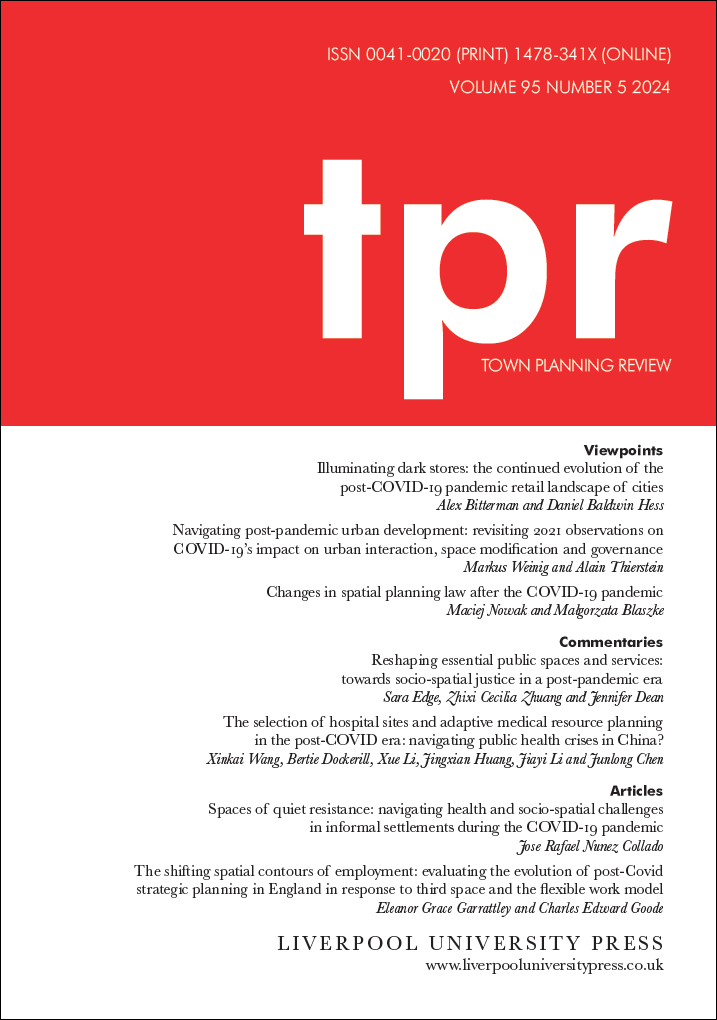
The editors of Town Planning Review (TPR) have selected the following paper as the Featured Article in TPR 95.5.
It is available to read Open Access as part of LUP Open Planning:
‘Reshaping essential public spaces and services: towards socio-spatial justice in a post-pandemic era’, by Sara Edge, Zhixi Cecilia Zhuang, and Jennifer Dean.
When asked to describe the paper and highlight its importance, the authors stated the following:
Public spaces (e.g. community centres, community gardens, food hubs cultural clubs, etc.) are vital places for facilitating social, cultural, economic and religious interactions and inclusion, particularly amongst racialized minorities and immigrant communities that experience cumulative environmental health inequalities. Yet during the pandemic lockdowns, underserved immigrant communities encountered increased barriers to accessing these crucial spaces, further isolating and excluding already marginalised community members. The pandemic also highlighted systemic issues contributing to these challenges, including ineffective policies that neglect community voices and fail to recognise the unique needs of minority populations, especially in changing suburban contexts.
As cities worldwide navigate a post-COVID recovery, we interrogate the ‘essential’ public spaces, places and services that must remain accessible (particularly in times of crisis) to benefit the settlement, well-being and inclusion of marginalised, racialised, immigrant populations. We consider novel engagement approaches that effectively include racialised minority groups’ voices in decisions about the future of public space and (sub)urban systems drawing upon examples from the Canadian context.
We emphasise the utility of a socio-spatial justice framework in reimagining and reconfiguring essential public spaces and associated services in the aftermath of the COVID-19 pandemic and unpack pillars of distributional, procedural and recognitional justice. Distributional justice is about overcoming disparities through fair distribution of benefits and risks across communities, including essential spaces, services, and amenities (Soja, 2010). Procedural justice emphasises the importance of inclusive and transparent participation in decision-making by all community members, particularly marginalised groups (Edge et al., 2020). Recognitional justice refers to acknowledging the diverse needs, identities, lived experiences, knowledge and values of disadvantaged groups during decision-making and challenging norms that perpetuate discrimination and exclusion (Grant et al., 2023).
We explore each of these pillars within the context of innovative urban engagement processes including community land trusts (Bunce and Aslam, 2016), cultural festivals (Fincher et al., 2014), community food hubs (Regnier-Davies et al, 2022) and food sovereignty initiatives (Black Food Sovereignty Working Group, 2023) to interrogate the status quo and illuminate pathways to more inclusive, fair and accessible communities.
References
BLACK FOOD SOVEREIGNTY WORKING GROUP. (2023), ‘Food sovereignty for black communities in Toronto: challenges and policy opportunities’ (Policy Paper), https://www.bfstoronto.ca/resources (accessed 6 December 2023).
BUNCE, S. and ASLAM, F. C. (2016), ‘Land trusts and the protection and stewardship of land in Canada: exploring non-governmental land trust practices and the role of urban commu- nity land trusts’, Canadian Journal of Urban Research, 25, 23–34.
EDGE, S., BROWN, E. L., GHOSH, S. and MURNAGHAN, A. M. (2020), ‘Procedural environmental (in)justice at multiple scales: examining immigrant advocacy for improved living condi- tions’, Local Environment, 25, 666–80.
FINCHER, R., IVESON, K., LEITNER, H. and PRESTON, V. (2014), ‘Planning in the multicultural city: celebrating diversity or reinforcing difference?’, Progress in Planning, 92, 1–55.
GRANT, A., MILLWARD, A. A. and EDGE, S. (2023), ‘Pursuit of environmental justice in urban forest planning and practice’, Frontiers in Sustainable Cities, 5, 1233878.
REGNIER-DAVIES, J., EDGE, S., YU, H.M. M., AUSTIN, N., NASR, J., DALEY, A. and KOC, M. (2022), ‘Towards equity and resiliency in a post-pandemic urban food system in Toronto, Canada: the role and value of community-based organizations in driving the COVID-19 emergency food security responses’, Urban Governance, 2, 336–46.
SOJA, E. W. (2010), Seeking Spatial Justice, Minneapolis, University of Minnesota Press.
You can read more about this in our article >

Follow us for more updates
Sign up to our mailing list
Twitter | Instagram
www.liverpooluniversitypress.co.uk
 Liverpool University Press Blog