
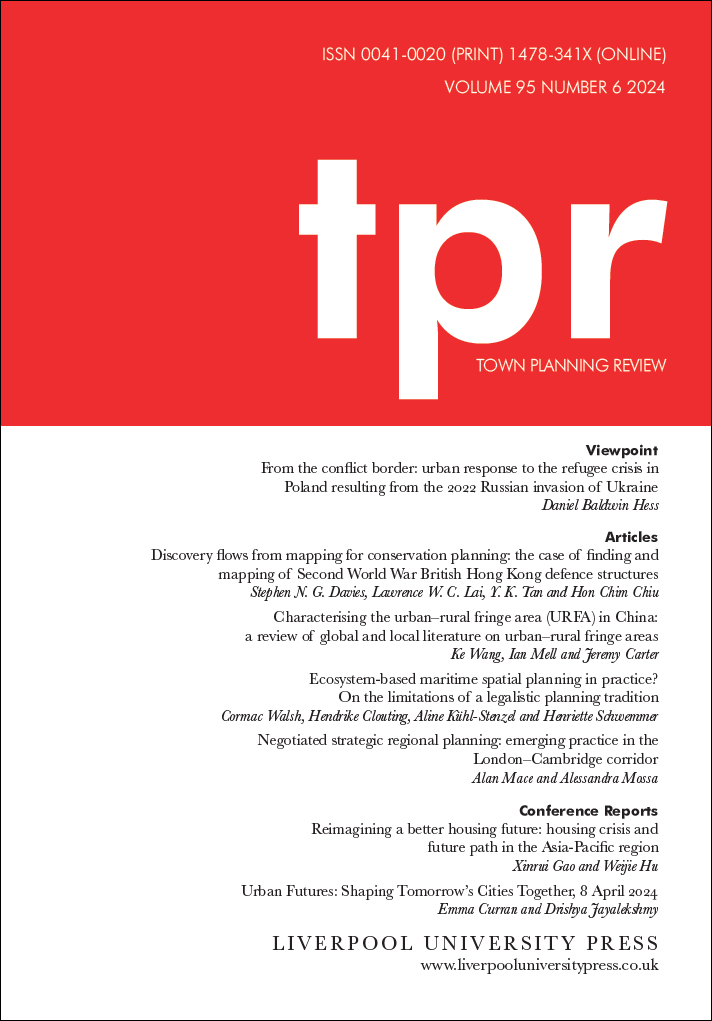
This ‘Call for Abstracts’ was initially issued in late 2024 by Professor Ben Davy who, as a former editor of Town Planning Review, would have acted as Guest Editor for this Special Issue on an important topic upon which he was passionate.
It is with great sadness that the journal now has to amend this call after the sudden and totally unexpected death of Ben late last week. He was an outstanding academic, mentor, and friend who will be sorely missed by all who knew him. Given Ben’s passion for this subject and his belief in the importance of voices and opinions being heard, the journal intends – in Ben’s memory – to continue with the Special Issue.
Within our editorial team, Sebastian Dembski had been working in partnership with Ben on the Special Issue and he will now act as the co-ordinating editor for the issue.
We hope that authors who had already submitted Abstracts still wish to continue working on this important topic, and we also look forward to the receipt of further abstracts.
Town Planning Review (TPR) is an international urban planning journal with an editorial board which spans the globe. The editors invite the submission of abstracts (300 words) for a special issue on ‘decolonising spatial planning education and research in Europe’.
Eurocentrism often presents itself as profound ignorance of Europeans about the European domination over lives outside Europe. Postcolonial studies call this ignorance colonial amnesia. Spatial planners suffer from colonial amnesia, for example, by ignoring that many European cities were built with revenues from slavery, overseas plantations and mines, and the exploitation of subjugated populations in Africa, South-West Asia, East Asia, Latin America, and Oceania. While fields like anthropology or geography have made progress in decolonising education and research, spatial planning only reluctantly addresses the colonial heritage of European cities and regions.
Who is invited?
Academics from the fields of spatial planning, urban planning, social or political geography, gender studies, planning history, urban sociology, planning law, architecture, heritage protection, post-colonial studies, or related fields.
Early career academics
We specifically encourage young academics and early career academics to submit an abstract!
Possible topics
- Planning with/inside/against the colonial heritage of European cities and regions
- Deconstructing the colonial and hegemonic underpinnings of spatial planning goals and instruments in Europe
- Questioning which contemporary planning ideas (e.g., sustainable development, resilience, climate-friendliness) continue colonial and hegemonic ideologies
- Including critical awareness for the European colonial heritage into spatial planning education
- Teaching post-colonial studies in European spatial planning schools
- Forging an agenda or strategies for decolonising spatial planning education and research in Europe
Output format
In your abstract, please choose as your preferred output format either a viewpoint (2,000 to 4,000 words) or full research article (6,000 to 8,000 words). Both formats will be reviewed fully.
Submit no later than 28 February 2025 (deadline for abstract submission).
Where do I submit?
Please submit your abstract to either Sebastian Dembski (co-ordinating editor for the Special Issue ) at: Sdembsk1@Liverpool.ac.uk or Bertie Dockerill (editorial office) at: Bertie.Dockerill@Manchester.ac.uk.
Next steps after abstract submission
An invitation to submit your viewpoint/article for review will go out mid-February. Your contribution must be submitted by 30 September, 2025.
Questions?
Please email Sebastian or Bertie for more information.
In a new video series, the co-editors of Town Planning Review explain what makes it a great place to publish your research, how the journal supports new and emerging authors, and the benefits of publishing in a Subscribe to Open journal.

Open Access takes your research further
TPR is part of LUP Open Planning, our Subscribe to Open initiative that allows us to publish the latest content Open Access. If the subscription threshold for the year is reached that year’s journal content will flip to Open Access – if this happens there is no publishing charge to authors, meaning that authors’ work can be made available Open Access without any cost to the author. Find out more >
Follow us for more updates
Sign up to our mailing list
Twitter | Instagram | Bluesky
www.liverpooluniversitypress.co.uk
 Liverpool University Press Blog