
Each year our Pavilion Poetry students assist with the publishing of our new collections, dedicating their time to an individual poet. In this interview, Sophie McQue talks with author Theresa Muñoz about her new collection, Archivum (Pavilion Poetry, 2025).
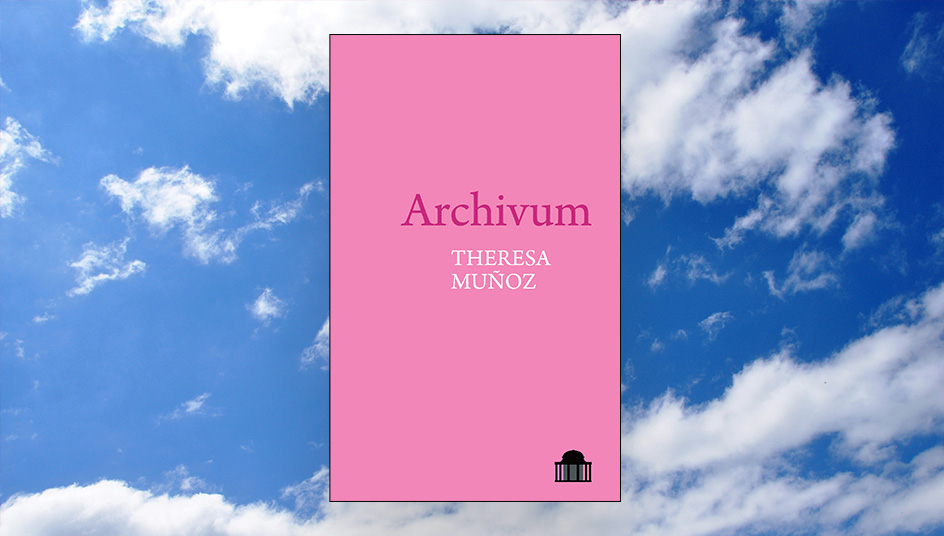
Archivum is a collection driven by archives and artefacts, with reference to objects belonging to and experiences lived by numerous female figures — Muriel Spark, Elizabeth Bishop and Eliza Junor to name a few. What inspired you to take this approach in the curation of the collection?
I have always been drawn to write poems about objects, like a letter, a coat, a bridge. I find it an interesting way to test the poetic line – how you can describe the essence of an object in a few words. The process of discovering items in archives is also interesting to me; we judge our expectations of the artefact against what we really find. And then we compare what we find to objects and events in our own lives.
I was inspired by the way archives can loosely exist; they’re not just items in a box. Essentially, they’re a collection of items belonging to an individual. So, an archive can be what’s in your jacket pocket. In some ways the body is an archive, the way it holds certain memories in different postures.
I wanted the book to read like an alternative catalogue of an archive. I also wanted to raise awareness of underrepresented individuals in Scotland; the Indigenous women who came to Orkney during the fur trade; Eliza Junor, a multi-racial woman and daughter of a former slave owner who is laid to rest in Rosemarkie in Scotland’s Black Isle; the psychotherapist Marie Battle Singer, who was in an inter-racial relationship with the poet James Burns Singer. I’m also interested in how we categorise archives; it used to be in a quite patriarchal way, and in very limiting categories with respect to race and ethnicity, but that is changing, hopefully.
A considerable number of poems in Archivum are derived from the Muriel Spark archive. What was it about Spark that influenced you enough to dedicate these poems to her? When did your connection to her begin?
I happened on the Muriel Spark archive through a Creative Scotland/National Library of Scotland initiative. It was a celebration of what would have been Muriel Spark’s 100th birthday, the ‘Muriel Spark Centenary’. There were new funds for artists to develop new work based on the life and work of Muriel Spark, which I applied for and received. There had also been an exhibition of Spark’s artefacts at the National Library of Scotland, called ‘The International Style of Muriel Spark’ and I used to spend a lot of time studying the objects, particularly her typewriter, dresses and letters.
I have a poem called ‘Footnotes comparing Muriel and I’. I think Spark carved a path for all women writers in Scotland. Her struggles were real: family pressures, body image issues; fighting for a place in a male-dominated field, and comparatively late in life for recognition. Her letters are fascinating; they are written with publication in mind, I think, and with such acerbic wit. She got very disturbing letters from her male fans, which I reference in my poetry. She was extremely loyal to her family and to her best friend, Frances Niven, her chum from the James Gillespie School for Girls. Spark grew up on
Bruntsfield Place in Edinburgh and when I walk past there, especially when the daffodils out, I think of what she did for Scotland and the literary world.
Memory operates spectacularly in the collection; each poem seems to tell us a different story or lived experience. Could you describe to us the relationship between poetry and memory? What does this mean to you?
I suppose every poem begins like a memory – you feel and describe the sensorial details of a particular location very clearly. I think with my poems, I try to sketch out the perimeters of the location, and then go deeper into the conflict, or what’s troubling the narrator in the poem. For me, poems have always been a mix of memories, history and falsehoods – a way to outline a question, an issue I’ve been thinking about, something in my life that I want to work on. I like how memories sometimes have a piercing quality, like a chorus in a song. In my poem ‘Hôtel Chevilion’, about a residency I took in France, I kept repeating the line ‘Strength, the river’. I remember how all the writers gathered every night by the river, sometimes speaking and sometimes just sitting in silence. Memories also contain a level of complexity, as in poems. I try to create poems that go off in different directions, with contrasting images, but carry the same feeling or theme.
The pacing in Archivum is particularly interesting; from one location to another, multiple voices and perspectives, one artefact to the next. What was the process behind the intermittent pacing of the collection?
It’s funny because Archivum was initially three separate sequences; one on the archives of Muriel Spark, one on a set of modern villanelles that I wrote about Edinburgh and its archives, and one on contemporary and historical inter-racial relationships. Yet when I was putting the book together, the three separate sequences seemed to run in parallel lines and didn’t really intersect. And it felt difficult to shape the arc of each sequence successfully. On the advice of our brilliant editor, Deryn, I rearranged the poems so that it was more of a story about myself as a writer of Asian heritage, trying to build a life as a third-culture-individual. I agree that the poems move around, perhaps contained by location and hopefully a consistent narrative voice. The poems are based on a long walk around historic sites of interest in the city; like most writers, I find that long walks and runs are a way to mull over new material.
Archivum takes us on a journey across Edinburgh, in poems such as ‘Water of Leith’, ’Balmoral Clock’ and ‘Queen Street Gardens’. Why is Edinburgh such an important place to you, and such an integral part of Archivum?
I’m from Canada, but I’ve lived in Edinburgh ever since I finished my PhD. It’s definitely our home now. All the important life-changing events that you go through happened to me while living in this city. A person once said to me ‘You stepped through the door to adulthood here’ and although I slightly cringed at the comment, I realized they were right. I love living in Edinburgh. I live near Meadows and the university and have seen the area change and develop so much, with new fusion restaurants, more international students and lots of inter-racial couples that walk past my house.
Over time, I’ve slipped comfortably into the paths and patterns of the city. Like walking along the Water of Leith and stopping to think about things. I commute regularly and I’m always looking up at the Balmoral Clock, wondering if I’m late for my train. The history of Edinburgh fascinates me, and I’m trying to write about the underrepresented voices that are hidden in archives.
Theresa Muñoz was born in Vancouver, Canada and lives in Edinburgh. She has received a Muriel Spark Centenary Award, Robert Louis Stevenson Fellowship, Creative Scotland grant and shortlisted for The Kavya Prize and a Sky Arts Royal Society of Literature Writers Award. She has produced several literary initiatives in the UK, including the Newcastle Poetry Festival and the James Berry Poetry Prize.
Follow @pavilionpoetrylup on Instagram and visit our website to pre-order Archivum.
Pavilion Poetry Launch 2025
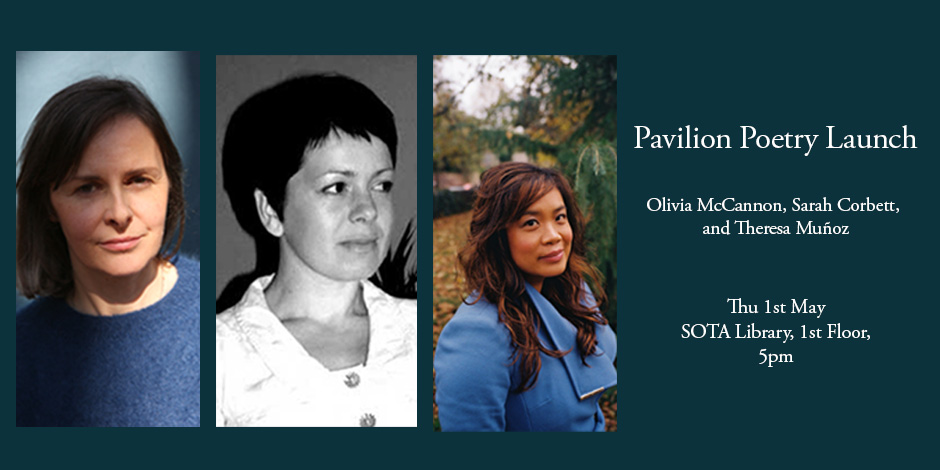
Join us in Liverpool on Thursday 1st May to launch our new collections from Olivia McCannon, Sarah Corbett, and Theresa Muñoz with the Centre for New and International Writing. Register for the free event here.

Follow us for more updates
Sign up to our mailing list
Twitter | Instagram
www.liverpooluniversitypress.co.uk
 Liverpool University Press Blog