
The editors of Town Planning Review (TPR) have selected the following paper as the Featured Article in TPR 97.1.
‘Sharing the good life: Colin Clark’s contributions to urban studies’, by Robert Freestone.
This article will be Free to Read for a limited time.
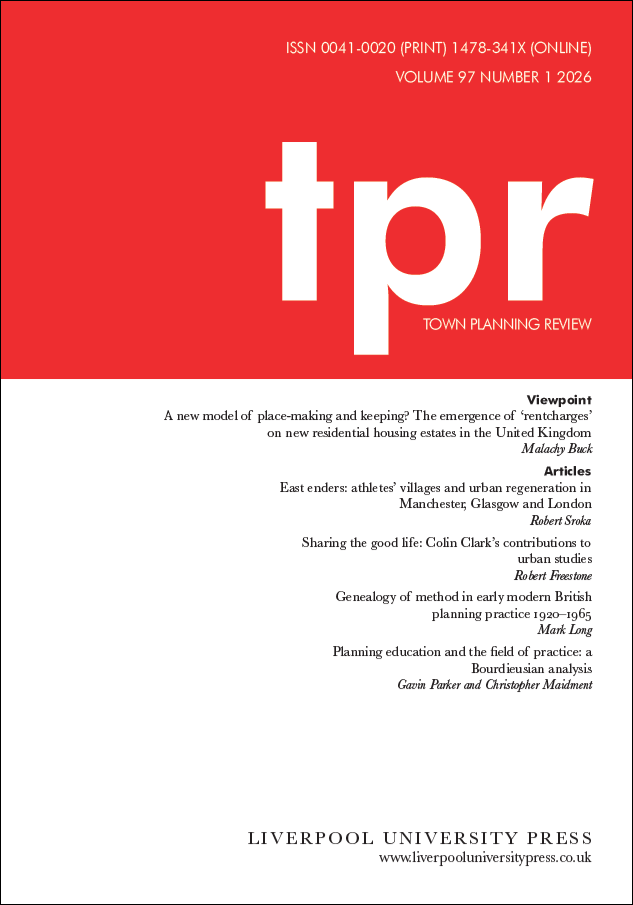
When asked to describe the article and highlight its importance, author Robert Freestone stated the following:
The history of modern planning has attracted a substantial literature, latterly more critical, inclusive and global than the standard timeline of garden cities, green belts and neighbourhood units dished up to several generations of town planning students into the 1960s. This sort of history was miraculously there even at the birth of the profession in the 1910s, as codified in the pages of Town Planning Review.
By contrast, urban studies has not attracted the same sort of historiography, perhaps stymied by the lack of a singular professional base and fragmented across multiple social science and design disciplines as it emerged from the late 1950s.
Economic instruments, implications and issues have been a vital component of planning in practice though arguably only fleetingly a driving intellectual force. There was a theoretical ascendancy from the late 1980s with the rise of political economy as a contextualising frame of reference, but urban economics has solidified its own legitimacy outside of any connection with planning.
The Anglo-Australian economist Colin Clark was unusual in crossing over to attract an academic and policy audience in urban planning. His interest in urbanism remained a side project, supplementing his major concerns with national income and development studies. Clark’s interest was raised by his involvement in large-scale social science investigations of Liverpool and London in the 1920s that exposed an underclass and instilled an awareness of, and commitment to, social justice in his work. Later came his identification of the importance of the tertiarization of urban employment opportunities and its interfacing with urban development trends.
Clark’s major contribution in nascent urban studies was to rediscover and document the distance-decay phenomenon of urban form and density. Well into the 1970s, this remained a touchstone for the rise of quantitative analysis and the appeal of location theory in delivering supposed universal truths of urban form.
Alongside several notables, including British planners William Holford and George Pepler, Clark was invited to speak at the 1951 conference that led to the formation of the current Planning Institute of Australia. His talk tapped into his early encounter with the Garden City movement to explore urban decentralisation through growth of regional settlement. He was to promote the advantages of new towns to redress the loss of efficiency and equity from metropolitanisation for the next thirty years.
Besides his authorship of these substantive contributions, Clark was an intriguing individual with shifting personal and political alliances: from the left to the right, from state planning to economic liberalism, and from Anglicanism to Catholicism. He was an affable contrarian, critical of orthodoxy and resolute without being impolite, which only entrenched his individualism over time. The late Peter Hall was a fan, often returning to Clark’s 1958 essay in Town Planning Review on transport as the ‘maker and breaker of cities’ in its space shaping through both densification and suburbanisation. Clark pops up in Hall’s classic Cities of Tomorrow (1988) as a ‘perspicacious economist’ underlining the very rationale of his book in covering both ‘intriguing’ events and acknowledging ‘that our ideas and actions have been thought and done by others, long ago’.
Colin Clark’s story reminds us of the importance and richness of the diverse historical strands that laid the foundations for contemporary urban studies, despite its relentless restlessness.
Also of interest: The 2026 Free Issues: Read a free issue of each journal.

Follow us for more updates
 Liverpool University Press Blog