
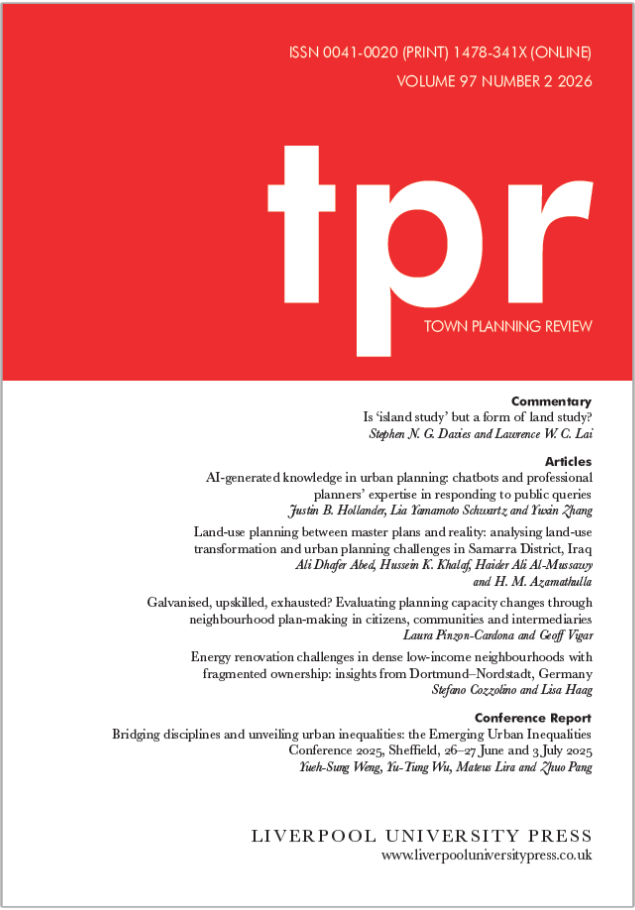
The editors of Town Planning Review (TPR) have selected the following paper as the Featured Article in TPR 97.2.
Galvanised, upskilled, exhausted? Evaluating planning capacity changes through neighbourhood plan-making in citizens, communities and intermediaries, by Laura Pinzon-Cardona and Geoff Vigar.
This article will be Free to Read for a limited time.
When asked to describe the article and highlight its importance, authors Laura Pinzon-Cardona and Geoff Vigar:
Our paper seeks to examine an issue much talked about by planners who do community-facing work but where there appeared to be little research: namely, in what ways does making a citizen-led plan affect the willingness and ability of citizens to engage in further planning activity?
In previous work published in TPR,[1] we noted how communities felt exhausted by the process of making a statutory neighbourhood plan and that it had created fissures in communities that left participants not wanting to engage in further such activity. More recently, however, we became aware of communities that had revised their neighbourhood plans or used them as springboards to do other placemaking activity such as set up a community land trust.
We were interested in this latter position for three reasons:
- What conditions led a community to continue to pursue further placemaking initiatives?
- What had they gained through making a neighbourhood plan that equipped them for this activity and why weren’t they exhausted?
- Was the presence of engaged professional planners within local authorities and planning consultancies significant in deciding to do more planning work?
We have been able to address these questions through three case studies to conclude, first, that further place-making activity often resulted from unfinished business with the neighbourhood plan, the need to deliver on social housing or green infrastructure, for example.
Second, making a neighbourhood plan gave a [very] small group of individuals greater knowledge of planning practices, uplifting human capital. This created an opportunity to leverage knowledge of planning systems and local government practices to pursue issues arising from neighbourhood plan making.
Third, professional planners played critical intermediary roles in ‘galvanising’ the development of citizen capacities. The presence of a supportive team of planning experts explains much citizen planning action beyond the plan, acting as critical friends when issues arise. Going further, our third case showed a local authority not only doing superb work in supporting communities to make neighbourhood plans, but also ‘bridging’ to other council staff and internal practices to make sure citizen efforts were translated into action, through reshaping development management practices for example. Again, this encouraged future citizen engagement in planning.
Although the above paints a rosy picture of the potential for neighbourhood plan development as an entry point into greater citizen input to placemaking and planning locally we should caveat this conclusion. While we should celebrate these examples, the conditions required for a neighbourhood plan to be such an entry point are rare and their presence and absence can exacerbate existing wider spatial injustices. Thus, the conditions needed to self-organise, be resilient to bureaucratic obstacles over long periods, and develop collaborative relations with planners as intermediaries are privileges lacking in many communities.
Future placemaking initiatives, such as the Neighbourhood Boards established under the UK Pride in Place initiative, should therefore be alive to the greater resources needed to ‘galvanise’ community capacity in some places, especially those with little history of planning activity or existing institutional infrastructure such as a parish council. Professional planners in local authorities and consultancies have a potential role in providing the skills and knowledge required to navigate statutory systems and bridge to established organisations. Participation cannot rely on who simply has the time, connections and stamina – fairer placemaking demands resources closely tailored to pre-existing levels of community capacity.
[1] Vigar G, Gunn S, Brooks E., ‘Governing Our Neighbours: participation and conflict in neighbourhood planning’, Town Planning Review 2017, 88(4), 423-442.
Also of interest: The 2026 Free Issues: Read a free issue of each journal.

Follow us for more updates
 Liverpool University Press Blog