
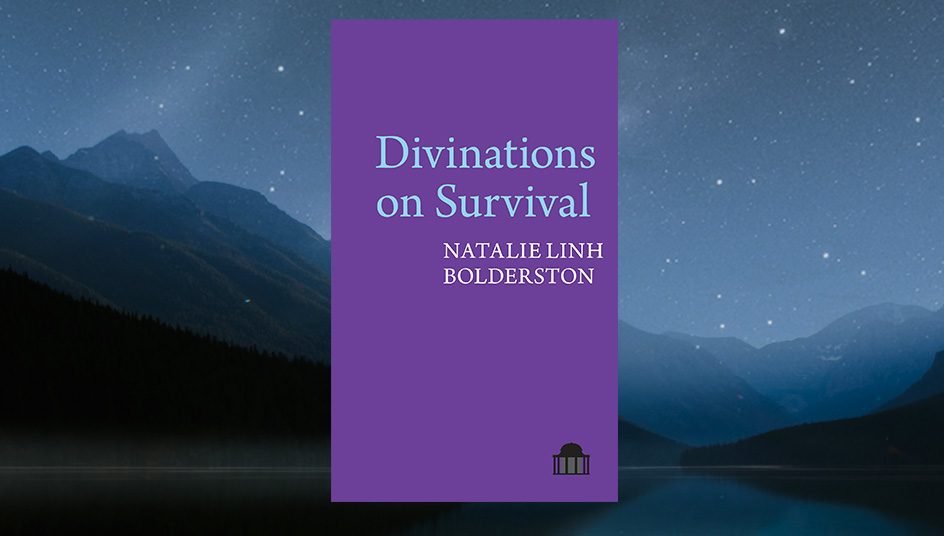
Each year our Pavilion Poetry students assist with the publishing of our new collections, dedicating their time to an individual poet. In this interview, Maddie Unsworth talks with author Natalie Linh Bolderston about her new collection, Divinations on Survival (Pavilion Poetry, 2026).
The poems in Divinations on Survival move between 1930s China, 1970s Vietnam and mythic time. How did you go about navigating these different geographic and temporal landscapes within a single collection?
I made a conscious effort not simply arrange the poems in a chronological order, but to scatter the different timelines and locations throughout the collection. In doing so, I wanted to mirror the way that memory — first-hand and inherited — actually works. Memory is not linear: it jumps back and forth in time and space; it obscures and reinterprets; it adds to new colours to old experiences.
By incorporating such temporal and spatial movements, I also wanted to allude to the textures of having a multihyphenate identity. All of these countries and eras are part of me, simultaneously, and cannot be sectioned off or unpicked. I aim to honour that complexity.
How did writing across three generations of women – your grandmother, your mother and yourself – shape the ethical and emotional responsibilities of this collection?
This is something that’s very important to me, and which I think about a lot. While many of my poems grow out of conversations I have with my mother and grandmother, I’m very selective with what I choose to zone in on in my writing. I choose small details that reflect larger emotional truths, rather than trying to relate narratives verbatim, which would feel much more exposing. The things I am told also get refracted and scattered through a poetic lens when I put them down on the page — often so much so that only my mother would fully understand all of the allusions that are present. There are ways of writing around a difficult thing when you can’t state it directly.
My mother also reads everything I write before I ever think of sending it out into the world. She has almost never asked me to change anything, and when she has, the changes have been minor details — the colour of a shirt, a certain turn of phrase.
In an interview, Ocean Vuong described his work as an ‘artistic collaboration with fact’, which is something I can relate to, especially when working with other women’s voices. The allusive and stylised nature of poetry offers personal stories some measure of protection; I think of my poems as spaces of multivocal speculation, rather than strict documentaries.
In these poems, myth and deity appear alongside lived family history. What did Chinese and Vietnamese myth allow you to articulate that personal narrative alone could not?
I think using a mixture of myth and personal narrative — sometimes braiding the two together — gives me and the reader multiple paths to the same feeling. While the myths and legends I refer to are old, their themes are perennial: loss, survival, love, hope. When considering them alongside familial memories — especially those focusing on women — I found some very potent echoes that gave me a new understanding of our stories. I also found that the strange and beautiful images that populate such myths powerfully distil what I want to say, and send my mind off in new directions. For example, in my poem ‘For Exile, or 嫦娥 [Cháng’é] Speaks From the Moon’, I refer to the myth of the Chinese moon goddess (in Vietnamese, she is known as Hằng Nga). For me, the image of a woman alone on the moon is a strong visual metaphor for loneliness, separation, and displacement. Her story provided me with a frame to talk about these issues — which, of course, also haunt my family’s stories — in a striking way, and gave me somewhere fresh to land.
In ‘Fragments of My Mother’s Homeland Underwater’, I refer to the myth of Âu Cơ and Lạc Long Quân, the ancestors of all Vietnamese people. Their story is about creation, union and the natural world, but also about separation and longing. It made me think of beginnings and endings, which then led to thoughts about my family’s origins, the horrific effects of war on both humans and nature, and the climate crisis. The myth laid down a thread that allowed me to hang all of these preoccupations together in a cohesive way; it offered a new pattern in which to rearrange existing fragments.
‘Protector’ is a personal favourite of mine among your poems. Could you tell us more about the inspiration behind this particular piece, and what you hoped it might communicate or evoke for readers?
Many years ago, I found the story of Triệu Thị Trinh, a third-century Vietnamese warrior woman who led a rebellion against the occupying Chinese army. There are some fascinating aspects to her legend: it’s said that she rode an elephant into battle, wore golden robes, and had a voice as powerful as a temple bell. There isn’t very much historical information about her, so I quickly became obsessed with writing my own versions of her. I was interested in her human vulnerabilities as well as her legendary strength; yes, she was a formidable military leader, but she was also a young woman simply trying to survive in a warzone. I imagined her griefs, her tenderness, her fierce protective instinct, and she quickly became another iteration of my mother. The figure in ‘Protector’ is therefore a stylised composite of Triệu Thị Trinh and my mother. In my poem, she has a child whom she is determined to save — a blurry version of me. With this rendering of us, I aimed to evoke the wild power of hope and fierce love under extraordinary circumstances.
Divinations on Survival speaks to a range of literary, cultural and political contexts. Which audiences, conversations or communities do you hope the collection connects with??
I write with mothers — my mother, in particular — and daughters at the forefront of my mind, so I hope that anyone with a complex but ultimately very loving relationship with their mother or daughter can identify with some of the poems in this book.
I also hope that this collection makes people who grew up in a similar cultural context to me feel ‘seen’ in some way — kids who always wanted to know more about who they were and what made their lives possible; kids who had to stitch together their history from fragments; kids who learned to access and love their culture through stories and rituals.
I would be hugely honoured if the UK’s various Vietnamese communities found something to connect with in this book, but I think it’s important to state that I’m not trying to speak for anyone. These poems are inspired by the particular stories told to me by my family, and while some people might relate to them, every family’s experiences are unique and multifaceted. I hope that readers are able to engage with my poems while understanding that they cannot comprehensively represent a whole diaspora; they contain just a few Vietnamese voices from a sea of many. I hope my book encourages audiences to seek out some of those other stories; to begin with, I can recommend the writings of Nhã Thuyên, Tuyền Đỗ, Hiếu Minh Nguyễn, Paul Tran and Ocean Vuong. Also, the publisher Major Books produces beautiful translations of Vietnamese literature, including traditional folk tales and contemporary novels.
With regards to how my book might sit in the current political climate: I hope the stories in my collection might offer some resistance to the racist dogma that is unfortunately dominating much of Western media. Given that many of my poems are informed by my family’s history as refugees — and allude to the way they were/are treated in the UK — I think they at least offer a counternarrative to the right-wing news cycles. When encountering my work, I want readers to be reminded of the importance of centring the voices of displaced communities and people of colour in general, rather than the discriminatory narratives that are often constructed about us.
Natalie Linh Bolderston is a Vietnamese-Chinese-British poet from Stoke-on-Trent. She has won an Eric Gregory Award and the Rebecca Swift Women Poets’ Prize, and has been shortlisted for the Forward Prize for Best Single Poem. She is an alumna of the Roundhouse Poetry Collective, the London Library Emerging Writers’ Programme, and Writing West Midlands’ Room 204 programme. Her pamphlet, The Protection of Ghosts, was published by V. Press in 2019.
Follow @pavilionpoetrylup on Instagram and visit our website to pre-order Divinations on Survival.
Pavilion Poetry Launch 2026
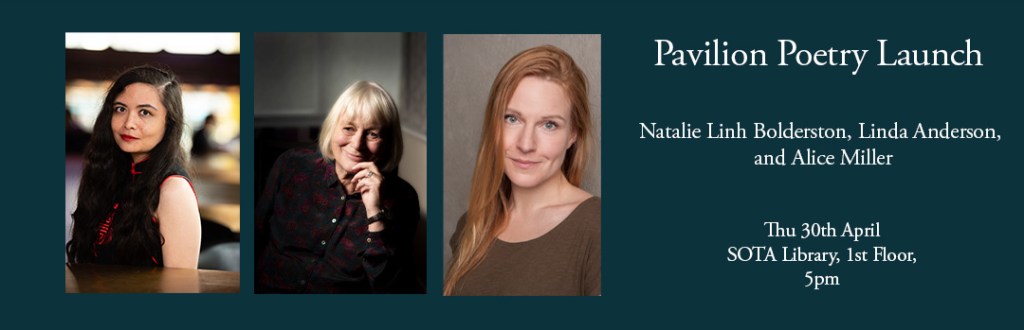
Join us in Liverpool on Thursday 30th April to launch our new collections from Natalie Linh Bolderston, Linda Anderson, and Alice Miller with the Centre for New and International Writing. Register for the free event here.

Follow us for more updates
Sign up to our mailing list
Twitter | Instagram
www.liverpooluniversitypress.co.uk
 Liverpool University Press Blog