
Democracy and Competition: Rethinking the Forms, Purposes, and Values of Competition in Democracy, edited by Alfred Moore and Samuel Bagg, sets out to reframe the role of competition in democratic theory
Competition is perhaps the central concept in modern theories of democracy.
It is at the core of Joseph Schumpeter’s famous account of the democratic ‘method’ for selecting leaders: ‘that institutional arrangement for arriving at political decisions in which individuals acquire the power to decide by means of a competitive struggle for the people’s vote.’ It is central to Anthony Downs’ economic theory of democracy, and the sophisticated political science accounts of party competition that have followed in its wake.
There has been a long tradition of criticism of the market models of politics implied by competitive understandings of democracy. But the concept of competition itself has received surprisingly little attention from democratic theorists. Even when they have been engaged in critique, there has been tacit agreement on what ‘competition’ means: the efforts of parties, through electoral campaigns and parliamentary manoeuvring, to win the loyalty of citizen-consumers.
Democratic competition has been treated – by its advocates and critics – largely in the one dimension of electoral politics. This, to be sure, is important. But seeing competition in this way has led democratic theorists to implicitly think in terms of whether we should want more or less competition in democracy.
In this volume, we set out to change the question: ‘When, where, and what kind of competition do we need in democracies today, and what purpose do these varied forms serve? How do they interact with each other, and with non-competitive practices?’
We think this shift in perspective is timely. There are two trends in the old democracies that make the theme of competition both salient and problematic.
On the one hand, we see today an escalating intensity of political conflict in many democracies, spurred by trends such as polarisation and partisan sorting. As the stakes of electoral contests grow, so too does the temptation toward norm erosion around the ‘rules of the game’, weakening losers’ consent, inviting political violence, and threatening the death of democracy.
On the other hand, we also see a trend toward concentration of political and economic power. Liberal democracies have maintained political competition while operating increasingly as ‘civil oligarchies’ (Winters 2011), preserving the power monopolies of existing elites regardless of the party in power.
Democratic competition thus seems both increasingly intense and yet also muted and constrained. Do we have too much political competition, or too little? The answer, we suggest in this volume, is both. But making sense of these twin threats requires us to take a more multi-dimensional view of the sites, forms, values, and purposes of competition in democracy.
Diverse competitive practices are involved in the interlocking set of social, economic, and political systems that make up modern democracy.
This book sets out to develop new resources for navigating this complexity.
Our volume brings together a wide range of leading scholars. We have sought in particular to represent both ‘deliberative’ and ‘realist’ schools of democratic thought. These schools may be associated with disagreements concerning the role of competition in democracy, but in this volume they share a desire to go beyond the narrow one-dimensional framework for imagining both the dangers and benefits of competition in democracy.
I won’t give a blow-by-blow summary of the chapters here, but I do want to outline the main structure of the book.
We begin with two chapters reappraising canonical theorists of competition, Natasha Piano focusing on Schumpeter, and Alfred Moore on E. E. Schattshneider.
In the second section we focus on political competition in its relation to public discourse. James N. Druckman shows how anti-democratic attitudes are to some extent conditional on the perception of anti-democratic attitudes of partisan out-groups. And André Bächtiger analyses the vices and virtues of ‘collaborative’ and ‘contestatory’ forms of political communication in deliberative processes.
We then turn to the complex relations between political, social, and economic competition, with chapters by Fabio Wolkenstein on the concept of equality in competition, Lisa Herzog on the relation between economic and democratic competition, Emilee Chapman on competition within social movement activism, and Mark Warren on exit-based empowerment.
We close the volume with broader reflections on competition in democratic theory. Shai Agmon and Samual Bagg develop an argument for the benefits of ‘frictional’ mechanisms of competition in democratic systems. Alexander Kirshner develops a novel account of the value of basic inter-party competition even in forms that fall well short of enabling genuinely egalitarian self-rule. Finally, Simone Chambers analyses the concepts of conflict, competition, contestation, disagreement, and opposition in contemporary democratic theory.
Our goal is not to provide a single “fix-it” manual. For one thing, and by design, these essays don’t all point in the same direction. But they do all open up a richer set of questions about how we should think about competition in democracy today. And together, we think, they can serve as a new map for democratic renewal.
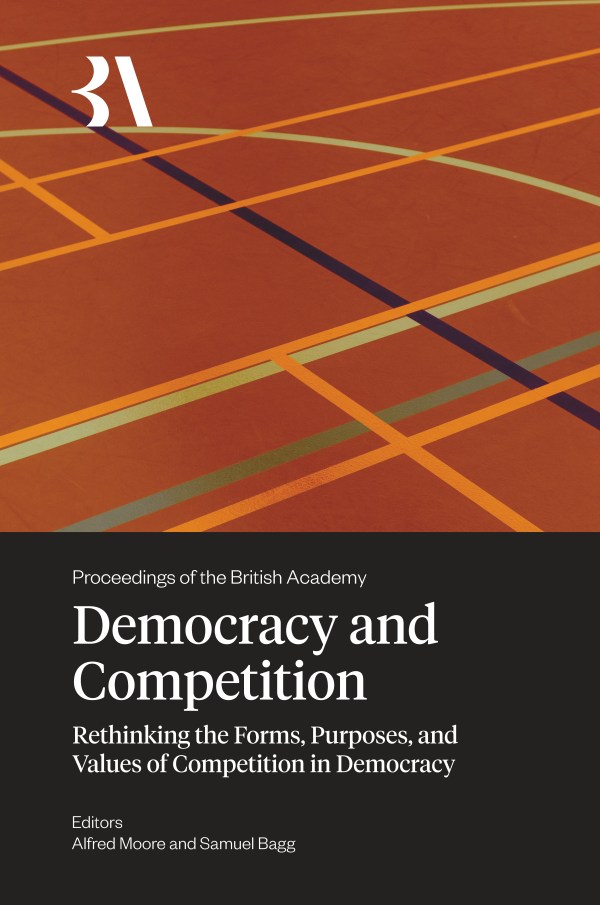
Democracy and Competition: Rethinking the Forms, Purposes, and Values of Competition in Democracy, edited by Alfred Moore and Samuel Bagg, is now available 20% off on our website.
Alfred Moore is a Senior Lecturer in the Department of Politics at the University of York. He is the author of Critical Elitism: Deliberation, Democracy, and the Politics of Expertise (Cambridge University Press, 2017), and has written widely on the politics of expertise. His work engages a wide range of themes in contemporary democratic theory, including anonymity and deliberation, democratic non-participation, and the concept of trust. In 2020-21 he held a British Academy Mid-Career Fellowship for the project Rethinking Political Competition, and he is currently researching the role of ideas of competition in democratic theory and practice.
Samuel Bagg is Assistant Professor of Political Science at the University of South Carolina. His research aims to reimagine democratic ideals and practices in light of realistic assumptions about the dynamics of social inequality and political power His first book, The Dispersion of Power: A Critical Realist Theory of Democracy (OUP, 2024), offers a comprehensive account of why democracy matters and how to make it better. Other recent work applies this framework to questions of institutional design and organizational structure, as well as the political ethics of identity, discourse, mobilization, and party competition.

Follow us for more updates
Sign up to our mailing list
Follow us on social media
www.liverpooluniversitypress.co.uk
 Liverpool University Press Blog