
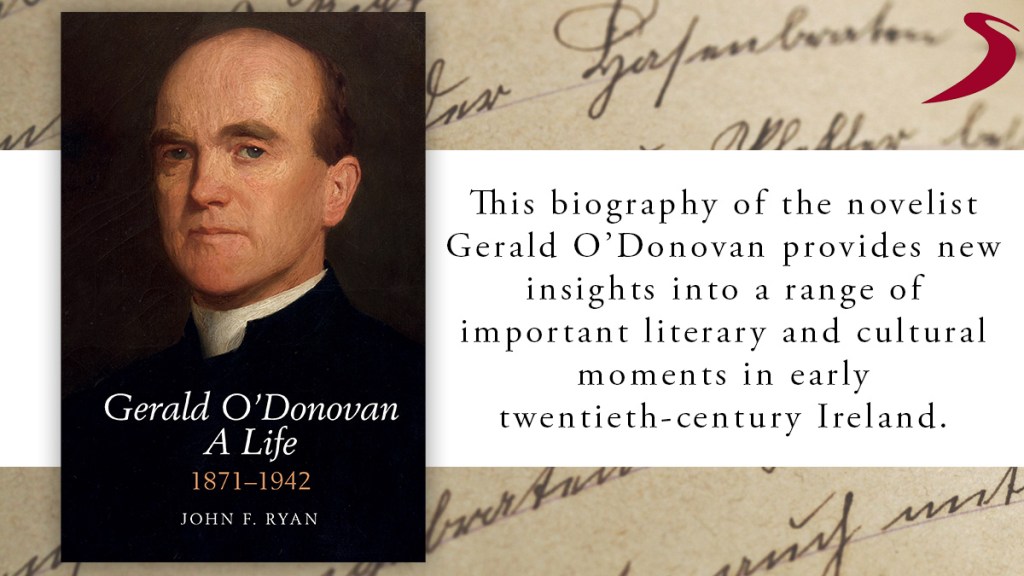
Gerald O’Donovan: A Life provides new insights into a range of important literary and cultural moments in early twentieth-century Ireland. Based on a rich array of archival material, the book explores O’Donovan’s life as a Catholic priest in Loughrea, Co. Galway, before charting his abandonment of the priesthood, marriage and relocation to England, where he published six novels including the controversial Father Ralph (1913). In this blog post, author John F. Ryan shares details of his research process behind the book.
Being in full time employment during my years of research on Gerald O’Donovan, which dated from the late 1960’s, it was a long-drawn-out process conducted in my leisure time, which, I found most absorbing rewarding, and fulfilling, even when at one stage it seemed that all would not be plain sailing.
In 1972, soon after I had commenced the work, the first biography of one of England’s most popular and prolific novelists of the inter war years, Dame Rose Macaulay, breaking what was probably the best kept secret in English literary circles, revealed that the subject of my research was the hitherto unidentified married man, with whom she had a secret love affair dating from 1918 until his death in 1942. I was intrigued to discover too that he was the inspiration for the majority of Macaulay’s novels, and that, ‘with regard to her light fiction, she habitually relied upon the stimulus of his lively mind, and ‘the sparkle of her middle period writings may be regarded as a reflection of his sardonic wit.’[1]
I subsequently learned that his daughter, Brigid, lived in London. On a visit to Oxford during the following year to a friend and former colleague, Tadgh Foley, then doing his doctorate there, who was obligingly looking up material on my behalf, we made a trip to London, where through the telephone directory we located Brigid ‘Donovan, who cordially invited us to visit there and then.
Possibly under the impression that our reason for looking her up was simply to pursue the recent revelations of her father’s relationship with Rose Macaulay, which was the news of the day, Brigid was somewhat reserved at the outset, making it clear that she did not interpret this as it was portrayed in the biography. She saw Macaulay as a faithful family friend, who had more in common intellectually with her father than did her mother, and who was very fond of her, and her siblings. It is unlikely at this stage that our host was convinced by our assurance that her father was a significant figure in his own right, worthy of a full biography, and that this was our reason for making contact.
Brigid and I kept in touch. On the basis that she had no knowledge about her father’s family background and knew very little of the details of his varied career, I kept her informed about my research, in which she came to express great interest.
Knowing that it would be impossible to produce a fully rounded biography without the approval and co-operation of the O’Donovan family, I was very encouraged by the interest shown by Brigid, whom I discovered had been secretary to T.S. Eliot and sub editor on his literary review, The Criterion, during her early career, and had just retired from her position in the British Council for Industrial Design, for which she had been awarded an M.B.E.
Aware that I would be visiting London regularly in connection with my research, Brigid generously invited me to be her guest on these occasions. During my stays with her she agreed to several interviews, in which she provided details of family life and relationships in the O’Donovan household.
About to leave her residence one morning, I casually ventured that her father must have left some papers. Pausing momentarily, she enquired if I had any plans for that day, which I confirmed, adding that they could easily be changed. Leaving the room, she returned with large folders that I assume had been stored in her garage in Kensington for quite some time, which she handed over to me, declaring to my great surprise that they contained her father’s collected papers, which I could take back to Ireland.
Needless to say, I put my plans on hold for that day, which I spent examining this ‘windfall’ that I hoped would provide the crucial information I so badly needed. I was not disappointed. The large collection of O’Donovan’s and his immediate and extended family member’s, and friend’s correspondence, stretching over many years provided fascinating insights into him and his life, including firsthand accounts of his career. A further wealth of information was provided by Beryl’s un-published reminiscences, ‘Locusts Food’.
In addition, the collection included correspondence from a number of people with whom O’Donovan had been involved, including, among many others, W.B. Yeats, AE, Douglas Hyde, Constance Markievicz, Dermod O’Brien, Lady Gregory, and Thomas O’Dea, his former bishop in Clonfert. There was the added bonus that in some instances it was possible to locate the other side of the correspondence in his respondent’s collected letters in an American university library manuscript collection.
Giving her ultimate seal of approval of my work, Brigid travelled to Ireland in the mid 1980’s to contribute to an R.T.E. [Ireland’s National Broadcaster] radio documentary based on my research that introduced her father to a new Irish generation.[2]
John F. Ryan
[1] Constance Babington Smith, Rose Macaulay A Biography ( London, 1972), p. 96.
[2] ‘A Light Across the Path’, The Story of Gerald O’Donovan ( 1871-1942), Priest Novelist and leader of the Irish Revival, through the Gaelic League, the co-operative movement, and the Irish literary revival, scripted by John F. Ryan, and produced by Kathleen Kelleher, first broadcast on 26 December 1988.
John F. Ryan is an independent scholar specializing in the life and work of Gerald O’Donovan.
Find out more about Gerald O’Donovan: A Life on the Liverpool University Press website.

Follow us for more updates
Sign up to our mailing list
Twitter | Instagram
www.liverpooluniversitypress.co.uk
 Liverpool University Press Blog