
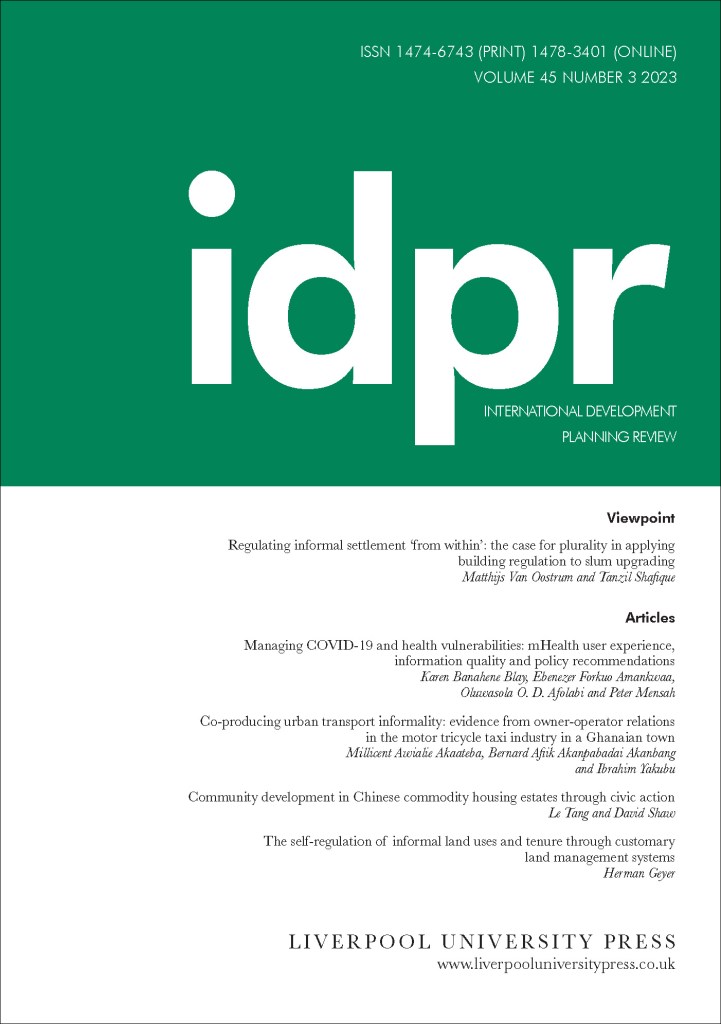
The editors of International Development Planning Review (IDPR) have selected the following paper as the Featured Article in IDPR 45.3.
It is available to read Open Access as part of LUP Open Planning:
‘Co-producing urban transport informality: evidence from owner-operator relations in the motor tricycle taxi industry in a Ghanaian town’, by Millicent Awialie Akaateba, Bernard Afiik Akanpabadai Akanbang, and Ibrahim Yakubu.
When asked to describe the paper and highlight its importance, the authors stated the following:
This research is motivated by the authors’ experiences of motor tricycle taxi operations (autorickshaws) in Ghana, marked by dominant conflicting narratives of legality, informality, and livelihood in many secondary cities. Although critical to urban mobility, informal transport services are often seen outside the purview of mainstream transport policy and planning agenda, and their much-needed on-demand transport services are not legalised. While many academics and practitioners acknowledge the resilience of informal transport workers, we know less about the actual actors stimulating the growth of the informal tricycle taxi industry, the forms of contractual agreements shaping its operations and the factors which continue to create, reproduce and sustain its operations.
Drawing on the concept of institutionalised co-production, we analysed the key actors in the industry and the owner-operator contractual relationships to understand why the industry continues to flourish despite its prohibition by Legislative Instrument 2180 (LI 2180). We argue that conceptualising the motor tricycle taxi industry as informal and illegal is only rhetorical and superficial. In practice, the industry’s day-to-day operations dismantle formal and informal binaries in urban transport services, since its major players and their practices are entwined in co-productive interactions steeped in fluid and complicated socioeconomic, political, and cultural linkages. Through a complex interaction of policy, politics, and power/wealth, state institutions and actors in Wa, Ghana play critical roles in creating and nurturing the motor-tricycle taxi industry. This is apparent in the initial funding source for tricycles, as well as the ongoing owner-operator and principal-agent relationships that shape the industry. The state’s role through a politically driven policy of the Microfinance and Small Loans Centre (MASLOC) to directly distribute tricycles or give out loans to unemployed youth to purchase tricycles for use as commercial transport, kick-started the now buoyant industry. This was later spurred by various state-affiliated actors, such as police officers who should be enforcing LI 2180, which prohibits commercial tricycles themselves now becoming entrepreneurs and owners of tricycles; public servants of government departments seeing commercial tricycles as a capital asset to generate supplementary income by renting tricycles to operators; and municipal authorities accommodating the industry through the collection of taxes and levies from operators. Thus, the motor tricycle taxi business in Wa and the formal economy are intricately intertwined, with its operations co-produced and supported through collaboration, accommodation, and social/economic innovation.
By analysing the players and operations of the motor tricycle industry in Wa, we call into question the applicability and usability of the concept of ‘informality,’ which denotes informal transport as not being sanctioned or licensed by official authorities. Instead, we contend that informal transportation services in Ghana are co-produced by hybrid actors, controlled by political solid and state-affiliated institutions and market agents, and tolerated by local authorities. This explains why, despite a ban on commercial tricycle operations, the tricycle taxi industry is thriving and fast growing across the country. Given the industry’s co-produced and hybrid nature, we propose a broad and reflective discourse on outlawing informal urban transportation services in many African cities. Its benefits to urban mobility and livelihood necessitate it being integrated into mainstream transport policy with significant attention devoted to the working conditions of industry workers to promote an inclusive transport system.
– Millicent Awialie Akaateba, Bernard Afiik Akanpabadai Akanbang, and Ibrahim Yakubu

 Liverpool University Press Blog