
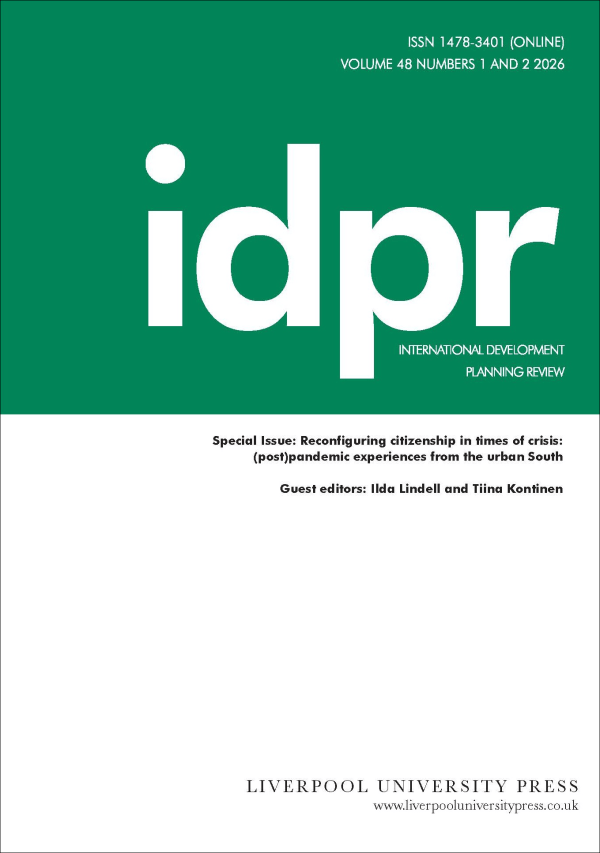
This double special issue of International Development Planning Review (IDPR) examines how the COVID-19 pandemic reconfigured state–citizen relations and reshaped urban citizenship across cities in the global South. Bringing together eleven empirically grounded studies of cases in Ghana, Kenya, Malawi, Mozambique, Nigeria, Tanzania, Uganda and Zambia, the issue approaches the health crisis as a critical lens through which to understand how rights, belonging and authority were renegotiated under conditions of deep uncertainty.
The following Q&A with guest editors Ilda Lindell (Stockholm University) and Tiina Kontinen (University of Jyväskylä) explores the motivations behind the issue, the common themes that emerged across its diverse case studies, and the broader insights it offers for understanding disruptive events in rapidly urbanising contexts.
- What motivated this Special Issue, and why did the COVID-19 pandemic provide such a critical lens for examining state–citizen relations in the urban global South?
IL & TK: The idea of a Special Issue emerged from personal interactions between us the guest editors (Ilda Lindell and Tiina Kontinen) about the prospects of bringing together insights from our respective research projects which shared a concern with the impacts of the COVID-19 pandemic in urban South contexts (1). Although much had been written about the immediate socio-economic effects of the health crisis in such contexts, we felt that there was still scope for empirically grounded analyses about the political and societal processes with potentially long-lasting implications beyond the pandemic. In particular, we wanted to elaborate and reflect upon the ways in which such a disruptive event contributed to the (re)configuration of state-society relations and of patterns of urban citizenship, as experienced by urban residents themselves. By declaring a state of emergency, justified by the health threat, state actors were in a position to greatly expand their powers while often being unable or unwilling to provide sufficient assistance to the urban majorities. The special issue became a venue to explore how urban residents variously perceived, lived and acted upon these circumstances. Eleven articles covering cases in eight countries in Africa gave us the opportunity to uncover how a global crisis became differently embedded in specific local contexts and elicited a wide spectrum of responses, experiences and outcomes. While the empirical focus is on African cases, the discussions draw upon wider literatures and have relevance for other urban settings in the urban south. The contributors include both junior and senior researchers with European and African affiliations and who have participated in the mentioned research projects.
- What common themes emerged across the diverse case studies?
IL&TK: The contributions talk to diverse social and political dynamics that unfolded during and beyond the COVID-19 health crisis. One theme concerns the diversity of state responses across different contexts, how they were justified and experienced. Taken together, the articles consider both the actions and inactions of the state and their effects. Another central and related theme pertains to how state-citizens relationships manifested and were potentially transformed in these processes. For example, several articles uncover the emergence of new categorizations of citizenship such as those dividing the population into essential and non-essential workers, with great consequences for different groups’ capacity to withstand the crisis. Thirdly, some articles illuminate how urban residents (re)imagined the state and made sense of pandemic responses, and how they adhered to or contested state (in)actions and categorizations. Several contributions also examine the diverse ways in which selected groups adapted their daily practices and acted to support themselves, enacting everyday forms of citizenship.
- What does the collection reveal about how states governed the crisis and how urban residents experienced and interpreted changes in state–citizen relations during the pandemic?
IL & TK: The contributions illuminate how state responses were diverse and uneven. The governance of the pandemic intertwined with the characteristics of specific political regimes and their political goals. One article describes how non-state actors were relied upon to implement pandemic regulations, through hybrid forms of governance. State (in)action was in some cases characterized by inoperativeness or indifference, leaving the majorities unprotected and dependent on their own devices. Where relief schemes were set up, support was inadequately distributed and research participants were often unable to access such support. In other cases, state actors resorted to forceful interventions, bans on activities such as street vending, and violence. One of the contributions describes a turn towards necropolitical forms of governance that persisted beyond the pandemic. States also used the pandemic to advance their agendas and interests. The pandemic measures were sometimes harnessed to legitimate the political power of the ruling party, especially when COVID-19 coincided with elections, for example by preventing opposition campaigns in Uganda. The pandemic also contributed to the accelerated construction of prestigious infrastructure projects such as the Nairobi Expressway in Kenya.
Urban residents’ experiences of state responses were highly diverse. For some, the presence of the state in their everyday lives increased significantly, but it was interpreted in contradictory ways. For example, participants in Tanzania trusted the President’s policies. In Uganda, citizens perceived the state as simultaneously caring and capable of protecting them but also as neglecting and restricting them, and politically benefiting from the situation. In some cases, suspicions of mismanagement of COVID-19 funds and political elites’ benefit from them, along with the experienced neglect and harassment by the state, crumbled citizens’ trust on state capability to handle the crisis. In other cases, state violence caused resentment and triggered uprisings, as happened in Maputo, Mozambique. The targeted groups experienced a destruction of both their livelihoods and their collective organisation, and a marked deterioration of their relations with the state. Overall, the contributions indicate a continuity and sometimes reinforcement of authoritarian tendencies within states during and beyond the pandemic.
- How do the contributions illuminate the ways in which urban residents enacted their citizenship in the context of deep uncertainty and constraints?
IL & TK: Several articles bring to light the diverse ways in which certain urban groups responded to the challenges posed by the crisis and to the state’s actions and inactions. In one case, the violent displacement of street vendors triggered an uprising that contested the state’s necropolitical interventions. More often, however, pressured urban dwellers resorted to more low-key actions. Displaced vendors defied bans by gradually returning to their earlier spots, thereby frustrating the exclusionary plans of the authorities and enacting claims to material spaces in the city. Faced with state neglect, many resorted to their own devices and networks to withstand the crisis. Those who lost their incomes from wage labour (such as teachers) during the pandemic, turned to informal activities as a source of income. Those who depended on self-employment (such as vending) adjusted the spatialities of their work to the new circumstances. For example, in some cases, street vendors increased their mobility within the city or moved to locations where regulatory enforcement was lower. In other cases, vendors experienced a decrease in their daily mobility and a contraction of the national and international scope of their operations. While such coping strategies can be understood as everyday practices of citizenship through which disadvantaged people sought to handle the crisis and sometimes state violence, many faced highly precarious conditions.
- Why do the insights generated through this collection matter beyond COVID-19, and what lessons do they offer for understanding future disruptive events in rapidly urbanising contexts?
IL&TK: Even if COVID-19 was an exceptional health crisis, disruptions related to other diseases, environmental hazards, or conflicts will occur in the future. The collection offers several lessons for understanding and preparing for future disruptive events in urban South. The articles show how state-led responses to the crisis often produced differentiated patterns of urban citizenship, not only based on income but also on political assessments of the value and ‘essentialness’ of different groups. The crisis contributed to the deepening of urban inequalities, where new exclusions were introduced through uneven restrictions on movement and state relief was inadequately distributed. As the articles illuminate, COVID-19 further intensified the informalization of work as some professionals needed to resort to informal income activities, and sometimes changed the geographies of informal work as street workers were pushed further to the city margins through state driven strategies of re-spatialization. State responses to disruptive events in the future might have similar effects, with important implications for urban societies in the urban South.
An additional lesson learned was the realization of inadequate preparedness and capacity of states to respond to disruptions of this magnitude. In preparation for future crises, building more structured support systems during ‘normal times’ that recognize the role of CBOs and other non-state actors would be essential. This would also require more inclusive governance structures, in order to strengthen resilience and enable compensation for inadequate capacities and resources of the state, and to impede the political instrumentalization of crises. Even if the contributions delved into experiences of vendors and other selected groups in urban environments such as Kampala, Lagos, Nairobi, Blantyre, Dar es Salaam, Accra and Maputo in Africa, the questions related to exclusionary urban remaking, in their contextual manifestations, bear relevance everywhere.
(1) The special issue mainly draws on findings from three research projects: (a) Informal livelihoods in the context of the COVID-19 pandemic in urban Africa: prospects for recovery and recognition, funded by The Swedish Research Council (grant number 2021-05417), PI Ilda Lindell, Stockholm University; (b) Re-articulating citizenship in the times of uncertainty: Hybrid narratives of Covid-19 responses in sub-Saharan Africa, funded by the Research Council of Finland (decision no 348234), PI Tiina Kontinen, University of Jyväskylä; and (c) Short- and long-term effects of the corona pandemic on informal workers in urban Africa, funded by the Swedish Research Council for Sustainable Development (grant number 2020-02029), PI Ilda Lindell, Stockholm University.
Support Open Access to IDPR
IDPR is part of LUP Open Planning, Liverpool University Press’s Subscribe to Open initiative.
When the annual subscription threshold is met, the latest content becomes Open Access for scholars worldwide, helping to build a more inclusive global research community. Each subscription plays a vital role in reaching this goal.
Recommend LUP Open Planning to your library today to help us to achieve:
✔ Immediate OA to the latest content for readers everywhere
✔ No Open Access fees for authors
✔ Greater visibility and impact for published research
If you would like to support Open Access for 2026—and gain exclusive access to the IDPR archive dating back to 1979—please use our online form to recommend a subscription to your librarian.

Follow us for more updates
Sign up to our mailing list
Follow us on social media
www.liverpooluniversitypress.co.uk

