
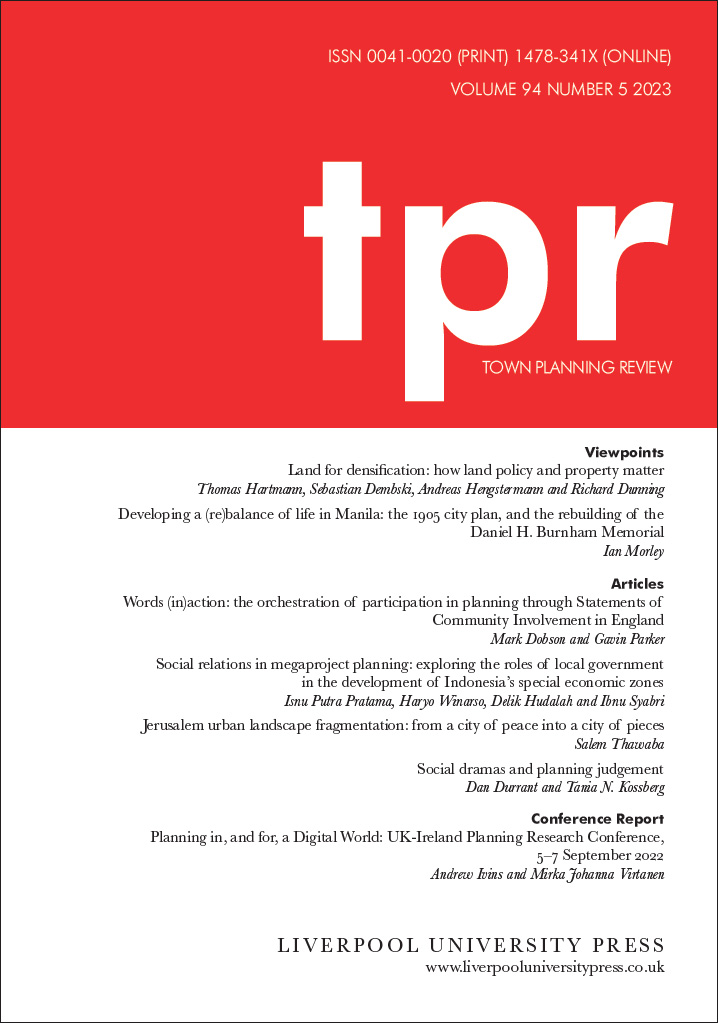
The editors of Town Planning Review (TPR) have selected the following paper as the Featured Article in TPR 94.5.
It is available to read Open Access as part of LUP Open Planning:
When asked to describe the paper and highlight its importance, the authors stated the following:
This article examines a critical aspect often overlooked in megaproject planning literature: the significant role of local governments in the intricate landscape of planning processes. These perspectives stem from the fact that local government has generally been regarded as an entrepreneurial agency that serves and prioritises the economic interests of elite (state or private) actors who seek to produce strategic ‘profit-oriented’ space rather than public interest and welfare. Drawing from Poulantzas’s insightful concept of ‘social relations,’ we delve into the dynamics of planning processes, treating them as a condensed manifestation of relationships, negotiations, and even contradictions among stakeholders.
The exploration takes us to Indonesia, a democratic nation ascending as an economic powerhouse in Asia. Within this dynamic context, the study hones in on special economic zones (SEZs), illuminating case studies of modern industrial megaprojects influenced by a decentralised development approach. The investigative journey involves qualitative content analysis, harnessing interviews, archival research, and on-the-ground observations from 2019 to 2021. Through this comprehensive exploration, a revelation emerges: Indonesian local governments hold a pivotal role in shaping SEZ mega-project planning. Their role extends beyond mere facilitation, encompassing the intricate task of reconciling the visions and potential conflicts among the state, private entities, and impacted communities.
In offering this new lens, we redefine megaproject planning as a tangible embodiment of the intricate social relationships interwoven among stakeholders. This perspective challenges the prevailing notion of megaprojects as being primarily driven by elite interests, whether state-level government or private entities. We augment the understanding of megaproject planning by embracing its complexity and acknowledging the multifaceted dimensions of governance and power dynamics.
– Isnu Putra Pratama, Haryo Winarso, Delik Hudalah, and Ibnu Syabri
School of Architecture, Planning and Policy Development at Bandung Institute of Technology, Indonesia.

Follow us for more updates
Sign up to our mailing list
Twitter | Instagram
www.liverpooluniversitypress.co.uk
 Liverpool University Press Blog