
German and European Cultural Histories, 1760-1830: Between Network and Narrative, edited by Crystal Hall and Birgit Tautz, has recently been published in the Oxford University Studies in the Enlightenment series. This book features eleven essays, an introduction, and an epilogue and is accompanied by a unique digital gateway into the arguments and supporting evidence in the volume. The digital collaboration hub features multimedia exhibits and interactive visualizations (found at https://liverpooluniversitypress.manifoldapp.org/projects/german-and-european-cultural-histories). In this blog post, the editors converse about considerations of approach and method (the multiple dimensions of network), in this latest publication from OSE.
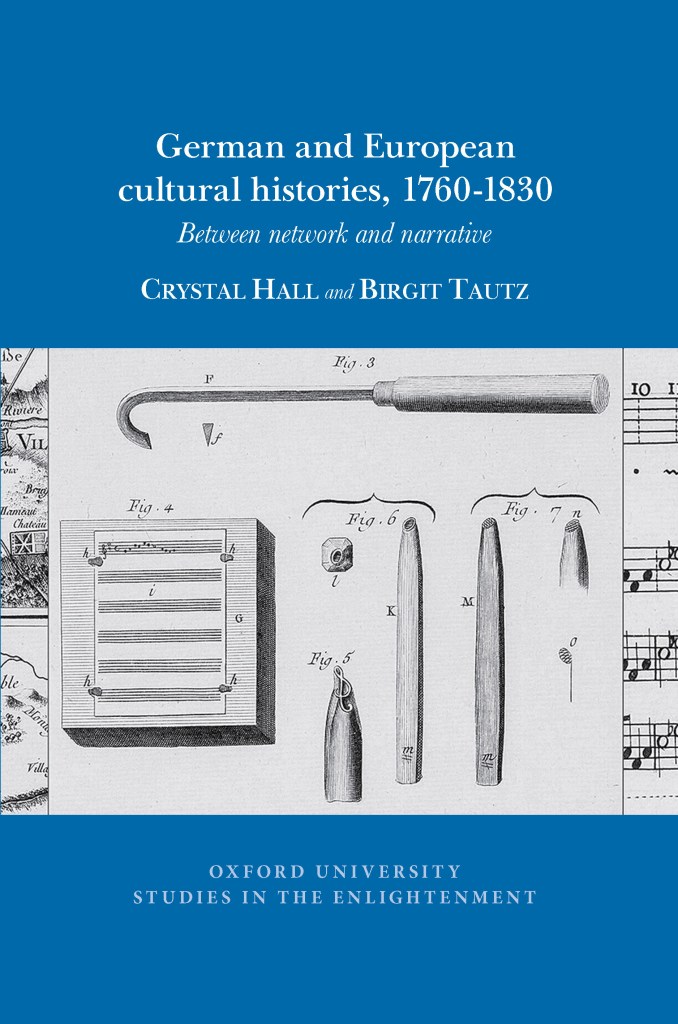
Crystal & Birgit: Our book went through a lengthy gestation process, partly because it grew out of a symposium, as so many edited collections do. But its central claim has only grown stronger in the process, namely that DH-supported network analysis will bring new perspectives to the many networked constellations that have been fundamental narratives in German and European cultural histories around 1800. Today, we clearly see advantages and possible pitfalls as conventional readings intersect with “distant” approaches. And we are more than ever convinced that Between Network and Narrative can be read in at least two ways, beginning with the book or starting with the materials online. Here we let you into one of our conversations, as we tried to sum up what sets German and European Cultural Histories, 1760-1830 apart from competing books and what makes you want to indulge in it:
Crystal: I’ll start by pointing out that our authors approach their objects of study with both digital and non-digital humanistic methods. While making important claims about German, French, English, and Italian cultural history around 1800, this hybrid volume also demonstrates that the binary of DH and non-DH sometimes imposes unnecessary boundaries on how a group of scholars can answer a complex question. For example, Mary Dupree’s close reading of a farcical tale of a declamator and Renata Schellenberg’s reconstruction of a failed attempt to influence art collecting are in direct conversation with Birgit’s computational text analysis and uncovering of cosmopolitan ideals in journals. By problematizing and contextualizing aspects of inherited narratives about the period, the contributions recover wide patterns and local variations of communication, collaboration, and identity building.
Birgit: I couldn’t agree more, and I really want to underscore the attention your comment, and many of our contributors, bring to local variations, the forgotten or underappreciated, often lone-actor’s cultural interventions that begin to tell alternate histories to the well-worn or established. Local instances of cultural production fed into networks of actions and activities, despite lacking causalities or even clear-cut intentions towards a greater whole. Our book really understands network analysis in a dual way, aside from the dominant digital humanities method featured in the book, we really zero in on the configurations of people, objects, and texts – all in order to cast alternatives to all-encompassing narratives that tend to define our views of literary and cultural life.So many of the fundamental narratives around 1800 involve or aim at the nation as organizing principle or concept or (as in the German case) telos, and we really understand the seemingly national attributions more openly, in terms of language, vernacular linguistic communities, but also material accumulations.
Crystal: The breadth of analyses showcases how a network can be a concept, a process, and a product. The best demonstration of this might just be the interactive network graph that represents the people, places, and institutions mentioned in the essays in the volume. I hope that readers will engage with this artifact to compare to their reading of the text so that they can experience a non-linear perspective on the book and the period that it represents.
Birgit: The index graph is just one of the rich resources on Manifold that re-engage with the multi-disciplinary nature of the contributions. They come from art history, history of the book, history, literary studies, and musicology and all of our authors contemplate the strengths and weaknesses of treating the period between 1789 and 1810 as either continuous with or a departure from the centuries before and after by examining different facets of the longer period between 1760 and 1830. While many essays investigate German-language material, nearly all expand into other European cultures and cover important regions, protagonists, objects, and constellations of bi- and multilingual life. They intersect Italian, French, and English networks and reach across the Atlantic into New England. And they provide critical perspectives on people, objects, and texts that test the boundaries of narratives of transmission, organization, and cohesion that often mark scholarly evaluations of this period in European history. In the end, German and European Cultural Histories, 1760-1830: Between Network and Narrative makes for a truly novel reading experience, in terms of what you read about as well as how you read between the book and Manifold.
German and European Cultural Histories, 1760 – 1830 is part of the Oxford University Studies in the Enlightenment series, published in collaboration with the Voltaire Foundation, University of Oxford. Access additional resources which accompany the book on the digital collaboration hub.

Follow us for more updates
Sign up to our mailing list
Twitter | Instagram
www.liverpooluniversitypress.co.uk
 Liverpool University Press Blog