
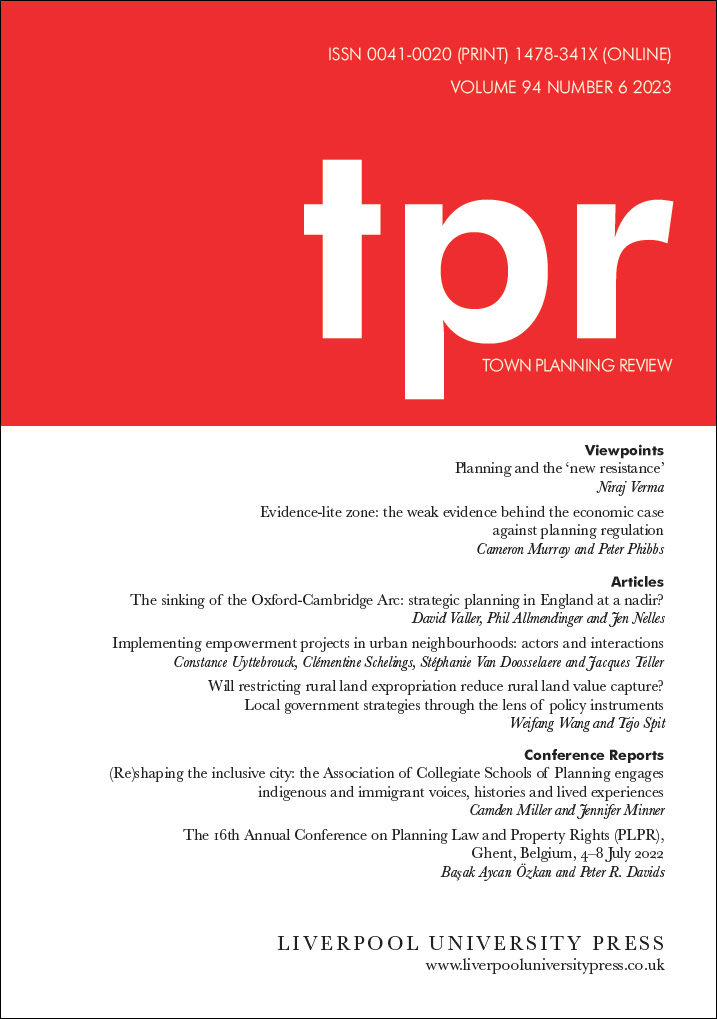
The editors of Town Planning Review (TPR) have selected the following paper as the Featured Article in TPR 94.6.
It is available to read Open Access as part of LUP Open Planning:
‘Planning and the ‘new resistance’‘, by Niraj Verma.
When asked to describe the paper and highlight its importance, the author stated the following:
Black Lives Matter (BLM) was unlike previous civil rights advocacy. It seemed to spring up out of nowhere, and even after it hit us, few could confidently say what it was, how it gained popularity, or who its leaders were. Some of its characteristics: the use of social media, the emphasis on identity, and the idea of resistance distinguished it, but they were also part of the LGBTQ and other identity-based “new” social movements.
In this article, I suggest that the right-wing response to BLM uses similar methods, is also identity-based, and grows outside the public eye. The assault against the teaching of Critical Race Theory in American schools shared identical characteristics. So did Brexit, particularly in its appeal to an identity some have characterized as “Englishness”. Both these resistance movements developed outside the public eye, gained followers, and acquired legitimacy on social media. When the “new resistance” emerged, it did so not as a fledgling idea or a nascent protest but as a full-fledged resistance that entered political battles and aimed to put its representatives into office.
The resulting political polarization between new social movements and the “new” resistance is palpable but has grown weary, and both the right and the left seem ready for change. How might we begin the process of reconciling these warring groups? The viewpoint takes on this critical question.
– Niraj Verma, Professor in the L. Douglas Wilder School of Government and Public Affairs at Virginia Commonwealth University.
Follow us for more updates
Sign up to our mailing list
Twitter | Instagram
www.liverpooluniversitypress.co.uk
 Liverpool University Press Blog