
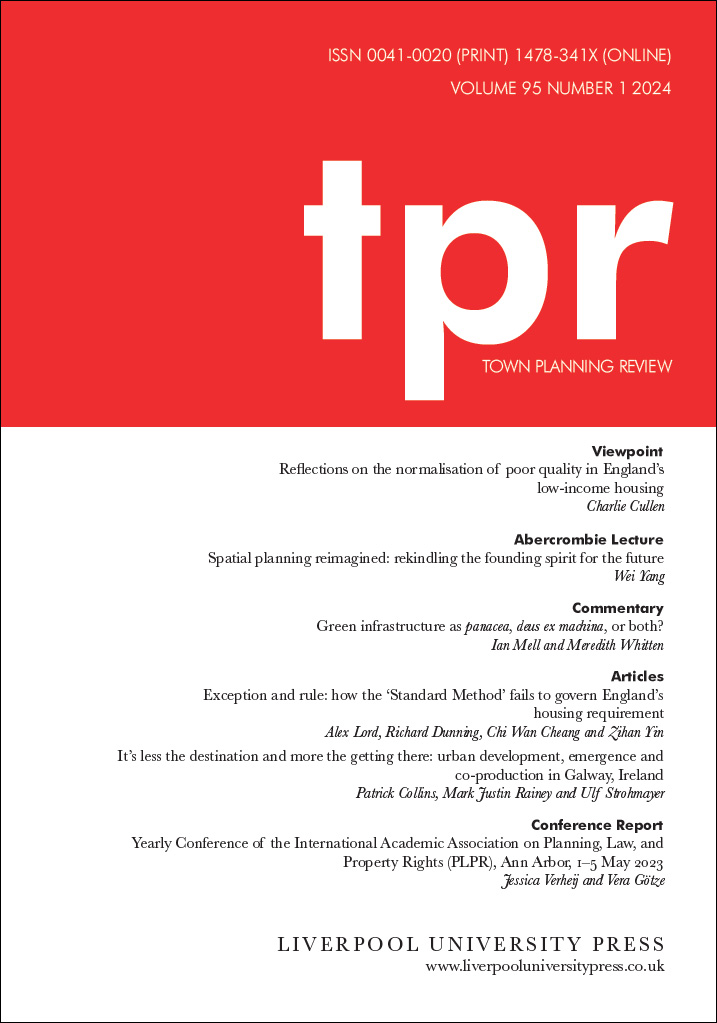
The editors of Town Planning Review (TPR) have selected the following paper as the Featured Article in TPR 95.1.
This paper will be free to access for a limited time:
The Abercrombie Lecture: ‘Spatial planning reimagined: rekindling the founding spirit for the future’ by Wei Yang.
When asked to describe the paper and highlight its importance, the author stated the following:
Exactly 80 years ago, Abercrombie’s most famous regional plan, the Greater London Plan 1944, was published. At that time, there was a strong belief in planning — it was considered a crucial positive force in postwar reconstruction efforts, key to addressing severe national challenges.
In the current post-pandemic world, a primary challenge we face is the profound global impact on both national and local issues. Simultaneously, the repercussions of local and national decisions extend their influence into the global sphere. This challenge is further compounded by the progressively blurred boundary between the physical and virtual realms. There is a surge of investment in AI and the Metaverse, but no matter how technology advances, it remains a fundamental human right to breathe fresh air, drink clean water, eat healthy food, have access to nature, and live in safe and decent homes. Many of these necessities remain a luxury for a significant portion of people living on this planet.
The planning profession was founded with the spirit of compassion, selflessness, and creativity. In a world desperate for humanistic solutions to tackle grand challenges, spatial planning holds vast potential when embraced as an applied social, environmental, and behavioural science discipline of global significance. I believe that we need a revival of spirit to shape a reimagined planning profession – one that is confident, creative, and impactful, with the ability to think globally and act locally.
However, this reimagination must begin from within the planning profession itself, which necessitates systemic changes. One of the most urgent actions is to leverage the power of digital innovation in spatial planning for the public good before it passes us by, and planners need to have the confidence to lead the way. Because innovation extends far beyond technological advancement, though new technologies are significant contributors, they do not independently revolutionise society. The fundamental driver of innovation lies in our ability to ask the right questions for the public good. By framing inquiries that challenge the status quo and encourage creative problem-solving, we unlock the potential to leverage innovation for the betterment of people, the environment, and society at large. Embracing the moral responsibility of fostering Truth, Beauty, and Goodness will propel the planning profession forward, repositioning it as a recognised part of the solution in the eyes of the public.
Therefore, to stimulate discussion and actions in the planning profession, in this paper, I share my thoughts on the key spirit and foundations of the planning profession, why we should rekindle the founding spirit for the future, and my vision for a mindset and methodological transformation – supported by various strategies. These strategies include rebuilding the pillars of Creativity and Civic Support, equipping planners with adequate capabilities and skills, and implementing methodological changes for a digitally enabled integrative approach to spatial planning. In addition, I introduce the vision of the newly formed Digital Task Force for Planning with the aim of harnessing the power of digital technology and scientific innovation to transform the profession.
It was a great privilege for me to have been invited by the Editors of Town Planning Review to deliver the 17th Abercrombie Lecture and publish in this oldest planning journal in the world, where Abercrombie was the first Editor. This unique opportunity allowed me to pay tribute to Abercrombie and other planning pioneers while sharing my thoughts on instigating systemic changes in spatial planning. It is my sincere wish that we act with urgency and purpose to reinvigorate the planning profession for a better future for everyone.
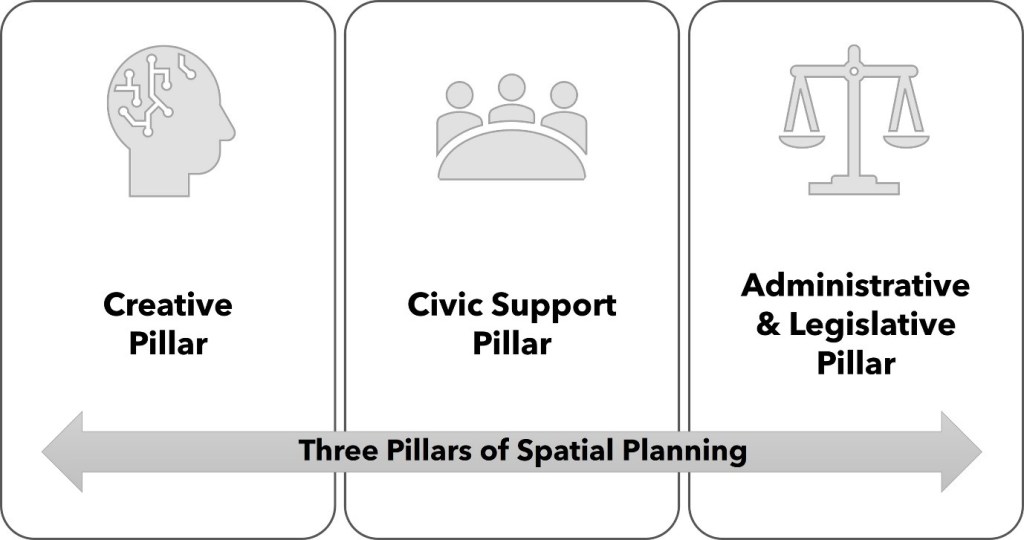
Yang, W. (2024), Spatial planning reimagined: rekindling the founding spirit for the future, Town Planning Review, 95.1
– Wei Yang.
Follow us for more updates
Sign up to our mailing list
Twitter | Instagram
www.liverpooluniversitypress.co.uk
 Liverpool University Press Blog