
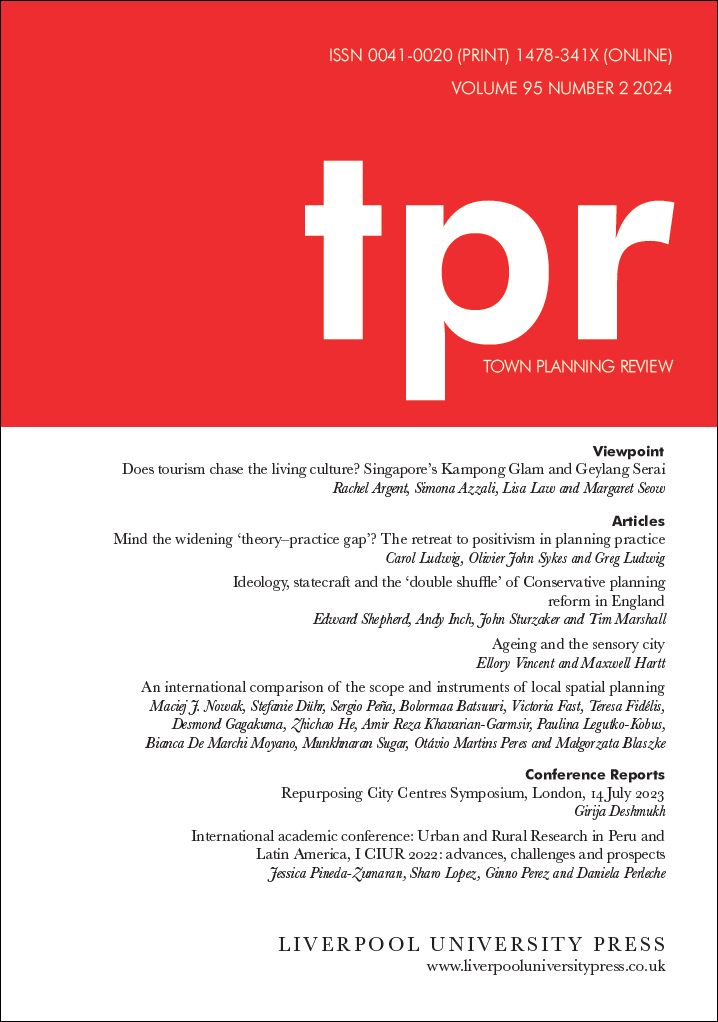
The editors of Town Planning Review (TPR) have selected the following paper as the Featured Article in TPR Volume 95.2.
This paper will be free to access for a limited time:
‘Ideology, statecraft and the ‘double shuffle’ of Conservative planning reform in England’ by Edward Shepherd, Andy Inch, John Sturzaker, and Tim Marshall.
When asked to describe the paper and highlight its importance, the authors stated the following:
Planning for housing development in England has long been politically divisive. New housing can be met with significant local opposition by communities concerned about the impact on local services and amenities. This can put pressure on local elected politicians and non-ministerial Members of Parliament to resist attempts by national governments to introduce adjustments to the planning system intended to facilitate more housebuilding. Meanwhile, facilitating more housebuilding may itself be seen as a political and economic imperative by national governments due to the embeddedness of home ownership in a neoliberal debt-fuelled growth model in which it is ideologically framed as a route to security and financial stability. This means that the creation of new homeowners is closely entwined with the political legitimacy of governments.
These political, ideological and economic dimensions of housing and their contradictions make planning for its development a significant challenge for all political parties. It is particularly so for Conservatives who have explicitly situated home ownership and housebuilding at the centre of their ideological project and whose electoral support has traditionally been distributed across affluent areas experiencing significant and unwanted development pressure. True to this inherent tension, successive Conservative-led governments since 2010 have sought to liberalise the planning system along free-market lines to enable a significant increase in housing supply, but these attempts have often been met by powerful resistance from its own supporters which has led to a watering down of planned reforms.
However, rather than read these events as representing failure or stymying of Conservative planning reforms, in this paper we interpret them as part of a dialectical ‘double-shuffle’. This is a shuffle between the two ideological and political poles of housing development in Conservative ideology and political strategy, a dialectic of reform and resistance that has served to reshape the planning system in ways that have cumulatively fragmented and undermined its coherence. To analyse this, we focus on the forms of statecraft through which Conservative governments have pragmatically sought to manage the conflicts arising from attempts at planning reform.
We explore how political ruptures with roots in the ideological contradictions of Conservatives have been pragmatically masked, displaced and diffused through forms of statecraft that have sought to manage the risk of planning conflicts damaging the wider Conservative project. We argue that the planning system that now exists has thus been significantly reshaped such that it is now an improvised product of ideological and political battles and their pragmatic management within the Conservative Party. We therefore emphasise the role of statecraft in fragmentary planning reform, not as an alternative explanation to the tensions and contradictions arising from ideology, but rather as an important part of the institutional work through which ideological conflicts over planning have been managed.
– Edward Shepherd, Senior Lecturer in Planning and Development in the School of Geography and Planning, Cardiff University
Andy Inch, Senior Lecturer in Urban Studies and Planning, University of Sheffield
John Sturzaker, Ebenezer Howard Professor of Planning, University of Hertfordshire School of Life and Medical Sciences
Tim Marshall, Emeritus Professor of Planning, Department of Planning, Oxford Brookes University
Follow us for more updates
Sign up to our mailing list
Twitter | Instagram
www.liverpooluniversitypress.co.uk
 Liverpool University Press Blog