
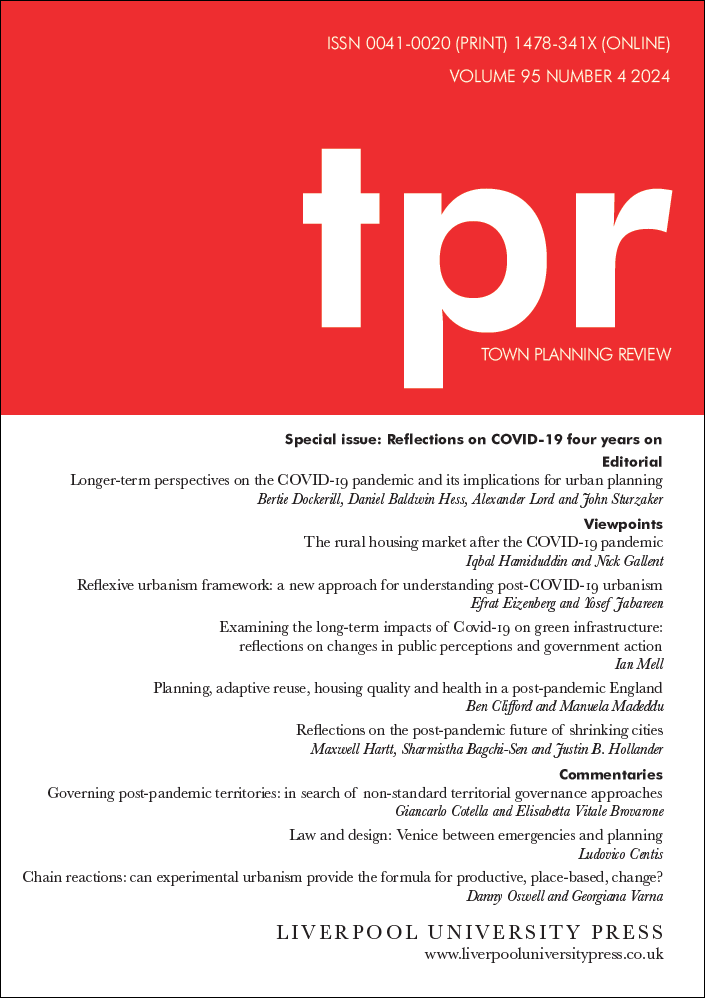
For this latest Featured Article the editors of Town Planning Review are highlighting the Editorial from TPR 95.4. This issue is the first of two special issues focused upon the pandemic and its continued after-effects, and it is available to read Open Access as part of LUP Open Planning:
‘Longer-term perspectives on the COVID-19 pandemic and its implications for urban planning‘ by Bertie Dockerill, Daniel Baldwin Hess, Alexander Lord, and John Sturzaker.
Between January and March 2021, Town Planning Review (TPR) devoted three consecutive special issues (92.1, 92.2 and 92.3) to the (then) emerging issue of COVID-19 and urban planning. It was the first planning journal to give the pandemic such prominence. In so doing, it actively sought to facilitate conversation within the discipline and between scholars of both the global South and North as to the effects and implications of the same; to provide a contemporaneous primary record of ‘the discipline’s collective thinking’ upon a health phenomenon the likes of which had not previously been seen (Tu and Reith, 2023); and to establish an initial ‘baseline of reaction’ upon which future scholars might draw.
Over the course of 54 Viewpoints voice was given respectively – as Dockerill et al. (2021) noted – to opinions and arguments focused on the immediate-term changes being wrought upon cities globally (especially in terms of housing and urban form); the impacts of change, with a focus on the themes of transport, the environment, food, ageing and health, and social issues; and ‘the future’, an arguably more speculative theme though one that was, through the contributions presented by our authors, grounded in concepts of governance and reflection.
Since then, a wealth of literature has been written upon the pandemic across numerous scales from rural to urban (Sturzaker et al, 2022; Florida et al, 2021), metropolitan to mega-city (Sharifi, 2020; Demirdag, 2024), and individual nation state to the global (Hamidi et al., 2020; Navitas et al., 2024). At the core of much of that corpus of new work upon issues of urban planning, governance and reform has been not only a dynamic reconnection with the historic nineteenth-century public health origins of the discipline, but also renewed calls for the development of ‘spatial plans, policies and actions that together will support a greener, place-based’ future (Manns, 2021, 310).
It is also the case, however, that the initial volley of exigent demands to futureproof our cities and associated systems against subsequent pandemics has, at least to an extent, been supplanted by new fears and concerns, with global news attention presently more focused upon issues such as Ukraine and the Middle East. With the World Health Organisation having declared in May 2023 that COVID-19 no longer represents a ‘public health emergency of international concern’ (WHO, 2023), it is relatively easy to see how issues of planning and preparing for future pandemics may slip further down both news and policy agenda.
Mindful of this, the ongoing need for professional and disciplinary reflection, and the opportunity that the passage of time enables when it comes to analysing both the longer-term impacts of the pandemic and the extent to which the comments and predictions of authors who contributed to TPR’s 2021 COVID special issues have been borne out, issues 95.4 and 95.5 of the journal are special issues focused upon the pandemic and its continued after-effects. Whether offering reflections, critiques and updates upon issues and themes discussed in the 2021 issues or wholly future-oriented in their approach, the associated viewpoints, commentaries, and articles contained within these two issues cumulatively remind us that the changes wrought to urban areas around the world remain significant, likewise the role of the planner in grappling with them. We are proud that TPR remains, in its 114th year, the home for debates of this sort.

Follow us for more updates
Sign up to our mailing list
Twitter | Instagram
www.liverpooluniversitypress.co.uk
 Liverpool University Press Blog