
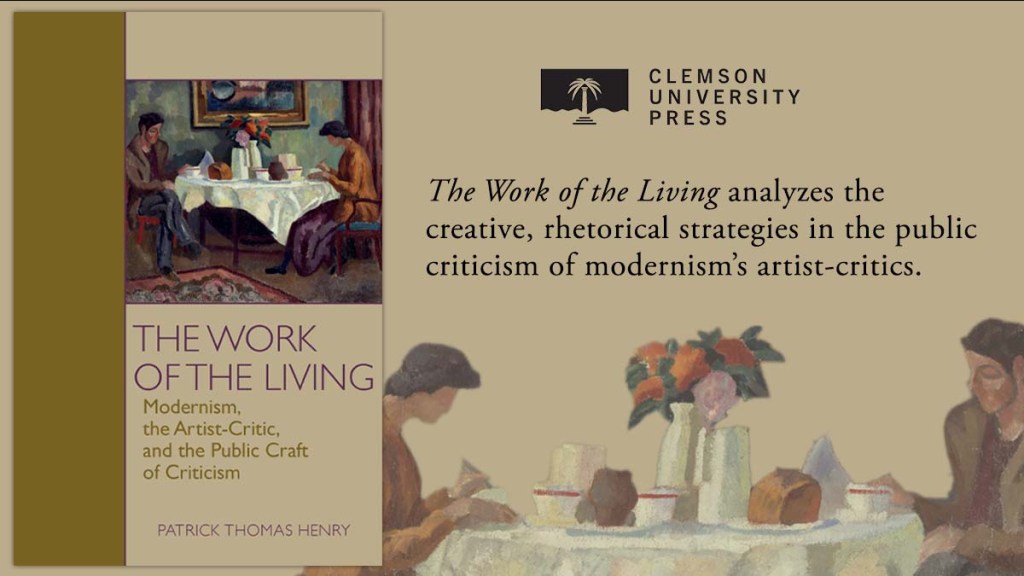
Through essays on Virginia Woolf, Roger Fry, Rebecca West, T.S. Eliot, and E.M. Forster, The Work of the Living by Patrick Thomas Henry contends that modernism’s artist-critics elevate criticism to a public mode of art and expression through their craft, rhetorical strategies, techniques, figurative language, and even their chosen circulations for their critical nonfiction.
In this blog post, Patrick Thomas Henry explores the notion that criticism should not be seen as separate from creative work, advocating for the idea that criticism itself can be a form of artistic expression, enriched by creativity and rhetorical skill, drawing on examples from literary figures and personal experiences.
In his two-part hybrid of dramatic dialogue and criticism, “The Critic as Artist,” Oscar Wilde regales the figure of the critic as an artist in their right. “Criticism is an art,” expounds the character of Gilbert, later adding that criticism “fills with wonder a form which the artist may have left void,” that criticism “may seek rather to deepen its [i.e., art’s] mystery.”
My book The Work of the Living takes up Wilde’s conviction in the aesthetic potentials of criticism, as a mode of creative expression in its own right. Yet, in many respects, the book interrogates one of the principles that literary studies and disciplinarily organization have bequeathed to generation after generation of writers—that creative and critical work are inherently separate enterprises.
But we should resist that tendency to cordon off criticism from creative production—even for writers who choose to pursue one genre over another.
In The Rise and Fall of English (1999), Robert Scholes recounts his gradual pivot away from the writing of poetry to the writing of criticism. The account appears in the book’s first interlude, a short personal narrative on the intersections of Scholes’ “commitments to literary theory and to the teaching of writing.” In fact, though, it’s the story of how the profession compelled Scholes to sideline one craft (poetry) for another (criticism). He writes:
“In graduate school at Cornell in the late 1950s, my fellow student Larry Dembo made it clear to me that a career in English depended upon one’s ability to publish literary criticism.”
On its surface, this is true—a tenure-track position in literary studies requires one to publish criticism. Scholes was keenly aware that criticism, too, requires the cultivation of a voice or style. He cites his own mentors like M.H. Abrams and his models, including his failed pastiches of the “not really academic enough” style of Edmund Wilson or the “lucid eloquence” of Lionel Trilling.
But this epiphany did not come without its own sacrifices. “I continued to write fiction and poetry while in graduate school,” Scholes confides, “abandoning those ambitions slowly and with reluctance. Only my resolve to make writing important in my critical work enabled me to reconcile this shift of energies.”
His tone is resigned, just a tick of the needle away from maudlin. Yet, what he has confessed mirrors advice that has been passed down in literature programs across decades. If you want to make a future in the profession, you have to align yourself with criticism and postpone (perhaps indefinitely) your creative ambitions.
A friend—an English major—gave me a copy of Scholes’ book after we graduated from undergrad in 2008. It’s a small mercy that I could read it before beginning graduate school. That may well have been my villain origin story in academia, the thing that prompted me to pursue both fiction writing and literary criticism. More than anything else, the whiff of despair in Scholes’ voice spurred me to question, time and again, why creative and critical writing should be viewed as such oppositional practices.
I allude fleetingly to this anecdote from Scholes in the introduction to The Work of the Living, when discussing the personal stakes of the book. As I point out there, I write short stories, edit creative work for the journal Modern Language Studies, and regularly write reviews and essays. The Work of the Living (and I’ll openly admit this!) stemmed from a somewhat selfish desire to see somebody argue that this career path isn’t only possible, but that it’s actually far more commonplace than the traditional disciplinary lines might suggest.
There’s still the question, though, of what’s to be gained for criticism when we dissolve the membrane between the terms “art” and “criticism,” or “artist” and “critic.” Though my younger self would’ve caviled at this, Scholes identifies one rhetorical achievement for this move. Criticism itself can be artistically crafted, he implies, through attention to voice and “the same concern for language and textual structures.” Scholes suggests that, if criticism were strictly about argument, then there would be no need for rhetorical play. But that’s patently not the case for modernism’s artist-critics: the aesthetics and word play are part and parcel of their analyses. Consider Virginia Woolf’s claims about narrative interiority in “Modern Fiction,” when she contends, “Life is not a series of gig lamps symmetrically arranged; life is a luminous halo, a semi-transparent envelope surrounding us from the beginning of consciousness to the end.” The figurative language, the parallel structure of the main clauses, and the effulgence of language following Woolf’s description fiction’s world as a “luminous halo”—all of it contributes to her contention that fiction shouldn’t spotlight us like streetlamps, but should envelop us in the radiant dawn of a character’s consciousness.
Or, we could put this as Oscar Wilde does in “The Critic as Artist.” “Without the critical faculty,” one of Wilde’s characters proclaims, “there is no artistic creation at all, worthy of the name.”
I would hazard, though, that collapsing this binary of art and criticism has another benefit. The artist-critic’s many selected venues—lecture halls, book reviews, newspapers, radio waves, book readings, classrooms, and so on—remind us that criticism doesn’t exist to serve the “profession” or “academia.” Instead, criticism is and always ought to be an art practiced for the many sectors of the public that co-exist in our complex media ecosystem. In Better Living Through Criticism (2017), A.O. Scott takes his time to warm up his readers to the pleasures of criticism and the ways in which criticism can extend our experiences with literature, art, and entertainment. Just as Elaine Scarry argues for the political and progressive potential of the beautiful in On Beauty and Being Just (1999), Scott contends that criticism isn’t about needling a strawman with barb after barb, a rhetorical death by a thousand stings. Instead, criticism compels us to do better, to be better.
Yet, even after grousing about our cultural tendency, fostered by late-stage capitalism, to “subordinate the creative, pleasurable aspects of our lives to supposedly more consequential matters,” Scott too slides the partition back into its track, dividing creative and critical work. “It’s the job of our art to free our minds,” Scott claims, “and the task of criticism to figure out what to do with that freedom.”
To push back against Scott, I would say simply this: two things can be true. Art can free our minds, and criticism itself can be artfully crafted, designed to unfetter and unlock our imaginations, our capacity for critical reasoning, through its orchestration of rhetoric, figurative language, analysis, and argument. The artist-critics of literary modernism model how we can achieve these multiple aims, all at once—how we can be creative and critical, how criticism itself is a malleable art that can be hammered and shaped on the anvil of our wits, time and again, to suit different audiences.
Patrick Thomas Henry
Patrick Thomas Henry is the fiction and poetry editor for the journal Modern Language Studies. He is currently an Assistant Professor and Coordinator of Creative Writing in the English Department at the University of North Dakota. He is the author of the short story collection Practice for Becoming a Ghost (Susquehanna University Press, 2024). He is currently at work on a novel that melds fabulism with an academic setting, along with ongoing research into the intersections of narrative perspective, subjectivity, memory, and modes of perceiving the world. He’s also at work on a craft book on the writing of fiction.
Find out more about The Work of the Living on the Liverpool University Press website.

Follow us for more updates
Sign up to our mailing list
Twitter | Instagram
www.liverpooluniversitypress.co.uk
 Liverpool University Press Blog