
Reconstructive Memory Work by Clíona Hensey is the first book-length study to focus specifically on writing by female descendants of harkis. In this blog post, Hensey explores France’s delayed acknowledgment of the Algerian War and the ongoing debates surrounding its memory, focusing on the Harki community’s fight for justice and reparations. Hensey emphasizes how these women critically engage with the shortcomings of official apologies and reparations, advocating for a more thorough reckoning with France’s colonial past and its lasting legacies.
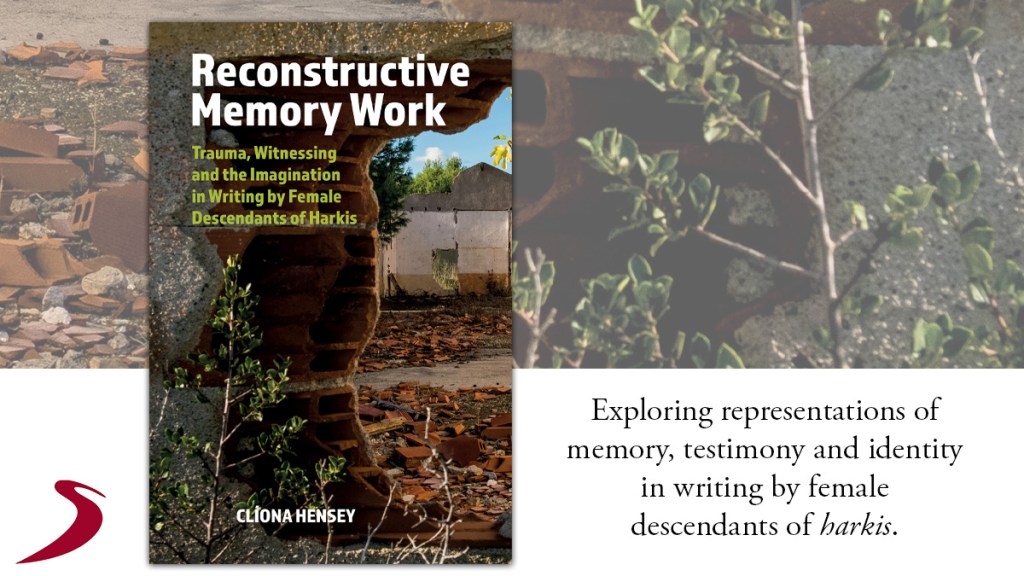
In France, the protracted period of officially-sanctioned forgetting that followed the Algerian War of Independence (1954-1962) was exemplified by the fact that its status as a war would not be officially recognised until 1999. Over the intervening quarter century, this official and societal silence has been replaced by debates on how best to commemorate the war, and on how to confront and negotiate the memorial legacies of French colonialism in Algeria. Such discussions are necessarily cross-temporal and transnational in scope, reminding us that pasts are never dredged up intact, but are rather placed in ever-evolving dialogue with presents and futures, whether real or imagined. These reflections, which form the crux of the arguments developed in my book Reconstructive Memory Work: Trauma, Witnessing and the Imagination in Writing by Female Descendants of Harkis, were rendered all the more urgent as I worked towards finalising the manuscript, against a global backdrop of protests against systemic racism, the dismantling of monuments and discussions around the necessity of confronting the traumatic reverberations of colonial histories.
It was within this transnationally charged context that President Emmanuel Macron entrusted a report on the memory of colonisation and, specifically, the Algerian War to Benjamin Stora, one of France’s foremost historians of the war’s legacies and memories. Delivered to Macron in January 2021, Stora’s report set out the areas and strategies he considered to be of greatest importance to the process of recognising and potentially reconciling diverse experiences and memories. Among these groups are the harkis, a term which officially designates Algerian men who served as auxiliary soldiers in the French army during the Algerian War, but which was, in many cases, extended to civil servants or other Algerians employed under the auspices of the colonial power. After the ceasefire in March 1962, a limited – and paradoxical – programme of “repatriation” was put in place by the French government, in spite of opposition at the highest level, including from Louis Joxe, then Minister of State for Algerian Affairs. Fleeing reprisals, the majority of harkis and their families found themselves placed in “transit” camps on the margins of French society, with some remaining there until their closure in the 1970s.
Harki descendants have been at the forefront of activism and media engagement with the aim of demanding recognition and reparations for their parents’ – and the wider community’s – experiences of discrimination, their perceived abandonment by the French state, and subsequent instrumentalisation by groups such as far-right political movements. As the notion of the “duty of memory” led to a “memory boom” in France in the 1990s, resulting in legal procedures to account for state-sanctioned crimes such as the public trials of war criminals, so harki descendants’ activism has followed these evolving memorial dynamics. Emblematic of this turn toward the logics of reparation was the case of crimes against humanity brought against France by a group of nine harkis, widows and sons of harkis in 2001. While unsuccessful, this appeal to the transnational language and institutions of memory claims was to find its echo, and a more successful outcome, 23 years later. In a monumental ruling in response to a case taken by the lawyer and son of a harki Charles Tamazount, the European Court of Human Rights condemned France in April 2024 for its “inhuman or degrading treatment” of the harkis in the Bias camp in the Lot-et-Garonne.
Although Stora’s report refrained from attaching a value to public apologies, in September 2021 President Macron built upon his three predecessors’ recognition of the French state’s abandonment of the harkis by issuing an apology which was followed, in February 2022, by a law that included provisions for the setting up of an independent reparations commission. To date, several sittings of the Commission nationale indépendante Harkis have taken place, the most recent in July 2024, with 6,767 cases for reparation accepted in the commission’s first year. Testimonies have also been collected from harkis and their families by various means, including on-site interviews and online forms.
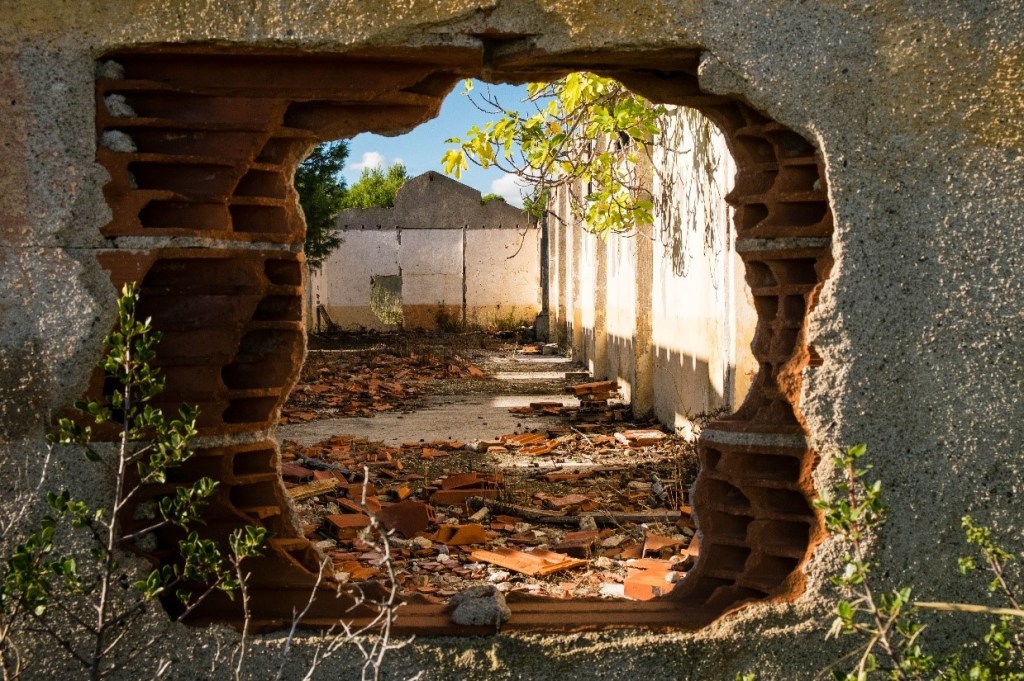
While these measures had long been cited as central to the harki community’s struggle, and as such were broadly welcomed as important avenues for belated recognition and reparation, it was of particular interest to note that daughters of harkis were at the forefront of critical approaches to these developments. Fatima Besnaci-Lancou echoes the most common criticism laid out in the Commission’s 2022 report, namely that the law is insufficient and discriminatory, since only harkis and their families who spent time in certain camps and other structures are eligible for reparation payments. Dalila Kerchouche goes further in describing Macron’s apology and the subsequent law as occluding grave human rights abuses committed on French soil, claiming that justice continues to be denied as harkis continue to be instrumentalised for electoral gain. The reactions of Kerchouche and Besnaci-Lancou are particularly striking when considered alongside their body of literary work, as well as that of the other six female descendants of harkis explored in the book. Rather than using writing as a purely testimonial platform, with the aim of gaining recognition for the harkis through recourse to well-worn discourses of sacrifice and loyalty to French Algeria, these works have largely followed the broader movement in activism and memory construction towards transnational idioms of human rights and decolonisation. Harki fathers and grandfathers, as well as the reasons behind their enrolment, are presented in these texts in their striking complexity, transcending simplistic binarisms of heroism and treason, instead inserting the creation of the harki within a broader colonial continuum. Framing public statements and laws within the well-worn tropes of recognition for the harkis’ service, and apologies within a logic of the betrayal of loyal servants to the Nation, thus falls short of the comprehensive reckoning with colonial histories and structures demanded by the authors and characters explored in Reconstructive Memory Work.
The daughters and granddaughters of harkis featured in the book largely view recognition and reparations for the harkis’ experiences as a step – albeit significant and long-awaited – towards more comprehensive forms of reparative justice. While autobiographical in content, these works span an impressive array of genres, and frequently blur the boundaries between memory and imagination – a binarism already rendered fluid by their position as second- and third-generation members of the harki community. It is, I argue, precisely this in-between position that allows these authors to propose alternative platforms for, and conceptions of, truth, testimony and witnessing. This is perhaps most strikingly apparent in passages in which authors or narrators cite, yet ultimately transcend, narrow official and juridical forms of dialogue and repair. In Moze, the first of a loose trilogy by the art historian and author Zahia Rahmani, the narrator – a fictionalised representation of Rahmani herself – is called to testify before a French reparations commission, strikingly similar in context and structure to its real-life counterpart set up two decades after Moze’s publication. Rather than testifying solely on behalf of her harki father at the commission, the narrator symbolically takes control of this testimonial space, delivering a complex colonial critique to the disinterested and frequently hostile commission members. Rahmani’s narrator is met with stony silence and, eventually, an empty room, as the commission members refuse to accept testimony that exceeds the strict limits of its legal foundation.
For writers such as Rahmani, imaginative, cross-temporal projections such as this ghostly Commission allow them to root their families’ experiences – and their own – in the colonial durée, and also in continued frameworks of marginalisation and racism. These are linked to but also distinct from colonial processes and attitudes, and are informed by both local and global contexts, often transcending the Franco-Algerian binary. Far from providing a satisfying coda to decades of activist demands, reading the official developments which coincided with the finalisation and publication of Reconstructive Memory Work alongside these works instead reinforces the importance of pushing the limits of testimony and dialogue, a dialogue which may be uneasy and fraught with obstacles, but which would seek to work towards a more comprehensive understanding of notions of justice and reparation.
Clíona Hensey
Clíona Hensey is a university teacher at University of Limerick.
Find out more about Reconstructive Memory Work on the Liverpool University Press website.
Follow us for more updates
Sign up to our mailing list
Twitter | Instagram
www.liverpooluniversitypress.co.uk
 Liverpool University Press Blog