
Peter Leese is the co-editor of Migrant Emotions: Inclusion and Exclusion in Transnational Spaces, recently published by Liverpool University Press. Here, he writes of two exhibitions at the Venice Biennale that complement his work as a cultural historian in expanding the migration studies debate.
A vast dark room. Two parallel strip lights outline the rectangle of the ceiling. On the floor a black shiny pool creates another rectangle. Look closer and the pool shimmers into an ink reservoir. From its shallows rise sticks, dozens: they support a large tabletop. Reams of white pages with sparse black print fill it from edge to edge.
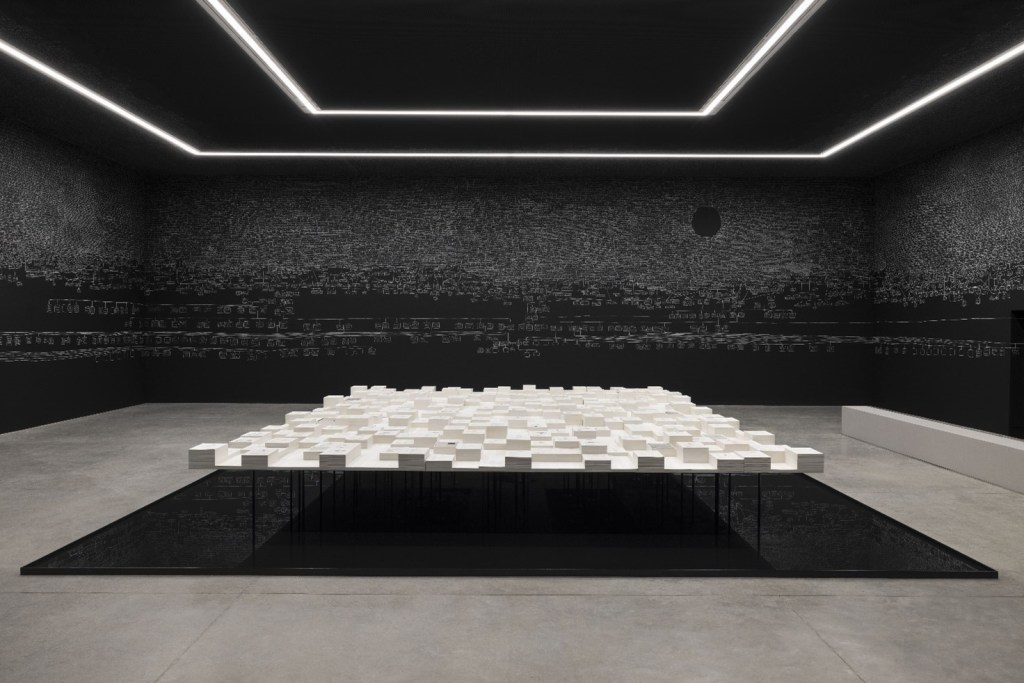
I visited Archie Moore’s kith and kin, Australia’s Pavilion at the 2024 Venice Biennale, in October. Names of the artist’s family and ancestors, drawn on the black walls in white chalk, spider up onto the ceiling. Hundreds of thousands of names, each inside a small speech bubble. Their crowded presence pitches me back in time 65,000 years towards the beginnings of Indigenous Australian civilization. The thousands of pages on the table name the Indigenous Australians who died in the penal system. Some of them died in the nineteenth century; shockingly, most in the twenty-first century.

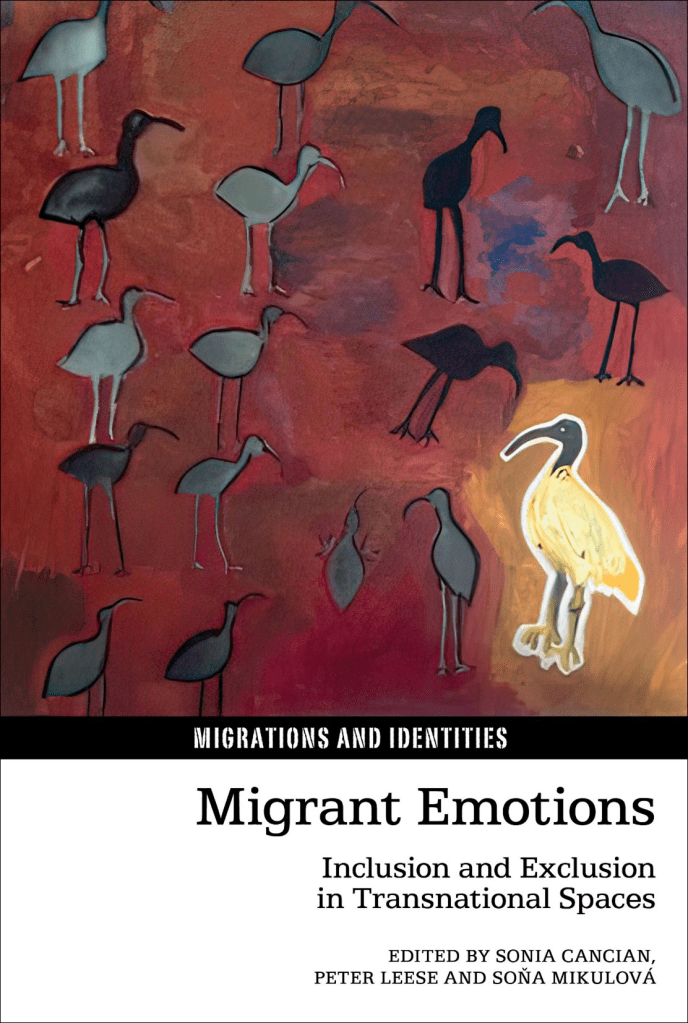
Moore’s kith and kin installation is difficult to forget. Weeks later I still see its fragments. They bring to my mind displacement among peoples who did not move, but who were nevertheless forcibly displaced by the invasion and desecration of their ancestral lands. ‘Diaspora, Dispossession and Refugees in our own Land: An Australian Indigenous Wiradjuri View’ is Robyn Heckenberg’s chapter in Migrant Emotions: inclusion and exclusion in transnational spaces published by Liverpool University Press in September 2024. With co-editors Sonia Cancian and Soňa Mikulová, we expand the migration studies debate by focusing on the emotions of those who move as well as on the emotions of those who observe migrants.
Robyn Heckenberg’s research is characteristic of the diversity in Migrant Emotions. Our contributors write not only about Indigenous Australia, but also about the Asia-Pacific region, Africa, and global connections to Europe. Their disciplinary approaches include legal, health and cultural studies, history, and anthropology. Our collection spotlights a wider range of migrant emotions: feelings of belonging and rejection among Hong Kong dependent visa holders; the acute distress of child migrants in the Republic of Ireland; fear, shame and anger surrounding Indonesian noise conflict in rural Japan. Migrant Emotions also shows how feelings act in the world: distress spurs action in dangerous situations; friendship and loyalty aid self-preservation.
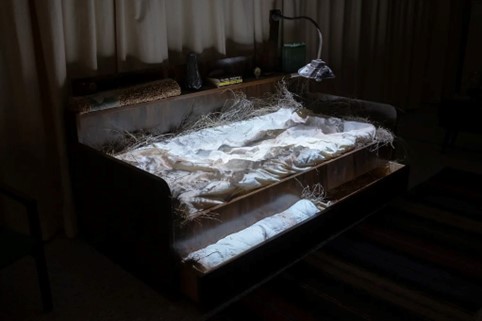
A cramped apartment: dim sitting room, bedroom, and kitchen, lit only by warm glow pooling under several lampshades. Water flickers across crumpled bedsheets over a straw-stuffed bed. Birch trunks grow out of kitchen cupboards. Three old TV screens project scrublands from outside into this interior, inhabited only by voices. They recall scenes of arrests and beatings. A sewing machine unexpectedly whirs – a machine gun.

The Bulgarian political prisoners interned in camps after World War Two until the early 1960s. The Muslim, Roma and Turkish minorities netted by the system in the 1980s. The Neighbours. Ours.
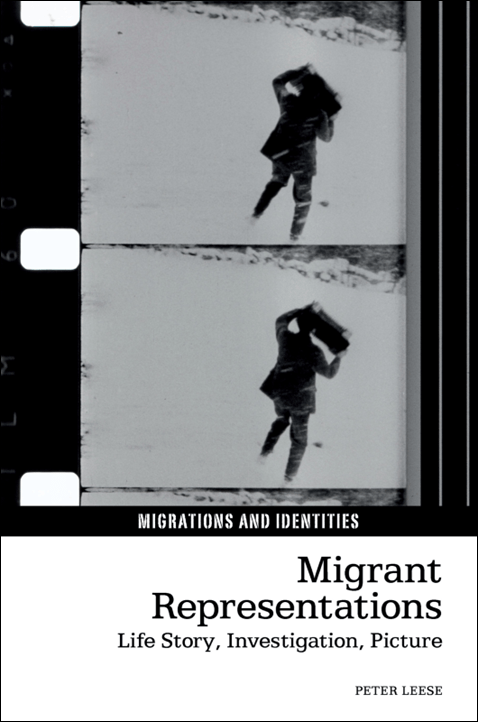
I met them at the Bulgarian Pavilion of the Venice Biennale, hosted by Krasimira Butseva, Julian Cherherian and Lilia Topouzova – a team of scholar-artists. Traumatic memory is so hard to picture. That’s why as a cultural historian I tried to do exactly that. My book Migrant Representations: life story, investigation, picture (Liverpool University Press, 2022) traces – from the late eighteenth century into the early twenty-first – how migrants have represented themselves and how they have been represented by others.
About a quarter of my book covers the same timespan as The Neighbours: the post-Second World War era. War era. The themes run in parallel. When migrants tell life stories, they remember mixed despair and hope, ambiguities of fear and friendship. Mary Saxby (1738-1801) speaks of homelessness and the struggle to feed her children. Charlie Chaplin (1889-1977) remembers his first disastrous Vaudeville tour in America. Lithuania haunts Jonas Mekas (1922-2019), long after he was forced to live abroad near the end of the Second World War. Such stories mirror the tricky exchanges between event and memory. They also highlight failures of understanding between host societies and their migrant subjects.
kith and kin and The Neighbours complement – as research-based visual practice – the written investigation of Migrant Emotions and Migrant Representations. Thanks to these two installations I reflect on my own work as a cultural historian, artist, author and editor. Small stories illuminate migrants’ predicaments and reveal their entanglements in power structures. Words, objects and images evoke intricacies of readings and misreadings. Chalked ancestral names, documented and undocumented lives and deaths, interviews broadcast by obsolete radios – they all call for our solidarity and attention.

Follow us for more updates
Sign up to our mailing list
Twitter | Instagram
www.liverpooluniversitypress.co.uk
 Liverpool University Press Blog