
To celebrate our 125th anniversary this year, we have been taking the opportunity to highlight and thank a selection of key figures in LUP’s recent history. Our final post in this series has been written by our Director of Journals Publishing Clare Hooper, who has put together a reflection on Professor David Bolt’s impact on the field of Disability Studies with the Journal of Literary & Cultural Disability Studies, among many other areas of his impressive academic career.
As scholarly journals publishers, we come into contact with many journal editors during our careers. It’s one of the most important working relationships we have, and you recognise early on the qualities you are looking for in the role. These may include intelligence, passion for their subject, enthusiasm, motivation, integrity, and a willingness to put in long hours working to make their journal the best scholarly resource it can possibly be for their readers, authors and reviewers.
I first met David Bolt in 2008, (very) fresh into my new role as Journals Executive at Liverpool University Press to discuss the new journal he had founded – centred around representations of disability in literature, culture, and indeed disability studies itself.
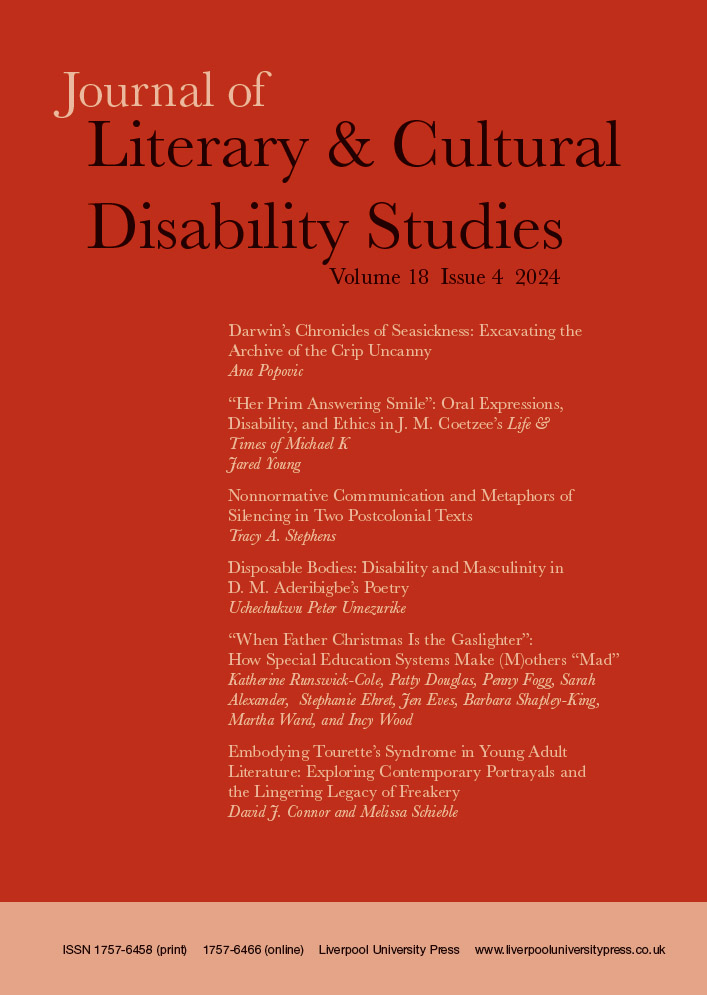
At the time, LUP published around 8 journals, and on a rainy train journey to Newcastle-under-Lyme to meet David, my colleague Anthony Cond and I discussed those qualities of a journal editor I wrote about above. It turned out we didn’t have much to be concerned about. David had all of them and his journal, The Journal of Literary & Cultural Disability Studies, which we agreed to publish almost immediately, has since made an incredible contribution to our list, as has he to his field.
His colleague and friend Professor Julia Miele Rodas, based in the English Department at Bronx Community College sums him up: ‘David is absolutely a FORCE OF NATURE….Every time I turn around, David is hosting another conference, publishing another book, starting another project, always faithfully bringing together people with an interest in disability to celebrate disability culture and identity and to generate thinking and discourse in the service of advocacy and inclusion. Working with David is such a pleasure—he’s level-headed, focused, responsive, collaborative, RELIABLE, everything one would dream of in a professional partner.’
Professor Tanya Titchkosky, Social Justice Education, OISE of the University of Toronto, agrees: ‘One of the most prominent and prolific disability studies (DS) scholars today, Professor David Bolt has brought our field and its connection to cultural studies full to life! He has supported an amazing number of people through his journals and book projects, conferences and critical DS curriculum. Prof. Bolt does it all with care, grace, and with an incomparable dry wit leading to constant engagement. His own blindness experience combined with his literary prowess has made his version of disability studies both compelling and inviting. And, I always enjoy Prof. Bolt’s response when I submit a review or email a question — “Hiya, Good one.” But, he’s the good one.’
Professor David Bolt is an extremely busy man. He is Director of the Centre for Culture & Disability Studies in the School of Social Science at Hope University in Liverpool, where he is also Professor of Disability Studies and Interdisciplinarity and course lead on the Disability Studies MA. His publishing record is distinguished – he is the editor of several book series – Autocritical Disability Studies (Routledge), Literary Disability Studies (Palgrave Macmillan/Springer) with Elizabeth J. Donaldson and Julia Miele Rodas, as well as general editor of A Cultural History of Disability (Bloomsbury) with Robert McRuer.
Robert remarks: ‘It has been a joy to work with David Bolt for almost 20 years on the board of the Journal of Literary and Cultural Disability Studies, which he has built into the leading journal in the interdisciplinary field of disability studies. I have loved the ways in which David consistently weaves the good things happening with JLCDS into events, large and small, at Liverpool Hope University, which has become a hub for new work in critical disability studies. I always love coming to these events, not just for the stimulating conversations but for the pleasures of passing time after the events are over with David and others, and experiencing David’s wit, warmth, and generosity. I particularly had the privilege of working with David on the six-volume series A Cultural History of Disability, which has volumes stretching from antiquity to the present. It’s another example of David’s unique skill in bringing together multiple scholars and thinkers and putting us all in conversation with each other.’
Now in its eighteenth volume, JLCDS is an essential Disability Studies journal for scholars whose work concentrates on the portrayal of disability. It is indexed in Scopus and included in Project Muse, and all this is testament to David’s hard work and dedication to the journal’s success.
Dr. Rod Michalko, co-author of Letter’s with Smokie: Blindness and More than Human Relations, states: ‘David Bolt has accomplished much for the field of disability studies through his research, teaching and through publishing particularly through his Journal of Literary and Cultural Disability Studies. This set of accomplishments is for me and, for many blind scholars, a source not only of inspiration but of pride as well. David has contributed greatly to the understanding, for blind and sighted scholars, that the experience of blindness is a rich and creative ground for perceiving and depicting the world around us.’
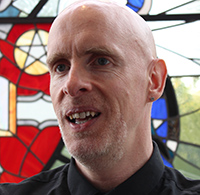
Dr. Owen Barden, Associate Professor for Disability Studies and Comments Editor for JLCDS, agrees: ‘David’s contribution to Disability Studies is immense, and it’s about so much more than his publications. David doesn’t just talk about, teach about and write about inclusion and appreciating disability, he embodies these things. He is always looking for ways to give people opportunities. It doesn’t matter whether you’re a Masters student looking for your first publication, a Doctoral student wanting to share your work at a conference, or a big-name Professor with a book to write, David makes it happen. I think what is so special and significant is the community and networks he has created, where everyone who wants one has a place at the table.’
The admiration and warmth in the responses I received from David’s colleague and friends when I asked them for their thoughts for this piece was evident, and something that kept coming up was David’s support for others, for his students, his colleagues, and the wider DS community.
The journal’s Book Reviews Editor Dr Ella Houston states: ‘As well as sharing his vast knowledge of Disability Studies with me, for over a decade Professor David Bolt has also taught me many things about valuing disability, alongside the importance of collegiality and friendship. Since I have known David, first of all as one of his undergraduate students, then as a student on his Disability Studies MA course, and now as a colleague in the subject of Disability Studies at Liverpool Hope University, he has always helped me to feel a sense of belonging at the university and within Disability Studies more broadly. As well as having far reaching impacts on Disability Studies, through founding and leading the Centre for Culture & Disability Studies, alongside the Journal of Literary & Cultural Disability Studies, David continues to make lasting expressions on many people’s lives. For instance, during his leadership of the Disability Studies MA (2013+) at Liverpool Hope, David has taught and cultivated the research interests and activist principles of students from across the globe (including the continent of Africa, Germany, India, America, Israel, the United Arab Emirates and Sweden). As well as his foundational critiques of representations of blindness in Literature, David has introduced various innovative approaches and concepts to Disability Studies (to name but a few, Autocritical Disability Studies, the tripartite model of disability, critical avoidance, metanarratives of disability and cultural stations).’
Ella also shared that in the 1980s David was singer and songwriter in the pop-rock group Life. Some of the band’s songs are recorded on his YouTube channel. Just something else to add to his list of achievements!
His hard work and commitment is evident. David’s Academic Support Worker, Kay Martin says of David: ‘I must say that as Professor Bolt’s Academic Support worker, his fellow colleagues and academics will have much better prose than myself here. However, working in such close proximity with David does give me a lot of first glance knowledge into how much work he puts into all of his endeavours “behind the scenes”. David is a kind, hardworking and passionate man who strives to ensure interdisciplinarity plays a key role in how disability is seen within today’s society. He is a gentle family man and friend who does not just see his role at Liverpool Hope University as a 9-5 job but rather, appreciates where his hard work has got him today; yet he has not become complacent as he continues to work meticulously every day. One of the main things I will take from David is the slogan ‘nothing about us without us’ and how disabled and non disabled people can very much work alongside one another; however, a non disabled individual in the same instance must also be okay with being led by a disabled person. I am so pleased David is being recognised in this way.’
Perhaps his contribution to his field can be summed up by Lennard J. Davis, Distinguished Professor, College of Liberal Arts and Sciences, University of Illinois at Chicago: ‘Years ago a shy graduate student contacted me. He told me he was blind and wondered if there was a future for him in disability studies. Of course, that student was David Bolt. When I replied I encourage him to pursue his dream of graduate school and attaining a PhD degree. We stayed in touch, and not at all surprisingly, he accomplished his goals and then some. In fact, David has become one of the foremost movers and shakers in disability studies. His work in developing disability studies at his university, his creation and stewardship of the Journal of Literary and Cultural Disability Studies, and his organization of conferences and lectures is really unparalleled in my opinion.’
It is clear that David Bolt not only possesses all the qualities a scholarly publisher looks for in their editors and then some – I am very glad that we took that rainy train journey, and that we get the chance to work with him every day on a journal that continues to thrive – even in the challenging times we see today in humanities publishing. That really is something special.
“Nothing about us without us.”
Professor David Bolt is Director of the Centre for Culture & Disability Studies. Find out more about the CCDS on their YouTube channel and watch Professor David Bolt’s Inaugural Lecture From Avoidance to Appreciation below:
In celebration of David Bolt’s contribution to LUP, access a free issue of the Journal of Literary & Cultural Disability Studies. JLCDS focuses on representations of disability and publishes a wide variety of textual analyses that are informed by disability theory and, by extension, experiences of disability.
Access Volume 15, Issue 1 for free on the LUP website >

Follow us for more updates
Sign up to our mailing list
Twitter | Instagram
www.liverpooluniversitypress.co.uk
 Liverpool University Press Blog