
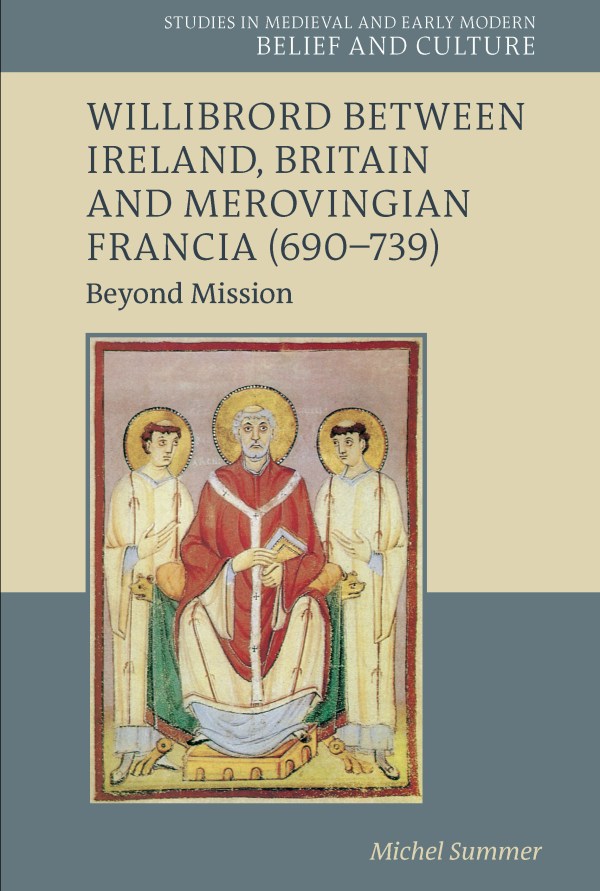
Michel Summer, author of Willibrord between Ireland, Britain and Merovingian Francia (690–739), discusses the notion that the early medieval missionary Willibrord was a European before there was a united Europe, and questions how modern categorisations from the 19th and 20th centuries are applied to the medieval period.
On 26 September 2024, Pope Francis paid a state visit to Luxembourg. At his reception in the capital, Prime Minister Luc Frieden gave a speech in which he referred back to the medieval history of the Grand Duchy: ‘We live in the country of St Willibrord, a missionary and great European before the European Union existed. He was the bishop of Utrecht in the Netherlands before he settled in Luxembourg.’[1] Frieden is not the first politician to portray the Northumbrian missionary Willibrord (658–739) as a proto-European: When an Irish delegation visited Luxembourg in 1961 to discuss Ireland’s membership of the European Economic Community, Prime Minister Pierre Werner referred to them as the ‘first Irishmen to have presented themselves since the time of St. Willibrord.’ Similarly, the former president of Ireland, Mary McAleese, characterised him as ‘Ireland’s first ambassador to Europe’ and ‘a true European’ during her visit to the town of Echternach in 2009, where Willibrord established his monastery in 697 or 698.
The notion that the early medieval missions and the spread of Christianity beyond the borders of the former Western Roman Empire had a decisive influence on the formation of modern Europe developed especially after the Second World War. In 1950, the French foreign minister Robert Schuman famously chose the career of the Irish missionary Columbanus (d. 615) – which took him from Ireland to Lombardy – as the historical precedent for his ideal of a united Europe. In this context, the establishment of the Frankish empire under Charlemagne (d. 814) was perceived both in academic and public discourses as the first successful attempt after 476 to reunite the western part of the continent in a culturally and politically connected entity. The prestigious Charlemagne Prize, which is awarded annually in the German town of Aachen for ‘work done in the service of the European unification’, still preserves this idea at the highest political level of the European union. Underlying this narrative is the assumption that the formation of modern Europe – which is here often reduced to its north-western part – was primarily shaped by the spread and consolidation of Christianity. The emergence of new Christian kingdoms and the later connection between the churches north of the Alps and the papacy allegedly concluded a ‘dark age’ of chaos and cultural decline after the fall of the Western Roman Empire.
Willibrord himself, who left Ireland for Frisia in 690, was supported by both the great-grandfather and grandfather of Charlemagne during his time on the continent, where his network reached from Utrecht to Rome. Like his better-known successor Boniface (d. 754), Willibrord’s activity was characterised by his mobility, the foundation of important monasteries and his adherence to the pope – it thus seems fitting to describe him as an early ‘European’. At second glance, however, the matter becomes more complex if we reconsider the (relatively recent) notion of the ‘missionary’ – a term not found in contemporary sources – and the Carolingian-centred narrative of early medieval history. Like Columbanus and Boniface, Willibrord spent of most his time on the continent within the borders of the Frankish kingdom and thus within a society which had been Christianised long before his arrival. When he landed on the shores of Frisia in 690, he could neither have imagined that Pippin III (d. 768) would usurp the throne of the Frankish kingdom 61 years later nor that his monastery at Echternach would be located in the heart of Charlemagne’s empire by the end of the next century. Furthermore, in 697/98, the foundation of the medieval county of Luxembourg was still three hundred years in the future.
The geographical, cultural and political coordinates of Willibrord’s world were thus fundamentally different from those of 19th– and 20th-century Europe. We therefore also need to ask ourselves whether he would have understood the concept of a united ‘Europe’ and how we need to define his role on the continent if we wish to reassess the traditional image of Willibrord as a missionary in the service of Carolingian military expansion. At the same time, the application of modern categories to the medieval past can be fruitful, as they offer us a starting point to analyse societies whose norms, ideas and behaviours often appear strange to us and to engage with non-specialist audiences. However, their usage should prompt us as historians to reconsider our own assumptions about concepts such as ‘Europe’, the periodisation of history and national identities and their applicability to the medieval past. By contrasting the contemporary sources with their modern reception, we are able to better identify the still significant influence of the 19th and 20th centuries on the way we write and think about the early Middle Ages today.
Michel Summer is a Postdoctoral researcher and secretary of the Institute for Franconian and Palatine History at Heidelberg University. He received his PhD in Medieval History from Trinity College Dublin in 2021. You can purchase Willibrord between Ireland, Britain and Merovingian Francia (690–739) here.
[1] Rede von Premierminister Luc Frieden anlässlich der Begegnung Seiner Heiligkeit Papst Franziskus mit den nationalen Autoritäten und der Bevölkerung im Cercle Cité, URL: https://gouvernement.lu/dam-assets/documents/actualites/2024/09/26-visite-pape/de-discours-pm.pdf [19.03.2025].

Follow us for more updates
Sign up to our mailing list
Follow us on social media
www.liverpooluniversitypress.co.uk
 Liverpool University Press Blog