
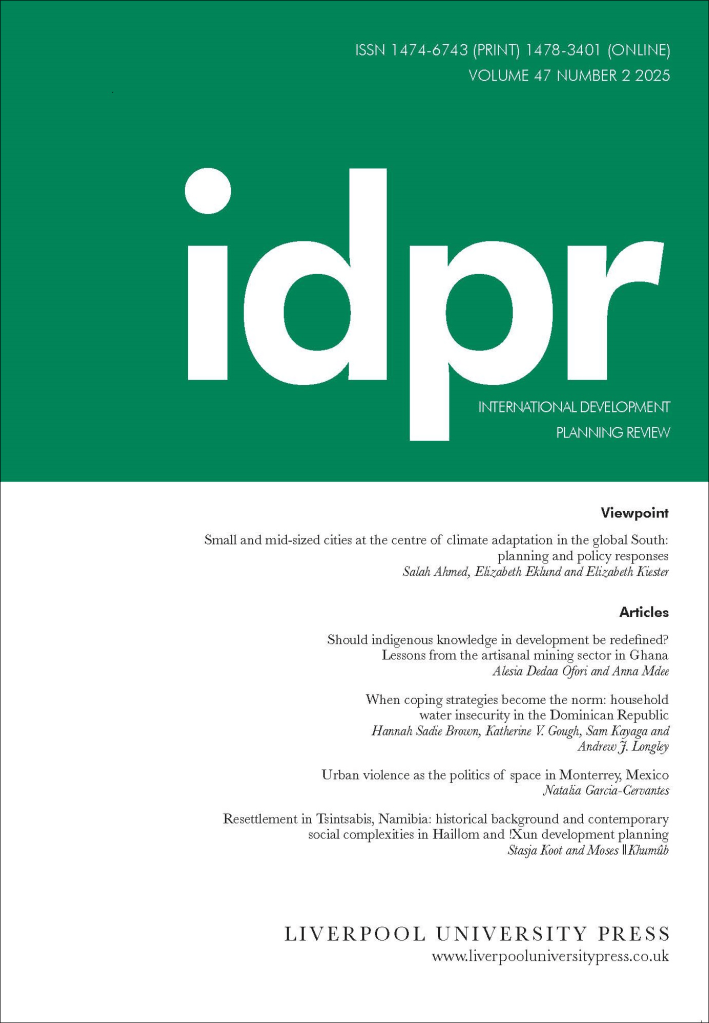
The editors of International Development Planning Review (IDPR) have selected the following paper as the Featured Article in IDPR 47.2.
It is available to read Open Access as part of LUP Open Planning:
Should indigenous knowledge in development be redefined? Lessons from the artisanal mining sector in Ghana by Alesia Dedaa Ofori and Anna Mdee.
When asked to describe the paper and highlight its importance, the authors stated the following:
Indigenous knowledge has long been portrayed as pure, timeless, and distinct from modern knowledge systems. However, this narrative oversimplifies the reality. As demonstrated in the context of Ghana’s artisanal mining sector, what is often labelled as “indigenous” is rarely a separate, isolated system. Instead, it represents a complex, evolving tapestry of blended ideas, practices, and beliefs shaped by ongoing interactions and negotiations between traditional and modern systems.
The dichotomy between indigenous and modern knowledge is, at best, illusory. While proponents of indigenous knowledge frequently highlight its resilience and harmony with nature, this knowledge is not static or immune to external influences. For instance, colonialism, modernisation, and globalisation have transformed how these systems are practised and understood. In Ghana, rituals and ideologies once rooted in indigenous spiritual traditions have been reinterpreted and rearticulated to coexist with capitalist and religious practices tied to modernity. This deliberate blending, or bricolage, shows how individuals and communities adapt knowledge systems to suit their shifting realities and needs.
Practices within small-scale gold mining communities in Ghana exemplify this. Indigenous practices, such as the belief in river deities and the taboos surrounding the use of these deities’ dwellings, are believed to instil fear and reverence for the environment, which subsequently helps create a harmonious nature-society relationship. Yet, as artisanal and small-scale mining intensified, indigenous spirituality became more entangled with economic interests and power dynamics. Even river deities, once central to safeguarding natural resources, are now invoked to legitimise capitalist objectives. This transformation highlights a fundamental truth: indigenous knowledge is not a fixed entity but is continuously reshaped by socioeconomic and political pressures.
One of the challenges in understanding indigenous knowledge, as the paper showcases, is the tendency to view “community” as a uniform concept. Communities are often seen as static, homogeneous groups with shared traditions and beliefs. However, this perspective ignores the diversity and complexity within these groups. Variations in access to knowledge, power dynamics, and evolving identities mean that indigenous knowledge within any community is uneven and multifaceted. Assigning rigid definitions to such knowledge strips it of its fluidity and fails to capture its evolving nature. This reality underscores the need to rethink and refine how we define indigenous knowledge, particularly in development discourse.
Ultimately, Indigenous knowledge, particularly in contested environments, cannot be confined to a single category or romanticised as an untouched legacy. Instead, it is a co-produced and hybridised system that responds to contemporary challenges and opportunities. Recognising this complexity and fluidity enables more inclusive and adaptive approaches to development, particularly in contexts where competing ideologies and practices intersect. As shown in the case of Ghana, the value and relevance of indigenous knowledge lie not in its perceived purity but in its capacity to adapt, integrate, and serve dynamic socio-economic landscapes.
Follow us for more updates
Sign up to our mailing list
Bluesky | Instagram
www.liverpooluniversitypress.co.uk
 Liverpool University Press Blog