
The editors of Town Planning Review (TPR) have selected the following paper as the Featured Article in TPR 96.3.
This paper is available to read Open Access as part of LUP Open Planning.
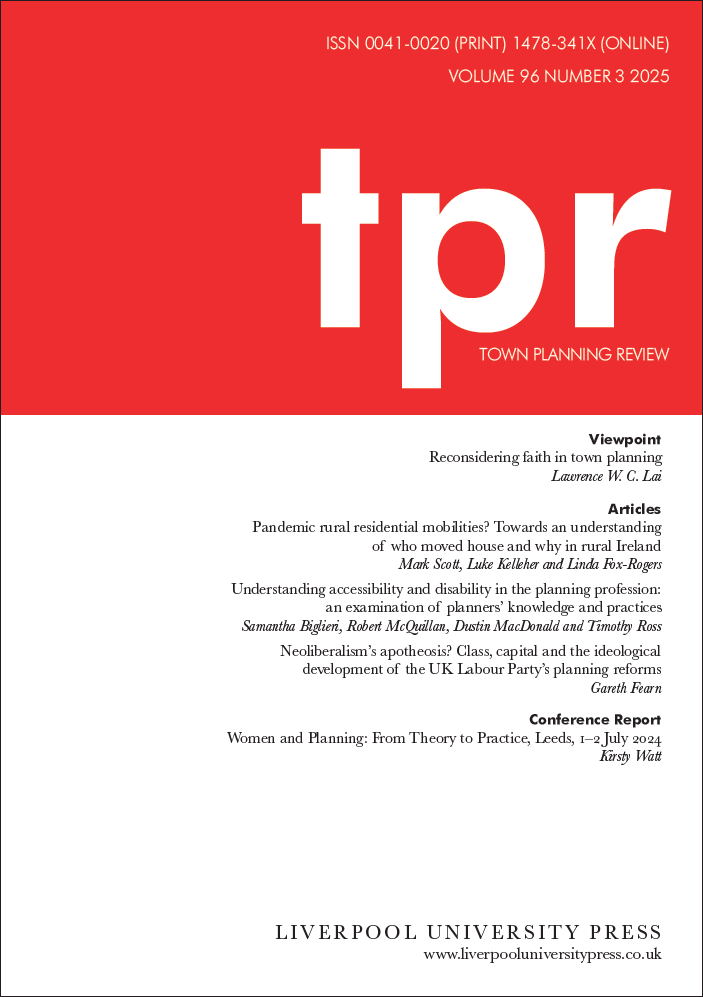
‘Understanding accessibility and disability in the planning profession: an examination of planners’ knowledge and practices’, by Samantha Biglieri, Robert McQuillan, Dustin MacDonald, and Timothy Ross.
When asked to describe the paper and highlight its importance, the authors stated the following:
As planners, we have a profound influence on built environments. We make decisions everyday that impact that way people experience the places they live, work and play. These decisions can determine whether community members can participate in public spaces with dignity, or whether they are excluded from these spaces.
Despite disability discrimination being prohibited for decades in Canada, and the province of Ontario having well-developed 20-year-old accessibility legislation, people with disabilities continue to encounter many inaccessible built environments in their everyday lives. We conducted this research with a view to understanding how planners understand and act toward disability and accessibility. Our study builds upon Rob Imrie’s (1997) seminal piece published over 25 years ago in Town Planning Review, which presents findings from a survey of local authority planning practices in the United Kingdom. This survey had similar aims, as it sought to understand how local planning authorities seek to facilitate access (or not) for disabled people. We see our study as a continuation of this work, building on Imrie’s legacy, as we explore local planners’ understandings of and actions toward disability in another country. While this study was conducted in Canada, our article highlights difficulties and inconsistencies between regulated access through legislation and its relationship to planning knowledge, perceptions, attitudes and the profession itself – and is informative as many other countries face similar difficulties with advancing accessible and inclusive communities with and for disabled people.
We wanted to know how our colleagues in the planning profession think about accessibility and disability, so we interviewed professional planners in Ontario about their attitudes, perceptions and knowledge of accessibility and disability in planning and their practice. In our article, we found that planners had a limited understanding of disability and accessibility and how they relate to legislation and policy. They also had limited experience engaging with people with disabilities in their work and talked about disability infrequently in their workplaces. Results also indicated that planning education and continuous professional learning largely ignore disability and accessibility, which may be contributing to planning practitioners being unprepared to engage in these topics with clients, employers and the public.
We believe that our profession must do better to ensure accessibility and disability are integrated into learning and practice. Dignity for the communities we serve depends on it. Based on our findings, we propose six actions to help planning bodies and practitioners advance their service of accessibility and disability:
1. Education:Incorporate disability and accessibility across planning curriculums and planning organizations’ continuous professional learning to ensure planners are educated on disability and accessibility.
2. Representation:Collect data on disability content in curricula, the number of disabled students applying to and enrolled in planning programmes, and the number of disabled planning faculty, and commit to continually assessing and improving the accessibility of planning workplaces.
3. Planning practice and process: Consistently question how disability is (or is not) being considered in planning policy, regulation and processes. Also, question whose voices are (and are not) being heard. Planners must go beyond minimum requirements to ensure disabled people’s voices are heard in consultation events, advocated for on projects, and acted upon in plans and their implementation.
4. Planning outcomes: Conduct consistent and regular evaluations of the ways in which disability and accessibility are treated in plans, policies and planned environments and include people with disabilities in these conversations!
5. Professional accreditation and advocacy: Professional planning bodies (like Canadian Institute of Planners and Ontario Professional Planners Institute) should reflect on their values and codes of practice to confirm they meaningfully include disability and accessibility. Also, consideration should be given to including language that emphasizes the rights of disabled people.
6. Reflection: Professional planning bodies should encourage their members to incorporate reflection into their everyday practice and, specifically, reflections on their positionalities, biases and actions relating to disability and other forms of social difference. It would be beneficial to identify ways in which planners’ reflections can be used to inform meaningful actions for addressing biases and shortcomings.
The most important finding of the study? All planners in the study wanted to do better – they were eager to learn more about access and disability to enhance their practice. This desire to do better is fundamental to ensuring we improve as individual practitioners and as a profession. We know that planners are committed to justice, equity and inclusion. Our article aims to serve as a roadmap for doing better as a profession when it comes to disability, access and creating communities for all. We are confident that with the right knowledge, education and tools, this goal is within reach.
Postscript: We would like to thank the Faculty of Community Services at Toronto Metropolitan University who made this research possible through their Seed Grant, our advisors Thea Kurdi and Shane Holten, and Town Planning Review for supporting this work.

Follow us for more updates
 Liverpool University Press Blog