
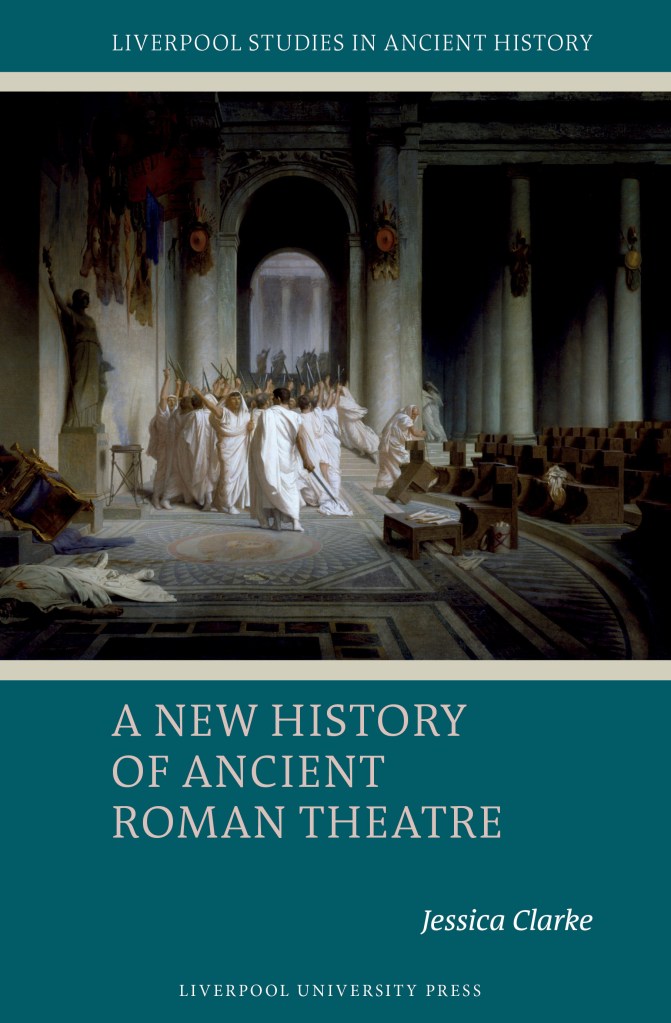
A New History of Ancient Roman Theatre by Jessica Clarke, published recently in the Liverpool Studies in Ancient History series, is a radical reappraisal of how theatre developed in ancient Italy and Rome. Here, author Jessica Clarke asks the question: was Roman theatre really Roman? Reassessing the consensus that Rome was the centre of theatre in ancient Italy through archaeological evidence, Clarke explores this exciting new perspective in this blog post.
When we talk of Roman theatre, we usually imagine a form of entertainment shaped entirely by the city of Rome. Our ancient accounts, written many centuries after the events they describe, all place Rome at the centre of their narratives, and the surviving dramatic texts of the playwrights Plautus and Terence are generally regarded as the definitive works of ‘Roman comedy’. In scholarship today, Rome is still assumed to be the driving force behind cultural innovation in the third and second centuries BCE, with other Italian cities following its lead.
Yet, when we look beyond the literary record and focus on the archaeological and visual evidence, a rather different picture begins to emerge. A New History of Ancient Roman Theatre brings the archaeological evidence into focus, mapping and analysing the spread of theatre buildings and theatrical visual culture across Italy from the seventh century BCE to the first century CE. In so doing, it reveals, for the first time, how theatrical practices evolved in Italy, how they were adapted to local conditions, and how Rome fits into a broader trajectory.
Take, for instance, the theatre at Pompeii. In the second century BCE, Pompeii built itself a magnificent stone theatre seating around 3704 spectators. This theatre was constructed almost a hundred years before the first theatre was built in Rome. It is a significant chronology. At a time when Rome relied on temporary wooden stages erected for festivals and other celebratory events, Pompeii had already committed to a monumental, permanent performance space embedded within the urban fabric of the city.
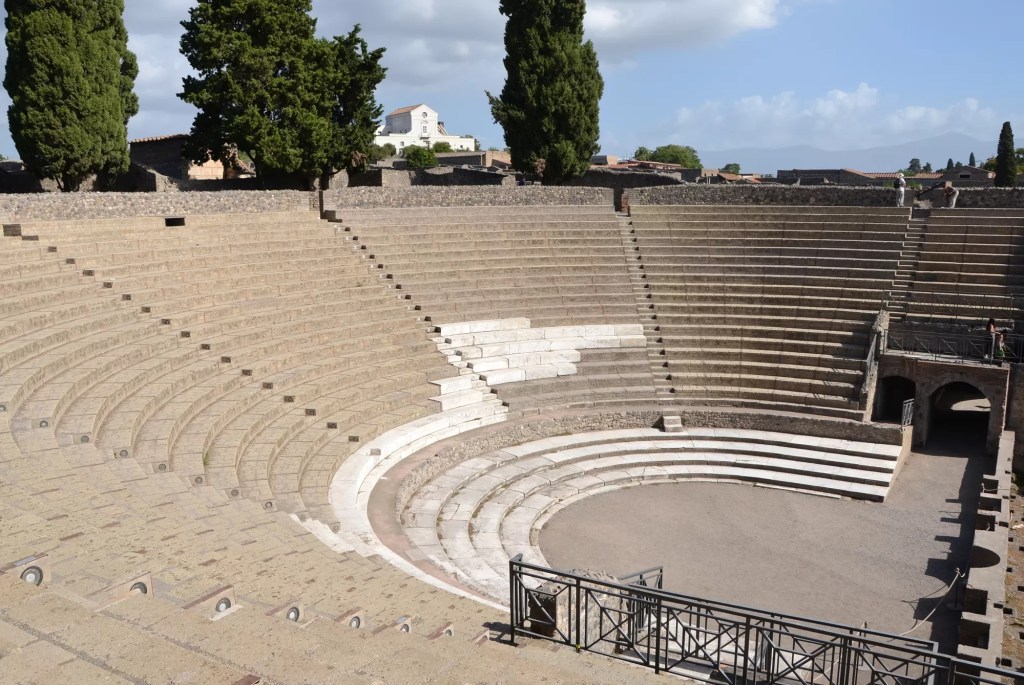
Moreover, Pompeii was far from being an isolated case. At least 33 Italian cities and religious sanctuaries built impressive theatres long before one was built in Rome. Whilst many ancient writers wondered why Rome lacked a permanent theatre for so long (Tacitus, Annals 14.21) and others tried to justify the use of temporary stages (e.g. Appian, Civil Wars 1.28), their explanations raise as many questions as they answer. Although rarely admitted by our ancient authors, theatrical infrastructure was developing across Italy well before it was monumentalised in Rome.
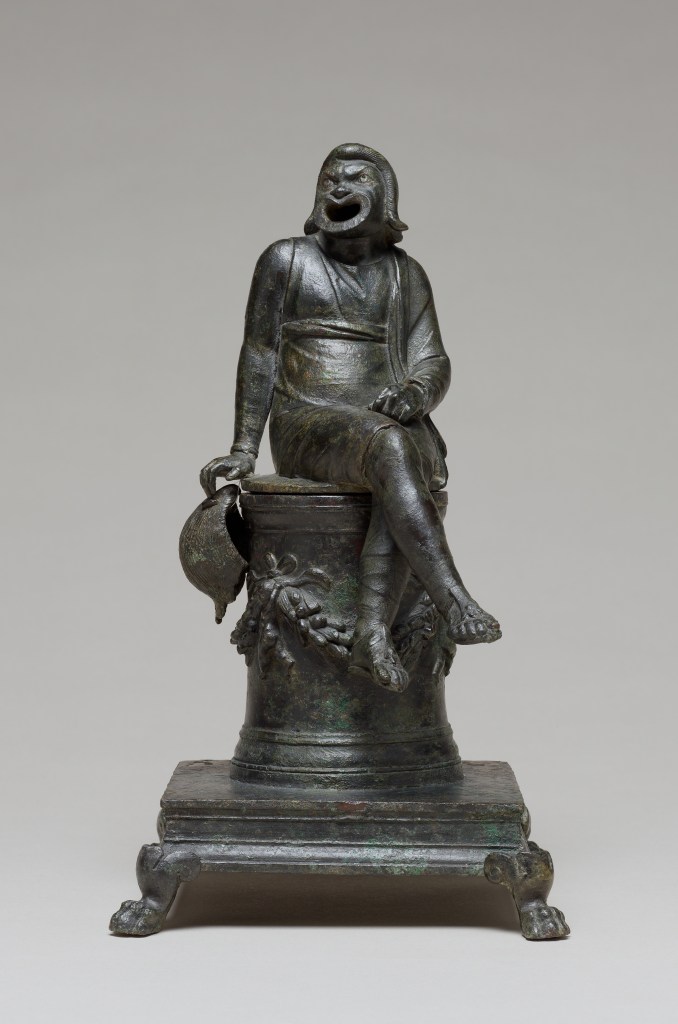
Architecture, however, tells only part of the story. If we turn to visual culture, we can see similar trends at work in the representation of theatrical masks. Throughout Italy, images of masks and actors appeared in a variety of forms, from terracotta figurines to mosaic floors, frescoed walls, and marble and bronze statuary, all indicating the presence of recognisable character types and shared performance conventions.

Especially striking is the prominence of the comic slave character. Representations of this character grew exponentially from the end of the third century BCE, outstripping any other theatrical character depicted in the Italian visual record. Whilst the comic slave became increasingly prominent in the playscripts of Plautus written at the beginning of the second century BCE, the visual evidence suggests that this increased interest in enslaved characters was already well established in Italy before Plautus committed it to writing.

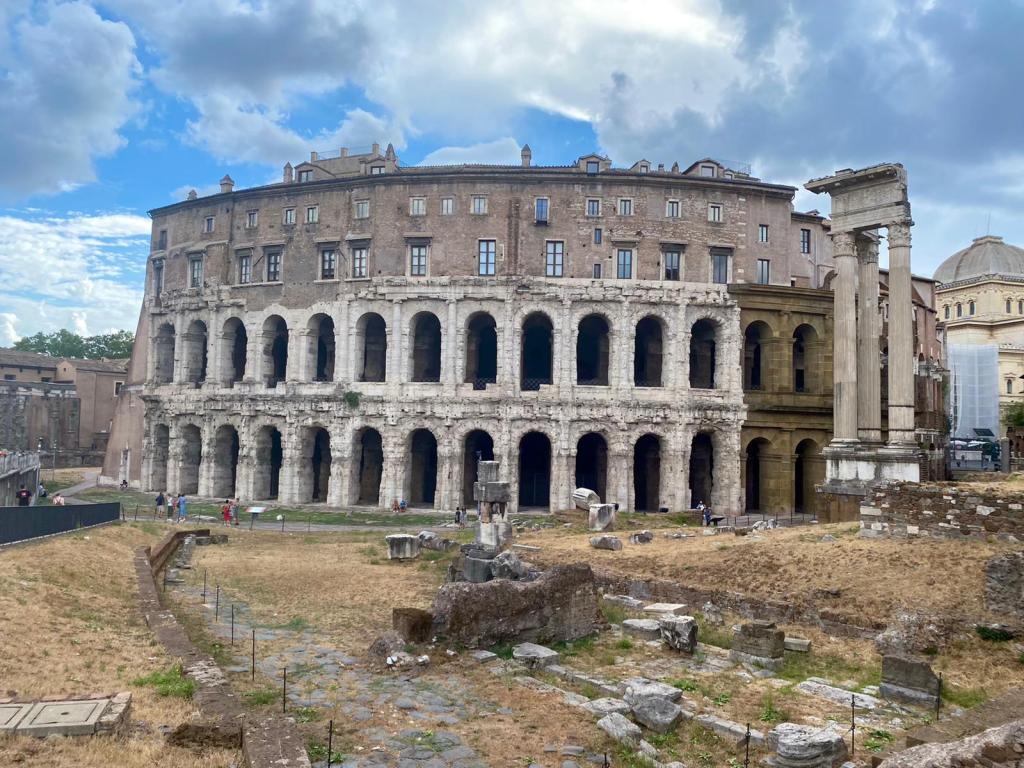
This is not to deny Rome’s eventual role in the development of theatrical entertainment. On the contrary, Rome’s role becomes clearer and more historically precise when properly contextualised within a broader narrative. The construction of the Theatre of Pompey in 55 BCE marked a decisive moment, signalling the acceptance of a permanent theatrical architecture in the city of Rome. Thereafter, from the Augustan period onwards, theatres took on a new scale and significance.
The Theatre of Marcellus in Rome, completed by the Emperor Augustus, along with over 40 new theatres built in cities across Italy, exemplify a phase in which theatrical architecture became increasingly monumental, highly visible, and closely tied to expressions of Roman political power. These buildings reframed theatrical culture and amplified existing practices with an explicitly Roman and increasingly imperial visual language.
Understanding this sequence of events allows us to reassess Rome’s cultural dominance without anachronisms. According to the archaeological evidence, Rome did not lead the early development of theatre in Italy, but inherited, transformed, and ultimately claimed a set of practices that had long been established in Italy. By shifting our attention to other Italian cities during the third and second centuries BCE, we can see early theatre as a complex hub of political, civic and religious life in the peninsula.
This reframing has broader consequences for how we write our histories of Republican Italy and Rome. By bringing archaeology into dialogue with ancient texts, A New History of Ancient Roman Theatre offers a new perspective on how theatrical culture developed in Italy and when and how Rome became a truly dominant political and cultural force in the peninsula. To understand Rome’s later imperial dominance, it seems we first need to look away from Rome.
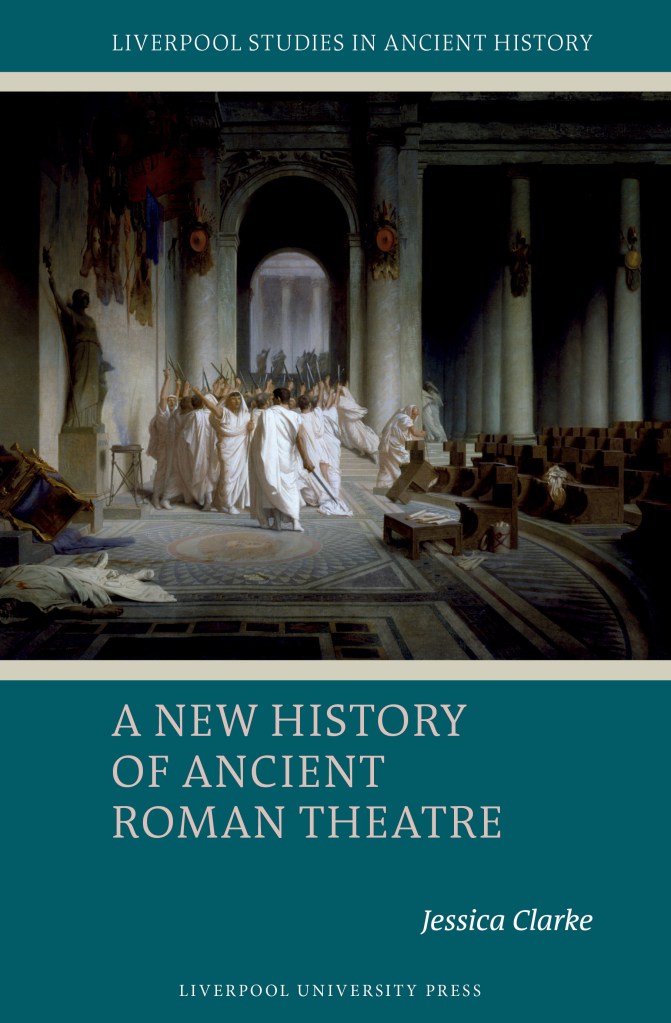
A New History of Ancient Roman Theatre by Jessica Clarke and the digital catalogue of the archaeological material is available via the LUP website here.
You can browse the rest of the Liverpool Studies in Ancient History series here.
Jessica Clarke is a historian and archaeologist specialising in ancient Roman theatre and entertainment culture. She was awarded her PhD by University College London in 2024.

Follow us for more updates
Sign up to our mailing list
Follow us on social media
www.liverpooluniversitypress.co.uk
 Liverpool University Press Blog