

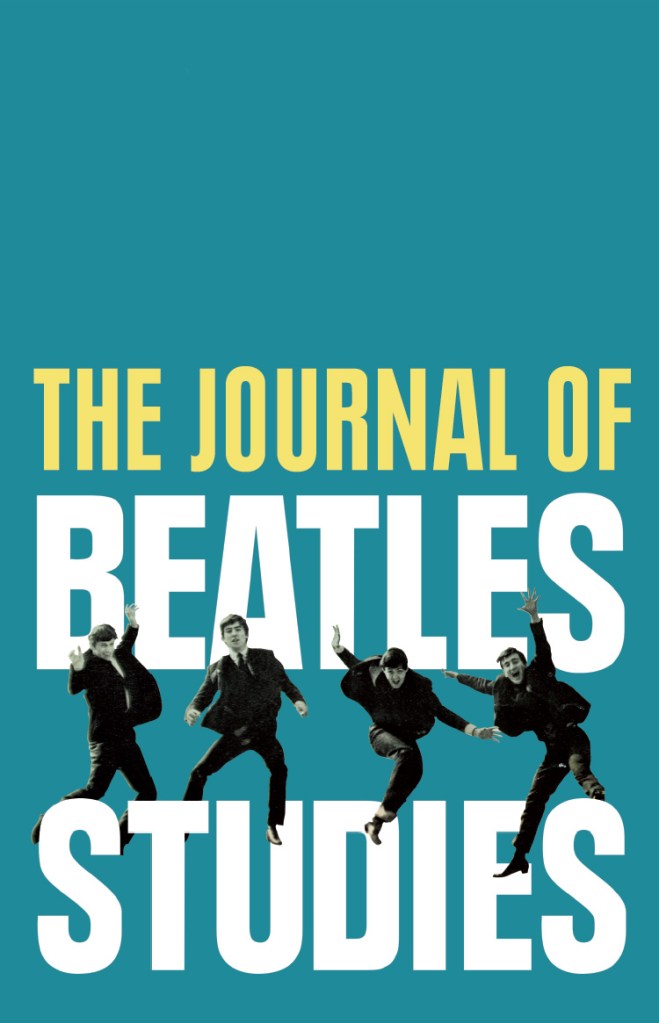
Ahead of the Spring/Autumn 2023 issue of The Journal of Beatles Studies we bring you a special preview of its introduction, written by co-editors Holly Tessler and Paul Long.
They reflect on the nature of Beatles Studies, seeking contributions from across the spectrum of Beatles scholarship, and the potential power of Open Access research to empower readers and contributors alike.
Introduction: Beatles Studies and citizen scholarship
Jyväskylä, Finland, doesn’t have many obvious connections to the Beatles. Yet it was a group of academics at the University of Jyväskylä who, in the late 1990s and early 2000s, made the first serious attempt to develop and define Beatles Studies as a distinct scholarly discipline through a project they called Beatles 2000. Their work yielded two edited collections, the aptly named Beatlestudies 1 (Heinonen et al. 1998) and Beatlestudies 2 (Heinonen et al. 2008 [2002]), as well as an international academic Beatles conference held in Jyväskylä in 2000 with attendant conference proceedings, Beatlestudies 3 (Heinonen et al. 2001). The stated aim of the Beatles 2000 project was ‘to describe and explain the songwriting and recording process of the Beatles, with a special reference to stylistic change’ (Heinonen et al. 2008 [2002]: vii). Volume 1, subtitled ‘Songwriting, Recording, and Style Change’, presents a series of quantitative and qualitative musicological analyses of the Beatles’ music throughout their career. The editors’ hope was that Beatlestudies would promote scholarly research about the Beatles in the same way that ‘Beethoven Studies publications promoted Beethoven research and research on other classical composers’ (Heinonen et al. 1998: iv). But back then, and perhaps even more so today, scholarly research about the Beatles often became a kind of lightning rod for critical opinion. Heinonen et al. note that with the release of their first publication, in Finnish musicology circles and in the Finnish media more broadly:
The book raised quite heated discussion, probably due to the publicity it gained. For example, Janne Makela … criticized the book for leaning on “traditional” musicology and cognitive science at the cost of “new” musicology and cultural studies. Antti-Ville Karja’s review … included somewhat similar tones, but his conclusion was by and large more favourable. Journalist and critic Kari Salminen’s … arrogant attack in Suomen Kuvalehti (the leading ‘quality’ magazine in Finland) replicated Makela’s key arguments with a harsher tone… (2008 [2002]: vi—vii).
In no small measure, this vehemence of feeling arises from the fact that unlike many other areas of academic research, which can often be specialist and niche, there are hundreds if not thousands of scholars as well as millions of fans who all have expert knowledge and very strong emotions about the Beatles and their music: passions run high. Thus it was with evident trepidation that that the editors of Beatlestudies 2 began their new work:
When the team gathered together again after the summer vacation in August 1999, it was unanimously decided that the second volume would concentrate more on themes current in contemporary popular music research and less on cognitive science and statistical methods. (Heinonen et al. 2008 [2002]: vii).
But in seeking to redress the concerns raised their first volume, with the publication of their second Heinonen et al. noted that they and their colleagues received still more criticism that their research on the Beatles had limited relevance to contemporary popular music study; that it reinforced tired stereotypes of the long-standing rock music canon at a time when newer and shinier areas of study demanded attention: ‘“it’s time for academia to leave Dylan, the Beatles and, for that matter, Madonna alone”’ (Buckley cited in Heinonen et al. 2008 [2002]: viii). Perhaps, then, it is unsurprising that in her keynote talk for the Beatles 2000 conference and her subsequent contribution to the third and final Beatlestudies publication in 2001, Sheila Whiteley titled her work, ‘No fixed agenda: the position of the Beatles within popular/rock music’ (Whiteley 2001). In her remarks Whiteley moved through a series of examples of the myriad ways in which the millennium-era world connected with the Beatles: critical reviews and journalism; fan clubs and tribute bands; tourism and heritage; nostalgia, cultural revolution and even hallucinogenics. Academics, she noted, have written about the Beatles in relation to genre, to gender, to cultural studies, history and musicology. Whiteley concluded that Beatles Studies would indefinitely remain a dynamic, expansive and expanding field, reflecting that:
Controversy remains over whether they were a modernist or postmodernist band, a sure indication of their place within academic critical debate, and there is arguably no popular music curriculum without the Beatles being firmly placed as prime examples in the analysis of style and genre. They are equally significant to musicological, historical, and cultural theory and now occupy an ever-increasing number of websites and databases. (2001: 12).
When Jyväskylä’s Beatles 2000 project concluded, scholarship about the Beatles continued to flourish, with an exponential number of publications and outputs released in the nearly quarter of a century since. However, there have been surprisingly few additional examples of sustained collaborative research activity such as Beatles 2000 over the last twenty years. As the Finnish project demonstrates, even when study is delimited by the mandates of a single academic discipline, there can be disagreement among practitioners about approaches, methodologies, theoretical underpinnings and so forth. Those debates (and sometimes disputes) are amplified when there are scholars from many different fields participating. These complexities are compounded further still when researchers outside the academy are involved: industry practitioners, journalists, even fans are all keen to share their work with the wider Beatles community. There have, of course, been a number of successful edited collections, (see, for instance, Womack and O’Toole 2021; Jenkins and Jenkins 2018; Womack and Kapurch 2016), as well as projects, conferences and practice-based research about the Beatles that advance and challenge long-standing narratives and understandings about the group. Nevertheless what Heinonen and his collaborators found to be true in Y2K remains true today: no single method, discipline or approach can fully encompass the breadth and depth of research about the Beatles.
This realization is something that we, as editors of the only scholarly, peer-reviewed journal dedicated exclusively to Beatles Studies, have been grappling with since the journal’s inception: where, how and indeed should we draw boundaries around what we feel constitutes valid areas of studies about the Beatles? Do we, like the Jyväskylä scholars, limit the Beatles research we publish to music and music-adjacent fields? Doing so would self-evidently disregard important emerging scholarship, under-represented voices and new thinking about the Beatles in any number of other contexts. Perhaps, then, we should limit the work we publish by method: seeking only qualitative research that sites the Beatles in the arts, humanities and social sciences; or conversely, those works that evidence their findings quantitatively. Clearly these kinds of binary, either—or approaches to framing scholarship about the Beatles are both unhelpful and exclusionary. And what of researchers who are outside the academy, either through circumstance or by choice? As an open-access journal, it would go against the grain of our remit to discount the voices, findings and experiences of those whose work is intended for non-scholarly audiences. Yet if our boundaries are too porous, how can we assure the quality and rigour of the work we publish? What would distinguish a scholarly, open-access journal from a Beatles fan publication, blog or website? These are issues that are not unique to Beatles Studies. New fields of academic discourse, especially when they intersect with popular culture and contemporary events, struggle to find their footing. Looking back at early scholarship in fields such as music industries studies, popular music and even media studies evidences this point. It is often journalist-scholars who first help to bridge the chasm between popular and scholarly discourse. For instance, music writers including Dave Laing, Simon Frith and Robert Christgau were, and remain, some of the earliest and most influential thinkers in establishing Popular Music Studies as a vibrant and interdisciplinary field of scholarly research.

This trajectory from mainstream to critical study has not been lost on us. In this issue, we have selected a range of articles that we feel is reflective of the vast diversity of proposals we receive. We have intentionally sought out voices from within and beyond the academy with the express purpose of offering a platform not only to ‘traditional’ scholars but also to those researchers for whom the route to academic and peer-reviewed publication is typically unavailable. This is not an altruistic exercise. Instead, it is intended to highlight the extensive amount of scholarship that is currently being undertaken about the Beatles, their music, their lives and their legacy as a means of beginning to think about ways of framing and making sense of all of these diverse and sometimes disparate ideas. To understand Beatles Studies as an entirely new field of endeavour would be to discount the innumerable studies published in the seven antecedent decades. Yet since Beatles 2000 there have been few successful and sustained efforts to bring together and attempt to coalesce a distinct field of scholarship about the Beatles: one that is not based on the methods, practices and discourses of other disciplines, but that creates its own set of principles, guidelines and debates: Beatles Studies. In the University of Liverpool’s MA The Beatles, Music Industry and Heritage as well as through this journal, understanding and contextualizing Beatles scholarship not as seen through the lenses of fields such as musicology, literature, management, statistics, sociology or computing, but through the unique and collective interdisciplinarity and hybridity of the practices that these — and others — bring to this nascent discipline of Beatles Studies is something that we hope will continue to crystallize over the ensuing years and decades, to the point where, like Media Studies, Video Game Studies and Gender Studies before it, it is not seen as a flight of academic fancy but as a legitimate and valuable field of research and scholarship.
Thus, in presenting this double issue of the Journal of Beatles Studies, we have intentionally sought work from across the spectrum of Beatles scholarship, inviting work from those within the academy but especially those beyond, whose practice we have termed ‘citizen scholarship’, adapted from the concept of participatory or citizen journalism, which Bowman and Willis have defined as ‘the act of a citizen, or group of citizens, playing an active role in the process of collecting, reporting, analyzing and disseminating news and information’ (2003: 9). This approach chimes with Raphael Samuels’ description of history as ‘a social form of knowledge; the work, in any given instance of a thousand different hands’ (1994: 8). His attention to public history as democratized, often personal, localized practice, and knowledge as produced by individuals and communities at grassroots level, while contrasted with the protocols of the professional historian, was not conceived at the expense of the latter.
Through citizen scholarship, then, we aim to shine a light on the potential power of open-access research. As editors we do not see our role as intermediaries or gatekeepers of Beatles Studies. Instead, we see ourselves as facilitators: of ideas, of discourse, of issues that are of significance to anyone who has an interest in critical thinking and scholarship about the Beatles. In deciding whether to publish work, our most important evaluative criterion is simply whether the piece presented provokes and challenges us and, we hope, our readers, to new ways of thinking and understanding the Beatles. In a way, this approach affords us the indulgence of having our cake and eating it: it is simultaneously top-down and grassroots research, informed as much through formal scholarly inquiry as it is community-led and experientially motivated. It is our intention that this approach should be one that is truly open-access in every sense: one that both platforms and empowers readers and contributors alike.
In the first article of this issue, Mark Duffett presents a critical analysis of Cass Sunstein’s concept of ‘informational cascades’ (Sunstein 2022) as a way of understanding the phenomenon of Beatlemania. Duffett posits that Sunstein’s ‘romantic behaviouralist’ approach alone is insufficient to account for the wider and more individualized aspects of fandom and fan behaviour. Bethany Easton is also concerned with aspects of Beatles fandom through her concept of ‘Reatlemania’. Drawing on ethnographic and auto-ethnographic research based on her own experiences as a locum caretaker of 20 Forthlin Road, the former McCartney family home in Liverpool now owned by the National Trust, Easton argues that through the varied ways in which Paul McCartney has engaged with the Beatles’ legacy, twenty-first-century fans have had new opportunities to emulate the experiences and emotions of 1960s Beatles fans, through a cycle of reflection, repetition and recreation: what she terms Reatlemania.
The next two articles share a similar quantitative method in exploring the creative evolution of the Beatles’ development as songwriters and musicians. David Pannell takes a holistic approach in analysing elements such as song structures, song topics, the participation of each musician in recording sessions and the type of instruments played. His research demonstrates emergent shifts in aspects of the Beatles’ music and compositions over time. Where Pannell’s study surveys the Beatles’ musical catalogue through a range of criteria, Jones, Knights, Padilla and Rodriguez concern themselves specifically with a quantitative accounting of the Lennon—McCartney songwriting partnership. Adopting a method of statistical, computational and mathematical modelling, the authors develop an algorithm for determining which elements and how much of each song in a selected sample of Lennon—McCartney compositions each songwriter contributed. Both articles argue that quantitative analyses provide a new approach and a more robust body of evidence about the inherent innovation and creativity within the Beatles’ songs than a qualitative discussion could yield.
Freelance journalist and author Jonathan Knott investigates the period in July 1967 when the Beatles considered buying a Greek island. Situating this little-discussed moment in Beatles history against the backdrop of a military coup, Greece’s aspirations to a tourism-based economy and the state of Anglo-Greco political relations all contributes to an illuminating account of how the Beatles’ cultural power and global influence — what Knott terms their ‘celebrity diplomacy’ — helped to influence a complex matter of 1960s European geopolitics.
Sign up to our mailing list to be kept up to date with all Journal of Beatles Studies news >
This issue’s ‘Across the Universe’ section reflects on a range of significant developments in Beatles Studies and history. Journalist and BBC Radio 4 presenter Samira Ahmed recounts her recent scoop in unearthing a never-before-heard recording of a live performance by the Beatles at Stowe School in April 1963. Heartwarming and heart-stopping in equal measure, Ahmed’s story transports us back to the explosive energy of early Beatlemania. But more than that, her article raises questions of class and gender that bedevilled British society of the era, and arguably continue to do so. February 2023 marked both the 90th birthday of Yoko Ono and what would have been the 80th birthday of George Harrison. To commemorate these milestones, authors Peter and Laura Smith reflect on ‘The night we danced with Yoko’ in a personal essay that intertwines an exploration of Ono’s beliefs and philosophies with the experience of taking part in one of her performance art pieces. Mike Jones presents an overview of the varied series of events in Liverpool organized to commemorate and celebrate Harrison’s birthday. Continuing the thematic thread between Liverpool and the Beatles, Peter Robinson contributes original poetry about his own experiences of coming of age in Liverpool, just a few years after the Beatles themselves. Paul Levinson similarly reflects on how podcasts influence the lives of Beatles fans today in ways that are both familiar and yet wholly apart from the ways in which the Beatles served as the soundtrack to important moments in his youth.
Reviews in this issue feature include a contribution from John Lyons, who takes a look at Bob Kealing’s 2023 book Good Day Sunshine State: How the Beatles Rocked Florida. Mark Donnelly reviews Dylan, Lennon, Marx and God by Jon Stewart (2022). Yoko Ono: An Artful Life (2022) by David Brackett is reviewed by Stephanie Hernandez. Katie Kapurch contributes an extended survey of Kozinn and Sinclair’s substantial work, The McCartney Legacy, Volume 1: 1969—1973 (2022). Both Bethany Easton and Nicolette Rohr review books about the Beatles and film. Easton considers Steve Matteo’s Act Naturally: The Beatles on Film (2023) and Rohr discusses The Beatles and Film: From Youth Culture to Counterculture (2021) by Stephen Glynn.
The range of original academic research, citizen scholarship, critical reviews and surveys attests to a wealth of approaches to what Beatles Studies presently encompasses. It is rigorous, inclusive and, of course, inquisitive. What is needed to nurture and sustain the field is further dialogue and debate, to which this journal remains receptive.
Holly Tessler, University of Liverpool, U.K.
Paul Long, Monash University, Australia
Co-Editors, the Journal of Beatles Studies
Bibliography
Bowman, S. and C. Willis (2003) We Media: How Audiences are Shaping the Future of News and Information (Reston, VA: The Media Center at The American Press Institute).
Buckley, D. (2002) ‘The year’s work in critical and cultural theory’, Popular Music 10(1): 122—134.
Heinonen, Y., T. Eerola, J. Koskimäki, T. Nurmesjärvi and J. Richardson (eds) (1998) Beatlestudies 1: Songwriting, Recording, and Style Change (Jyväskylä, Finland: Department of Music, University of Jyväskylä).
Heinonen, Y., J. Koskimäki, S. Niemmi and T. Nurmesjärvi (eds) (2008 [2000]) Beatlestudies 2: History, Identity, Authenticity (Jyväskylä, Finland: Department of Music, University of Jyväskylä).
Heinonen, Y., M. Heuger, S. Whiteley, T. Nurmesjärvi and J. Koskimäki (eds) (2001) Beatlestudies 3: Proceedings of the Beatles 2000 Conference (Jyväskylä, Finland: Department of Music, University of Jyväskylä).
Jenkins, H. and P. O. Jenkins (eds) (2018) Teaching the Beatles (Boca Raton, FL: Routledge).
Kärjä, A-V. (1999) ‘Beatles Jyvaskylassa; miksipa ei?’ [The Beatles in Jyväskylä: why not?] in Heinonen et al. (2001).
Makela, J. (1999) ‘Klassikko sellaisena kuin se on?’ [A classic as it is?], in Yrjö Heinonen, Tuomas Eerola, Jouni Koskimäki, Terhi Nurmesjärvi and John Richardson (eds), Musiikin suunta (Jyväskylä, Finland: Department of Music, University of Jyväskylä).
Salminen, K. (1999) ‘Tutkimus on pop’ [Research is pop], Suomen Kuvalehti 45.
Samuels, Raphael (1994) Theatres of Memory: Past and Present in Contemporary Culture (London: Verso).
Sunstein, C. R. (2022) ‘Beatlemania: on informational cascades and spectacular success’, Journal of Beatles Studies 1(1): 97—120.
Whiteley, S. (2001) ‘No fixed agenda: the position of the Beatles within popular/rock music’, in Heinonen et al. (2001: 3—14).
Womack, K. and K. Kapurch (2016) New Critical Perspectives on the Beatles: Things We Said Today (London: Palgrave Macmillan).
Womack, K. and K. O’Toole (eds) (2021) Fandom and the Beatles: The Act You’ve Known for All These Years (New York: Oxford University Press).
MAY WE SUGGEST: Music, Sound, and the Moving Image: audiovisual essays as videographic film criticism

Follow us for more updates
Sign up to our mailing list
Twitter | Instagram
www.liverpooluniversitypress.co.uk
 Liverpool University Press Blog