
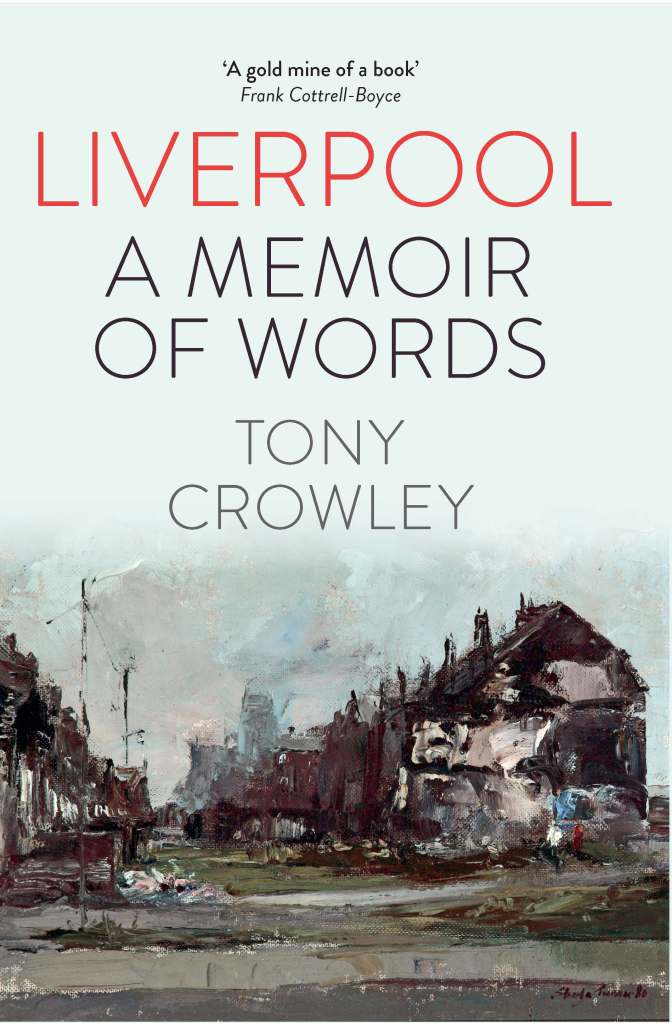
The author of The Liverpool English Dictionary and Scouse: A Social and Cultural History has a new book publishing with LUP on 1st November. Tony Crowley’s Liverpool: A Memoir of Words is a work of creative non-fiction that combines the study of language in Liverpool with social history, the history of the English language and personal memoir. Beautifully written, and based on a lifetime’s academic research, it will educate and delight Liverpudlians, students of language, and social historians alike. Ahead of the book’s publication and the book launch at Liverpool Irish Festival on Friday 27th October, we caught up with author Tony Crowley to hear more about this new work.
Liverpool: A Memoir of Words is your third book on the language of Liverpool. Did you set out to write a trilogy?
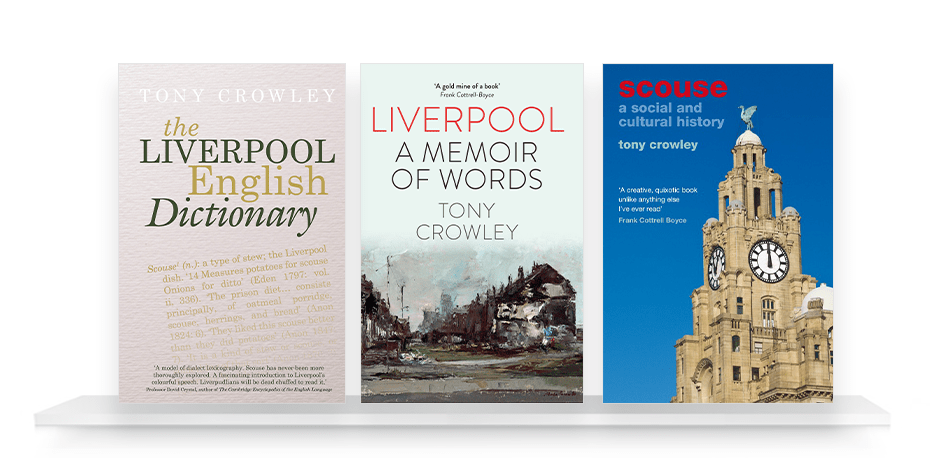
Hah, no – really not! I do other sorts of work – I have a book on the murals of Northern Ireland coming out next year – but the three Liverpool books are inter-related and form part of a research project that effectively goes back to my undergraduate days at Oxford University. I came from a Liverpool working-class background so as you can imagine, Oxford was something of a strange place in all sorts of ways. But it was in relation to language (and what we now call cultural capital) that I was most made to feel an outsider. I kept on coming across words that we used at home but that weren’t used in the university context, or words that seemed to be stigmatised in different ways, and of course there was a lot of reaction to the way I spoke (ranging from people doing impressions to straightforward antagonism). Anyway, I suppose I realised at that point that there was something special about Liverpool English and I started keeping a record of words, phrases, ways of saying things. And then towards the end of my degree, I did a course in the History of the English language, which I found fascinating, and that led to a D.Phil on ‘Standard English’ and the politics that surround it. That became my main focus for quite a while, and I was involved in a lot of the educational language debates in the 1990s. But in the background, all through that time, my interest in Liverpool English never waned and I just kept building the archive and thinking about it from time to time. And from that work, eventually, I produced Scouse: A Social and Cultural History (2012), The Liverpool English Dictionary (2017), and now Liverpool: A Memoir of Words – all with LUP!
But the books are very different?
Well, as I say, they came out of the same over-arching research project, but yes, they are very different books. Scouse is an historical study, though it includes some theoretical work in sociolinguistics, and its aim is to challenge the popular and mis-leading story of Liverpool English that I grew up with but which, as it turns out, is false. The Liverpool English Dictionary is what it says on the cover: a list of Liverpool words with their etymologies and their different senses over time. The title mimics that of the Oxford English Dictionary deliberately – I used the OED methodology in my research for the LED. Liverpool: A Memoir of Words is different from the other works. They were strictly academic and deployed traditional and cutting-edge research in order to make a contribution to a set of important debates around language in Britain, particularly in relation to ‘dialects’ (or as I prefer to call them, ‘local vernaculars’). LAMoW is distinctive in that it tries to combine academic research with an experiential account of what it was like growing up in Liverpool at a particular moment in history and speaking the language of that place.
As you say, Liverpool: A Memoir of Words is an innovative book in terms of form and content. Could you say something about how you came to write it?
Yes, it is innovative. Although it has a traditional format in one sense (A-Z, starting with ‘Ace’ and ending with ‘Z-Cars’), it tries to do something new by combining three distinct approaches – the study of linguistic history, social and cultural history, and personal memoir. In my earlier works on Liverpool English, I adopted a relatively straightforward academic approach with the aim of producing substantive research. In LAMoW, I wanted to present an account that is based at least in part on the experience of someone who learned Liverpool English and then carried it with him in his journey through education, a career in British and American universities, and life in general. I’m firmly convinced that the best research has a personal motivation – there always has to be something of the researcher in the work – but in this book I wanted to foreground my experience and to explore it as a way of thinking about Liverpool English, language in contemporary Britain, and the often problematic ways in which both are studied.
What’s the most important thing that people might take from the book?
Well, there are two complementary things. The first is serious: I hope that the book shows that that the language of Liverpool is a complex, fascinating, and living vernacular form – well deserving of respect. The second is joyous: I hope that the book illustrates the creative, humorous and frequently irreverent aspect of Liverpool’s language and culture. Liverpool is a place of language and laughter – I would be made up if Liverpool: A Memoir of Words manages to convey that.
Find out more about Tony Crowley’s new book Liverpool: A Memoir of Words on our website or join us at the author’s event at Liverpool Irish Festival, Liverpool English with Tony Crowley, on Friday 27th October.

Follow us for more updates
Sign up to our mailing list
Twitter | Instagram
www.liverpooluniversitypress.co.uk
 Liverpool University Press Blog