
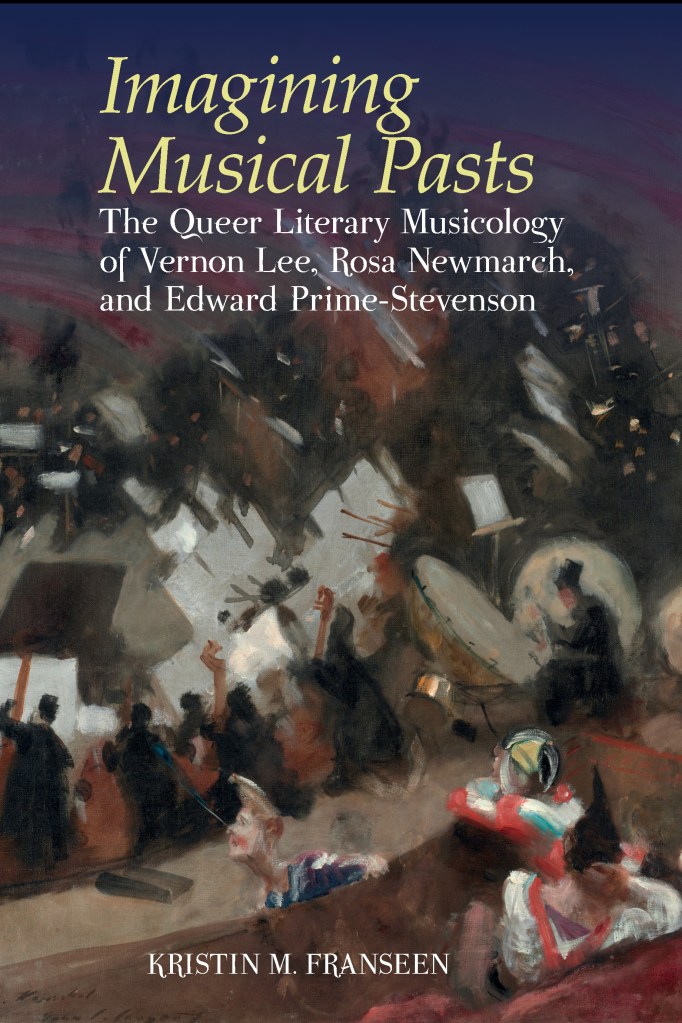
New from Clemson University Press, Imagining Musical Pasts: The Queer Literary Musicology of Vernon Lee, Rosa Newmarch, and Edward Prime-Stevenson explores the complicated archive of sources, interpretations, and people present in queer writings on opera and symphonic music from ca. 1880–1935. In this blog post, author Kristin M. Franseen introduces her book’s serious use of “informal sources” (gossip, anecdote, speculation) and the importance of these traces in reading queer history.
Gossip about musical celebrities and well-known works is nothing new. It long predates the online social media platforms of the twenty-first century, the twentieth-century phenomenon of the gossip magazine and unauthorized autobiography, and most long-established elements of the current music industry. Even if we limit ourselves to surviving written and/or printed sources, anecdotes on the lives of famous performers and composers emerged alongside popular interest in biography and music criticism as media. Such stories served a wide variety of functions—including to make or break someone’s reputation, to advertise upcoming performances, to provide moral lessons for children, and (of course) to shock or titillate with supposed scandals or secret knowledge.
Musicology conventionally views the use of gossip, rumour, or anecdote with a healthy dose of scepticism and suspicion. While these sorts of stories were often formative to early biographies of canonical composers, they also frequently contradict established historical sources and tell us more about the person repeating (or creating) a particular piece of gossip than they do its subject. One might consider, for example, the numerous anecdotes and nicknames attached to performances of particular Haydn symphonies. While some of these are well-documented and date from Haydn’s lifetime, others emerged after the fact and clearly reflect later nineteenth-century images of Haydn’s personality, career, and place in the German musical canon (not to mention assumptions about how late eighteenth-century orchestral music was performed and received).
It can be easy to dismiss these sorts of stories as overly simplistic and anachronistic. Yet even an account that turns out to be dubious or wholly untrue reveals something about the stories we tell about music. What are we do to do, for instance, with gossip, anecdote, and other unreliable sources (whether accurate or otherwise) that reflect some kind of marginal or marginalized musical knowledge? In the case of many queer histories, the kinds of archival documentation of specific individuals, communities, and scenes that might conventionally be used as “evidence” is often incomplete, unsympathetic, or just plain absent. Surviving traces of historical rumours by and about queer musical experiences reflects a kind of counter history that could be important to those who shared it, even when it does not necessarily align with historical sources. In Imagining Musical Pasts, I follow some of these traces through different literary genres (including both fiction and nonfiction), perspectives, and ways of reading queer history.
Take, for instance, stories surrounding Piotr Tchaikovsky’s Symphony No. 6 (popularly known as the Pathetic or Pathétique). For several decades following Tchaikovsky’s death in 1893, popular gossip (particularly in Anglophone commentary) linked the work to rumours of the composer’s homosexuality, supposed depression, and apocryphal claims of blackmail and/or suicide. Both critical and credulous biographers reacted to these ideas in constructing their particular image of Tchaikovsky. Gay figures such as sex reformer and socialist Edward Carpenter and music critic Edward Prime-Stevenson saw Tchaikovsky as evidence of queer contributions to the arts (although they would have course not have used that terminology). More homophobic commentators—such as the main character in James Gibbons Huneker’s Old Fogy (1913), a parody of conservative music criticism—read immorality and decadence into Tchaikovsky’s works (often using the loaded euphemism “morbid”). Rosa Newmarch, one of Tchaikovsky’s first English biographers, was critical of those who saw in the Pathétique evidence of Tchaikovsky’s supposed suicide, although she was also clearly very aware of her readers’ interest in the subject. And while Newmarch herself was careful in not overtly addressing the issue of Tchaikovsky’s sexuality (or, indeed, her own) in her public-facing writings, some of her readers—most famously E.M. Forster (who privately credited her as inspiring the discussion of Tchaikovsky in his novel Maurice)—clearly read the subtext back into her work.
Nor was queer gossip necessarily limited those composers now understood to have led queer lives. Prime-Stevenson, a music critic in New York City during the 1880s and 1890s before moving to Europe and writing two books on the history of homosexuality under the pseudonym “Xavier Mayne,” wrote at some length about what we might consider queer musical subtext that could be heard without conscious understanding. He claimed in his The Intersexes: A History of Similisexualism as a Problem in Social Life (ca. 1909) to hear “revelations of a sentimental-sexual kind” in the Pathétique, as well as in “legendary in-reading” of Beethoven’s Piano Sonata, op. 111 and “the ultimate voices in a homosexual message in symphonic music” in works by Brahms and Bruckner. In his criticism (published under his own name), Prime-Stevenson hinted at queer readings of composer biographies, emphasizing Brahms’s supposed masculine appeal and “psychosexual secrets” in Schubert’s relationships. Other queer commentators were more skeptical of seeming links between supposed musical meaning and composer biography. In her massive music perception study Music and its Lovers (1932), Vernon Lee mused that many of her survey respondents might have their experiences of specific musical works shaped by popular knowledge of the composers’ lives. This was also true of living composers during this period—Ethel Smyth, for example, was aware of how her gender nonconforming image affected her celebrity as much if not more than her fame as a composer. While her lesbianism is not openly discussed in her published memoirs, she observes in As Time Went On… (1936) how her choice of dress, activities as a suffragette, and status as a composer and conductor of large-scale works contributed to her status as a public figure.
Rumours of supposed secret messages in popular symphonic music and operas provided queer listeners with a shared body of musical works and biographical and historical knowledge that seemed to lurk beneath the surface of mainstream musical tastes. While such rumours are not necessarily to be taken as historical fact, they represent evidence of a kind of queer musical listenership and queer readership for music history and theory, composer biography and memoir, and musical fiction long before such topics could be discussed more openly in either scholarship or popular media. Imagining Musical Pasts centres these interpretations as an important element of early twentieth-century musical community, identity, and experience.
Kristin M. Franseen is a FRQSC postdoctoral fellow at Concordia University, where she is also a research associate with the Simone de Beauvoir Institute. She received her PhD in musicology from McGill University in 2019. Articles stemming from her dissertation appear in Music & Letters, 19th-Century Music, and the Cahiers de la Société québécoise de recherche en musique. Her research focuses on the role of gossip, anecdote, and fiction in the history of musicology and composer biography. She is currently at work on two projects: (1) a critical look at music critic and amateur sexologist Edward Prime-Stevenson’s record collecting and self-publishing activities and (2) an examination of Antonio Salieri’s literary reception history.
Imagining Musical Pasts is available to order on our website.

Follow us for more updates
Sign up to our mailing list
Twitter | Instagram
www.liverpooluniversitypress.co.uk
 Liverpool University Press Blog