
Crises are a permanent feature of the human condition. Unavoidable, ever-present; increasing in frequency, seemingly — in 2022, Collins Dictionary crowned ‘permacrisis’ as its word of the year. (Its word of the year for 2023 is ‘AI’, which itself portends further crises of apocalyptic proportions; there is a very possible scenario, according to some experts, where AI will take over the earth and destroy its human creators. When asked about this, ChatGPT assures us its intentions are pure — it will be a benevolent god.) Crises threaten and disrupt our daily lives, upend our economies and lead to breakdowns within our societies, so the better we can understand them, deal with them and foresee them, the greater our resilience.
To this end, we can stretch our views both backwards and forwards from the present moment. In looking to the future, academics, data boffins and ‘superforecasters’ attempt to predict when and where the next crisis will appear, with varying degrees of success. Such predictions relate to future pandemics, environmental breakdowns, regional conflicts, and much more, and pressure groups urge politicians to do more than just holdfast and keep the ship afloat (as if, following the predictions of Asimov’s psychohistorians, we must bounce from one crisis to another, each a milestone on the path towards some end point in history when everything will somehow get better).
Looking backwards, historians write histories of people in crises, focusing on themes that affect our present moment. Yes, I am one of them — Crisis and Resilience looks at how sugar merchants in Bristol coped with warfare, political change, and other hazards that impacted their day-to-day business activities. While this is of interest in itself, and helps deepen our understanding of the past and, according to the principles of path dependency, the present, at some level we are supposed to learn lessons that will help us avoid making similar mistakes in the future. The problem with learning from the past to help guide our way through the future is that the people we study and the choices they made are so heavily impacted by their situation and context: their histories and path dependency, the extant technology of the time, their ecology.
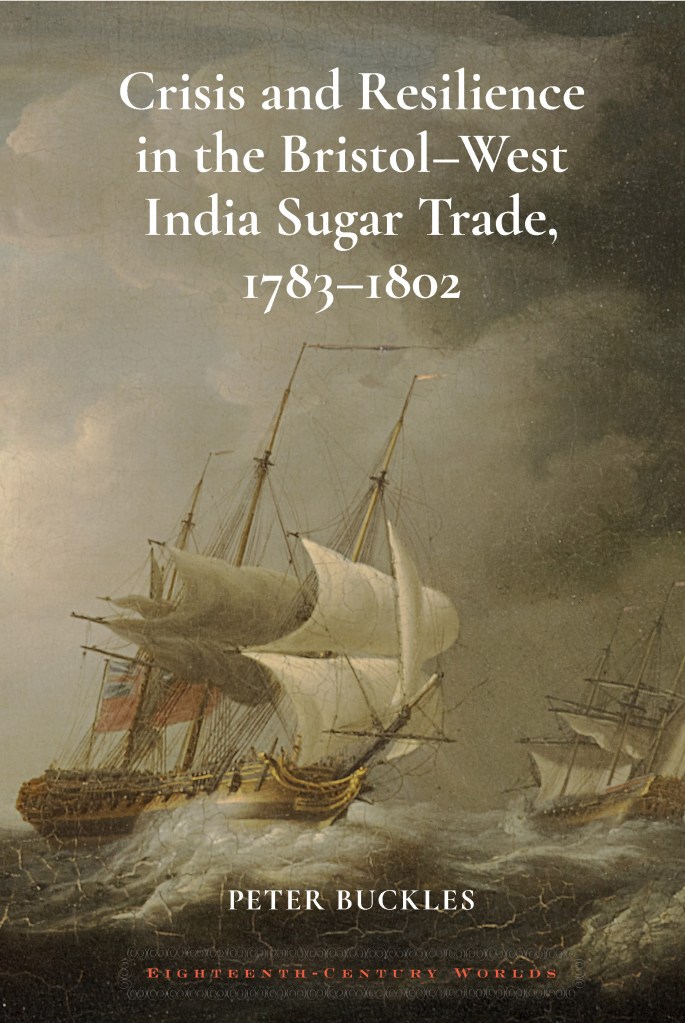
At the very least, looking at the choices they made from the options they could see can help us frame our understanding of the present. The merchants who feature in Crisis and Resilience were a cautious lot, though not all, and not in the same way, who eschewed risk and sought careful and steady profit from tried and tested routes of commerce. This in stark contrast to today, one might suggest, where Silicon Valley-style moonshots and high-risk, high-reward strategies abound. Indeed, in the late-eighteenth century economy (following in particular the South Sea Bubble), excessive risk taking was not just frowned upon but, in an interconnected, decentralised economy made up of small firms and bound by personal reputation, was considered immoral. People who took big risks and overdrew their accounts were duly scorned when this led to their inevitable failure and bankruptcy.
In our present world of faceless firms and rampant corporatism, one must be wary not to romanticise the personalised business of the past. Low-risk, reputation-based commerce was not the only factor that contributed to economic resilience. The eighteenth century economy, at least in the Euro-Atlantic sphere, was built upon enslaved labour. The success of sugar merchants especially, and their resilience during times of crisis, was founded in no small measure upon the exploitation of African people, forcibly enslaved and trafficked to the West Indies. Merchant wealth was driven by the sale of sugar (the price of which rose dramatically during wartime), and consumption in the Americas drove the expansion of manufacturing in Europe. In Britain, this stalwart growth combined with high taxation, along with financial tools and institutions that had matured in the transatlantic trades, contributed to its success in the French Wars.
What can we learn from such a past? Seeking to emulate successes and avoid repeating mistakes, all the while addressing historical inequalities and rectifying historical wrongs that echo inexorably through to the present, is a monumental task. It is a task that must be faced head on, however, and the role and historians is to analyse and explain the past so that we might undertake such an endeavour. Crisis and Resilience contributes, in its own way, to this important mission.
Peter Buckles is a historian, writer and data scientist currently working in academic publishing. He received his PhD from the University of Liverpool in 2021 and published his first article on historical social network analysis with Enterprise & Society in 2022. He has presented his research at numerous conferences, and his passion for finding novel methodologies to explore historical questions has manifested in a chapter published in Business News in the Early Modern Atlantic World, edited by Sophie Jones and Siobhan Talbott.
Find out more about Peter Buckles’ new book Crisis and Resilience in the Bristol-West India Sugar Trade, 1783-1802 on our website.

Follow us for more updates
Sign up to our mailing list
Twitter | Instagram
www.liverpooluniversitypress.co.uk
 Liverpool University Press Blog