
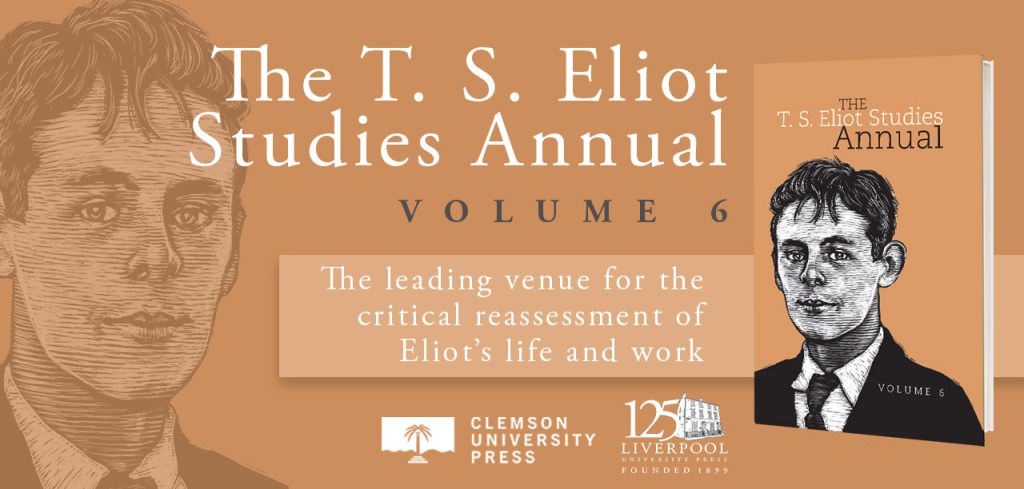
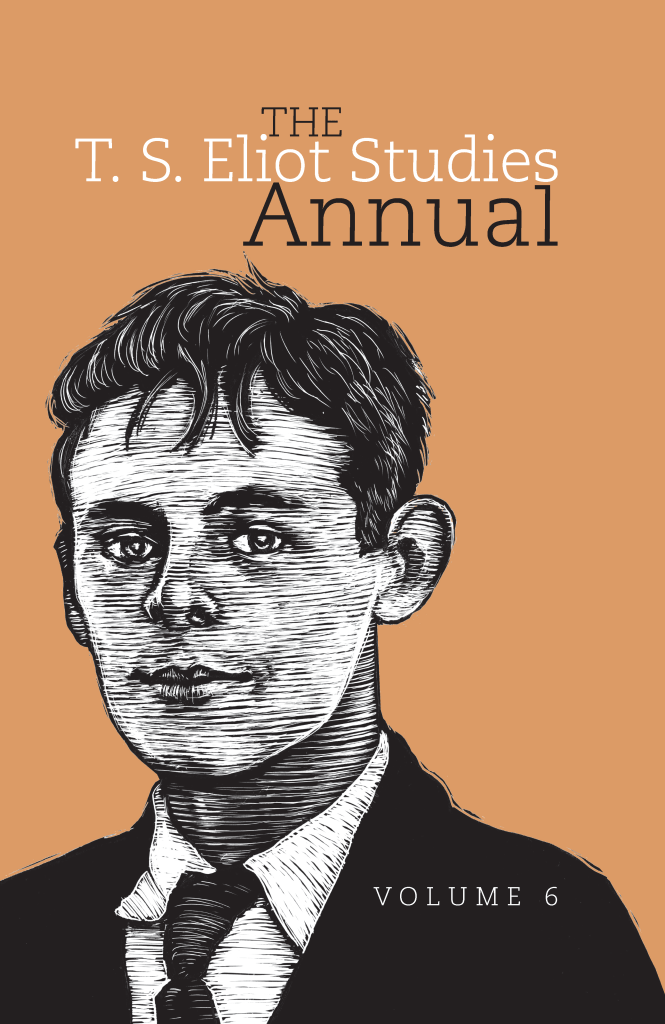
To celebrate the release of the latest issue of The T. S. Eliot Studies Annual (Volume 6), we are showcasing an article by Anita Patterson titled ‘T. S. Eliot’s Black Arts Legacy: Robert Hayden, the Middle Passage, and The Waste Land‘ which is featured in Volume 6 of The Annual. The article is free to read via the LUP website throughout July-August 2024, in tandem with the activities of the T. S. Eliot Summer School for 2024.
This article is part of a larger project that explores how the legacy of T. S. Eliot’s modernism figured in the development of a poetics of social critique in works by Robert Hayden, Gwendolyn Brooks, Melvin Tolson, and LeRoi Jones/Amiri Baraka during the Black Arts Movement. Instead of turning to an oversimplified mythology of Black consciousness and its affirmation of militant racial separatism during the 1960s, I attempt to show how placement of Eliot’s works in dialogue with Hayden’s poetry can open new perspectives on The Waste Land; and, in turn, to consider how Eliot helped to foster one of the richest periods in Black American political and cultural history.
Decades ago, in a groundbreaking 1988 study, Henry Louis Gates postulated that the concept of “motivated Signifyin(g)” could be used to denote an oppositional mode of cross-racial repetition and revision that allowed Black authors to “enact and recapitulate the received, classic confrontation between Afro-American culture and American culture.” Writing at a time when theories of intertextuality and revisionism formulated during the early 1970s—such as Walter Jackson Bates’s “burden of the past” and Harold Bloom’s “anxiety of influence”— still prevailed and focused primarily on British, Irish, and white American authors, Gates’s intention was to explore how new works of Black American literature engaged, revised, and entered this canon of monuments, much in the spirit of Eliot’s “Tradition and the Individual Talent.” “Motivated Signifyin(g),” Gates explained, “functions to redress an imbalance of power, to clear a space, rhetorically […]. Writers Signify upon each other’s texts by rewriting the received textual tradition […]. This sort of Signifyin(g) revision serves, if successful, to create a space for the revising text. It also alters fundamentally the way we read the tradition, by defining the relation of the text at hand to the tradition.” Building on Gates’s work, Ed Pavlic conceived of “syndetic homage” as a mode of revisionary engagement that allows for “cross-racial resonances that do not deny racial dissonance but […] generate at least the beginning of a call and response discussion in the place where racial and cultural traditions meet.” In my article, I read Hayden’s “Middle Passage” as a syndetic homage to The Waste Land, and explore how, through his act of Signifying, Hayden discloses a crucial, suppressed feature in Eliot’s poem, illuminating that “Death by Water” is haunted by the cataclysm of the Middle Passage.
Born in Detroit in 1913, Hayden by his own account knew nothing about Eliot when he was a student at Detroit City College in the early 1930s. He began his more serious and systematic study of Eliot’s poetics when, in 1941, he enrolled in the MA program at the University of Michigan and met W.H. Auden, an experience that dramatically transformed his style. Thus far, the poem by Hayden that has received the most scrutiny regarding his attraction to Eliot’s modernism is “Middle Passage,” which he began to compose while studying with Auden and originally published in 1945. This narrative poem depicts the atrocities of the transatlantic slave trade with a focus on the 1839 mutiny aboard the Amistad led by Joseph Cinqué (also known as Cinquez), telling the story of the Africans onboard who, after the Amistad eventually landed in Montauk, Long Island, were arrested and imprisoned in New Haven, and whose legal journey ended successfully after John Quincy Adams defended and won their case before the Supreme Court in 1841.
Michael Harper has memorably described Hayden’s “Middle Passage” as an “answer” to The Waste Land. Engaging with his work, I explore how Hayden’s variations on Eliot’s variations on Ariel’s song from The Tempest, and especially Hayden’s concern with the enslaved father’s corpse and the Middle Passage shed new light on Eliot’s suggestive Shakespearean allusions, as well as the drowning of Phlebas the Phoenican in “Death by Water.” Eliot’s tacit concern with the profit and loss of the slave trade in “Death by Water” is foregrounded when we
recall that the Phoenicians discovered and operated tin mines in the British Isles that were brutally worked by slave labor, and their empire comprised a vast confederation practicing expansive maritime trade in the ancient world that included slaves. In addition, I discuss how the stratification of allusions in Hayden’s Signifying project underscores the significance of two other influences in The Waste Land, namely, Samuel Taylor Coleridge’s “The Rime of the Ancient Mariner,” a poem that has been extensively studied as an indictment of the slave trade; and “The Slave-Ships,” by John Greenleaf Whittier. A founding member of the American Anti-Slavery Society who served a term in the Massachusetts legislature, Whittier was not only one of the best-known New England abolitionist poets of his era, he was also Eliot’s 4th cousin twice removed. As Eliot and Hayden would both have been aware, Whittier acknowledged his indebtedness to “The Rime of the Ancient Mariner” in the 1838 edition of his Poems by including a quotation from Coleridge on the book’s title page. The shared preoccupation with slavery and the Middle Passage in Coleridge and Whittier demonstrates a close affinity with The Waste Land, especially when we consider Eliot’s portrayal of the doomed New England fishermen in the discarded early draft of “Death by Water.” Although this journey depicted in the draft is northward, towards the Arctic, not towards the Antarctic, as in Coleridge, Eliot’s phrase, the “long white line” recalls the “line” approached in Whittier’s “The Slave-Ships” as well as the reference to a “Ship having passed the Line” in the argument of “The Rime of the Ancient Mariner.”
Reading Hayden’s “Middle Passage” as a syndetic homage to The Waste Land has been invaluable and transformative insofar as I’ve gained new insights into Eliot’s poem by shifting relations among the existing traditional order of monuments. Acknowledging this crucial but neglected aspect of Eliot’s legacy, I can now better explain how poems by Hayden, Brooks, Tolson and Jones/Baraka during the Black Arts Movement laid a foundation for a genealogy that includes more recent works by Harper, Rita Dove, Elizabeth Alexander, and others.
You can read Anita Patterson’s article, ‘T. S. Eliot’s Black Arts Legacy: Robert Hayden, the Middle Passage, and The Waste Land‘ in The T. S. Eliot Studies Annual volume 6 in full via the Liverpool University Press website for free from July – August 2024.
Follow us for more updates
Sign up to our mailing list
Twitter | Instagram
www.liverpooluniversitypress.co.uk
 Liverpool University Press Blog