
During our 125th anniversary year, we are featuring friends of LUP through celebrations and conversations about LUP and the publishing industry more widely. For this next piece, we have Christabel Scaife, Senior Commissioning Editor at LUP, in conversation with Sherryl Vint, Professor of Science Fiction Media Studies at the University of California Riverside, founding journal co-editor, book series editor, and author at LUP.
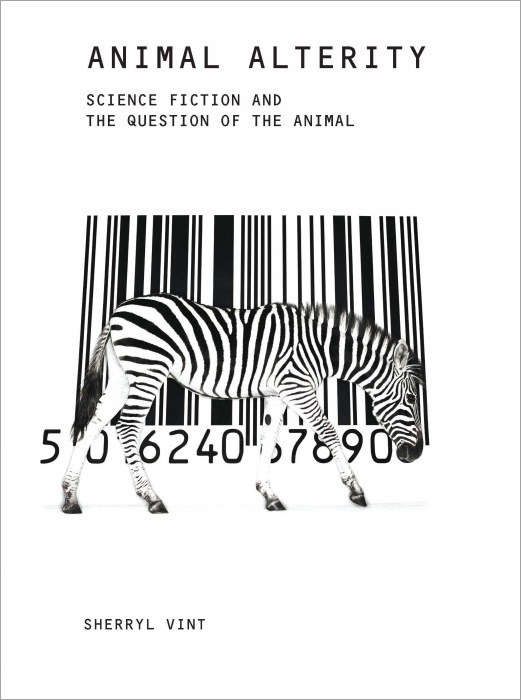
Christabel: You’ve worked with LUP in a number of different capacities over recent years: as a founding co-editor of the journal Science Fiction Film and Television, a co-editor of the book series Liverpool Science Fiction Texts and Studies, and the author of a monograph, Animal Alterity: Science Fiction and the Question of the Animal. Could I ask how you first came to start working with the press?
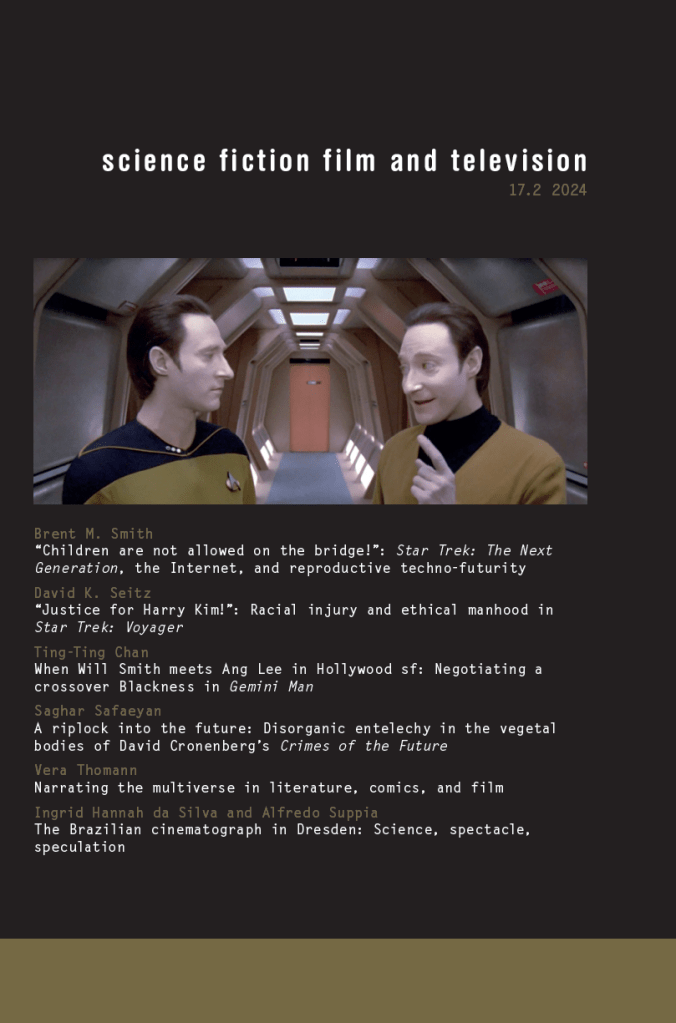
Sherryl: I believe that my first time working with LUP was for the publication of my book Animal Alterity, which came out in 2009, but this was happening pretty much in parallel with the work to establish Science Fiction Film and Television and so I couldn’t say for certain which project began first. Certainly, I was well aware of LUP before I came to work with the press, as it is one of the university presses that was first to be open to focusing on sf texts. The genre is widely recognized as an important cultural form today, and many university presses now regularly publish sf works and often have sf-focused series, but LUP has been established in this space for a much longer time. It was really exciting to be able to work with Mark Bould to establish Science Fiction Film and Television, since we recognized that journals focusing on media sf did not yet exist, and yet such texts were an increasingly important part of the sf landscape. We appreciated LUP’s enthusiasm for creating a journal to address this gap.
Christabel: What changes have you noticed in Science Fiction Studies over the course of your career?
Sherryl: It wouldn’t be an overstatement to say that pretty much everything in the field has changed over the course of my career. When I was a graduate student, I ended up working on sf because it was the genre best suited to help me explore a set of theoretical questions that I was interested in. My advisors cautioned me about the risk that working on sf would not be legible on the job market. For the last ten years now, I’ve held a job that I was hired into with the task of creating an academic program that would focus on how sf engages with a range of important questions today, from the impact of science and technology on daily life, to the existential threat of climate crisis, to articulating visions of a better social world that are linked to activist projects such as abolition and decolonialism. The genre has become much more diverse in the range of writers that it recognizes as part of the field: the recently articulated framework of co-futures, described in the Routledge Handbook of Co-Futures, captures this wide range of cultural perspectives. And with Andrew M. Butler and Mark Bould I’ve just finished editing the New Routledge Companion to Science Fiction, which updates a volume we first co-edited in 2011. When we returned to this book to consider an update, we had to begin almost from scratch, with a newly conceived TOC, in order to address how much the field has changed in the last fifteen years.
Christabel: I like to think that LUP has contributed towards the growth and development of Science Fiction Studies as a field over recent years. Do you have any thoughts about ways in which academics and university presses can usefully work together to shape a field of study?
Sherryl: I would agree that LUP has contributed toward this growth and development and that university presses are essential partners in this work of growing fields. LUP publishes two of the main journals in the field, Science Fiction Film and Television and Extrapolation, as well as the Liverpool Science Fiction Texts and Contexts series. Journals are often the first place that cutting-edge ideas in a field are communicated to a wider readership. And as the anthologies I have cited above demonstrate, handbooks and companions and similar kinds of publications are often essential work for articulating a field in formation, or a transition of a field. They curate conversations about where we are in our scholarly discussion, and can often serve as prompts for imagining where we need to go next. And by collecting together works in conversation, such volumes become important teaching resources, which ideally will prompt the next generation of scholars – both to build on this work, but also at times to contest it and suggest new areas of enquiry not yet conceived. In addition to the great collaborations that already exist, I’d like to see even more opportunities to publish in the mode of conversation rather than fully finished projects: books that might be written as a series of exchanges between two or more scholars; or short books (essentially the novella form of non-fiction) that can serve as provocations to new conversation or further research.
Christabel: Such interesting ideas! And speaking of handbooks and companions, we have an exciting sf-related handbook in the pipeline… I hope to be able to announce it next year. Final question: we all know it’s hard to make predictions, but do you have a sense of where the field is heading? What topics or approaches do you think will be attracting the most scholarly attention over the next few years?
Sherryl: I think trying to predict the future in this way is almost inevitably asking to be called wrong in the near future, but I’ll venture some thoughts on where the field is heading. I think the last 10-15 years have been a tremendously exciting period of growth in sf – in the range of countries and previously minoritized voices who are now part of the conversation, in the range of interdisciplinary ways that sf is engaged, especially in cross-disciplinary ways in the classroom. So I anticipate that these factors will continue to grow and continue to create a richer field. But I also think that scholars increasingly are called to pay attention to the less utopian aspects of the centrality of sf to our contemporary cultural landscape. As Jordan Carroll’s recent book Speculative Whiteness and Douglas Rushkoff’s Survival of the Richest show, trying to enact a future first envisioned in sf can be embraced by those with a wide range of political views. The academic tradition of sf scholarship has tended to focus on left-leaning sf and its connections to utopianism, and I think increasingly we need to engage with a contemporary reality in which the kind of sf that has the most influence is not necessarily the kind of sf we prefer. I also think that sf engaged with media will become even more important than it already is, especially sf as it connects to social media modes of narrative distribution and to digital gaming. These are not areas of scholarship in which I have expertise but I expect them to grow and be ever more important in the future.
Christabel: Thank you so much for sharing your thoughts, Sherryl, and thank you for your wonderful contribution to our work at the press.
We have made Sherryl Vint’s Liverpool Science Fiction Texts and Studies book Animal Alterity: Science Fiction and the Question of the Animal free to read for a limited period to coincide with this conversation.
Access the ebook for free on the LUP website >

Follow us for more updates
Sign up to our mailing list
Twitter | Instagram
www.liverpooluniversitypress.co.uk
 Liverpool University Press Blog