
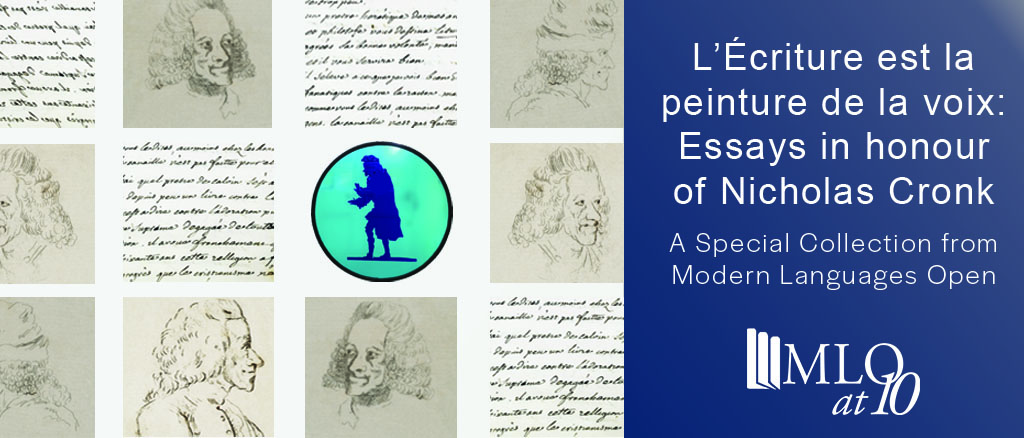
We are delighted to introduce ‘L’Écriture est la peinture de la voix: essays in honour of Nicholas Cronk‘, the latest special collection from Modern Languages Open which is available to read Open Access.

This festschrift has been published in honour of Professor Nicholas Cronk, Professor of European Enlightenment Studies; Fellow of St Edmund Hall and Wolfson College, Président de la Société des études voltairiennes, and Director of the Voltaire Foundation.
This celebration of Nicholas’s work is formed of two equal and complementary parts (one print, one digital). The essays reflect Nicholas’s varied research interests and, drawing on his print and digital endeavours, they explore questions central to the eighteenth century, such as the writing process, justice, revolution, as well as the legacy of the Enlightenment.
This online special issue brings together sixteen essays that speak to Nicholas’s research interests, including various forms and practices of dialogue (such as intertextuality and correspondence), and the broader artistic culture of the eighteenth century. They also speak to the quote that serves as the title of this festschrift.
Essays in honour of Nicholas Cronk: a convivial collection
TW: How did you first meet Nicholas?
GP: It was in January 2007 that I first arrived at the Voltaire Foundation. Within two weeks, on 13th February, we all assembled downstairs, where Nicholas was made Officier des Arts et Lettres by a representative from the French Embassy. The occasion exemplified so many of Nicholas’s achievements and qualities: his hugely distinguished career, his knack for giving a good speech, and a convivial gathering to follow. You were Nicholas’s student, of course. Did you meet him as an undergraduate?
TW: Like you, my first encounter with Nicholas was convivial. It was the final year of my undergrad degree at Cambridge, and I was allowed to attend an early-modern French research seminar. Nicholas was the invited speaker and – to the packed room of people sitting on armchairs, sofas, and on cushions on the floor – he gave a riveting paper. Afterwards, whether the question came from a naïve student or an established scholar, he treated everyone seriously and kindly. I remember thinking, if ever I pursue postgrad studies, that’s the man I want to work with. And then a couple of years later, I came to Oxford where he supervised my DPhil. And he’s been a mentor ever since.
GP: I think it’s fair to say that many of the contributors to L’Écriture est la peinture de la voix were taught by Nicholas or benefitted from his mentoring and support. And the diversity of the essays in the collection testifies to his broad range of expertise and interests, from Voltaire’s historical, polemical and political works to, more generally, epistolary writing, book history and song, as well as other writers, such as Rousseau, d’Holbach, Bernardin de Saint-Pierre and Françoise de Graffigny. Voltaire’s reception and posterity being another key area in Nicholas’s own research that is also reflected in this festschrift.
TW: You’re absolutely right, and to help our readers navigate that breadth, this festschrift comprises two equal components. The print volume features almost exclusively essays about Voltaire. Readers will discover new insights about such celebrated works as Candide and the Questions sur l’Encyclopédie, and they will also explore, for instance, how Voltaire read other dramatists in private and how he engaged in public polemics. For my own part, I learned a great deal about Voltaire’s legacy, in the Revolution and well into the twentieth century. We are also thrilled to have the online component of this festschrift. In these freely accessible essays, readers will encounter other philosophes and eighteenth-century figures including Denis Diderot, Friedrich Schiller, Cesare Beccaria, and members of Marie-Antoinette’s family.

essays in honour of Nicholas Cronk
GP: When, with our colleagues at Liverpool University Press, the idea to make a ‘hybrid’ festschrift first came up, I was delighted. Nicholas was an early champion of digital publishing, notably being a driving force behind the Electronic Enlightenment platform, on which work began in the early 2000s. At present the Voltaire Foundation is engaged in digitising to a very high standard all 205 volumes of the critical edition of Voltaire’s complete works, and under Nicholas’s directorship we also launched a new online journal, Digital Enlightenment Studies. Because of that, in conjunction with his vast experience of producing beautiful print books, it is very fitting that the collection of essays in his honour should take this dual form. The fact that the special issue of MLO is Open Access also speaks to Nicholas’s instincts to share scholarship as widely as possible. I think it was one of our peer reviewers who said something along the lines of some of the essays being almost an extension of the Voltaire Œuvres complètes project, with others reaching out more widely into interdisciplinary areas, and here again, I think the double nature of the collection showcases the material nicely.
TW: Interdisciplinarity is indeed at the heart of this festschrift, not least because these essays cover considerable chronological breadth, from eighteenth-century political texts, through nineteenth-century art criticism, and up to Stanley Kubrick’s gorgeous film Barry Lyndon. And, to return to your point about conviviality, that interdisciplinary is possible because of the expertise of the many renowned scholars who eagerly contributed to this festschrift. We’re thrilled that Robert Darnton wrote the preface ‘Nicholas Cronk’s Voltaire’, which appears in both components. I won’t single out any of the thirty-three other contributors – that wouldn’t be in the spirit of this celebration – so I invite our readers to dive into this rich trove of essays about Voltaire, the eighteenth century, and its enduring legacy.
Articles in the collection
Robert Darnton, Preface: Nicholas Cronk’s Voltaire
Gillian Pink and Thomas Wynn, Introduction
Gillian Pink and Thomas Wynn, Publications by Nicholas Cronk
Nathalie Ferrand, Être étranger dans La Nouvelle Héloïse
Ruggero Sciuto, More of the Same? D’Holbach and the Temptation of Self-Quotation
Simon Davies, Les paratextes de Bernardin de Saint-Pierre: ‘j’ai senti, j’ai aimé, j’ai parlé’
Pierre Musitelli, Giustizia fatta: observations sur un registre des condamnés à mort (1471–1764) de la bibliothèque de Beccaria
Caroline Warman, ‘Des mémoires sur la vie de cet illustre philosophe’: George Leman Tuthill’s Unwritten Biography of Diderot
Andrew Kahn, Ippolit Bogdanovich and Voltaire’s Épître à l’impératrice de Russie: Adapting Praise
Ritchie Robertson, Schiller’s Response to Voltaire in Die Jungfrau von Orleans: Enlightened or Romantic?
Robert Morrissey and Glenn Roe, Hidden in Plain Sight: The Questions sur l’Encyclopédie in the Nineteenth Century
Kelsey Rubin-Detlev, Mme de Graffigny and the Archduchess: Indirect Correspondence between the Court and le monde
Catriona Seth, ‘Des nouvelles de mon infortunée sœur’: Marie-Antoinette dans les lettres de l’archiduchesse Marie-Christine à l’empereur François
Jean-Alexandre Perras, Homo bulla: variations axiologiques sur l’éphémère
Michel Delon, Regard rapproché, regard éloigné dans la critique d’art, de Diderot à Huysmans
Martin Wåhlberg, Contrafacta: le chant, les timbres, la romance et les conditions de la poésie au tournant des Lumières
Edward Nye, Mettre en question le grapho-phonocentrisme: la langue des signes au dix-huitième siècle
Alexis Tadié, Éloge de l’inauthenticité: le dix-huitième siècle à l’écran, autour de Barry Lyndon de Stanley Kubrick
Enjoyed this? You might like:
In Praise of… Charles Forsdick, Drapers Professor of French at the University of Cambridge.
Follow us for more updates
Sign up to our mailing list
Twitter | Instagram
www.liverpooluniversitypress.co.uk
 Liverpool University Press Blog