
The Scottish picaresque as environmental justice, written by Denys Van Renen, has recently been published in the Oxford University Studies in the Enlightenment series. This blog post, by the author, highlights its intervention as the first book-length study to analyze the genre of the picaresque as drawing attention to how the eighteenth- and nineteenth-century iterations of it respond to environmental disasters. Ultimately, the economic precarity of the genre’s low-born characters renders them more attuned to environmental precarity.
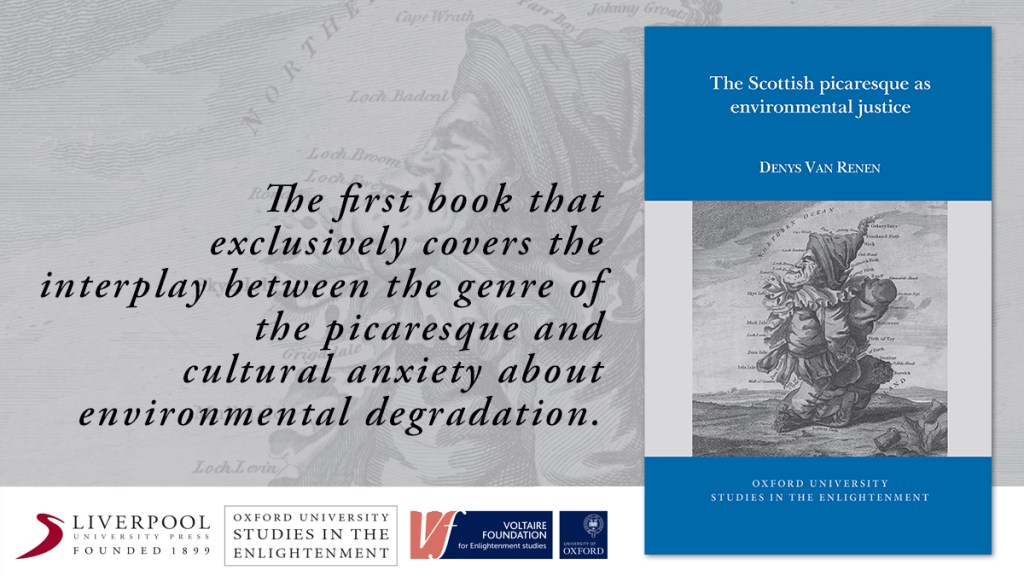
One of the most fascinating elements of the research process for The Scottish picaresque as environmental justice involved tracing efforts by eighteenth- and nineteenth-century Scottish writers or those of Scottish descent to regenerate lands benighted by environmental devastation through their attentiveness to them. On the one hand, the English writer, Hannah Cowley, speaks of Scotland, for example, as the proper site for industry because it cannot degrade a country with such scant vegetation and so little biodiversity. Of course, English authors exaggerated the barrenness of the region. On the other hand, Scottish authors and those who grudgingly came to appreciate Scotland’s variegated environments, like Samuel Johnson, awakened the island to the ecocatastrophes engulfing the island. This book argues that the picaresque—a genre that features the episodic adventures of a low-born rogue—served as the literature most suitable to enter these lands of environmental degradation, for these lands were written off by the well-born and reawakened by picaros who discerned plants and animals which, like themselves, were struggling to survive amidst the onslaught of deforestation and other ventures that transformed the nation into a storehouse for the British empire.
After writing on the Scottish author Tobias Smollett some years ago, I noticed eighteenth- and nineteenth-century authors’ obsession with his picaresque oeuvre. While, not a picaresque novel, his poem about the atrocities during and in the immediate aftermath of the Battle of Culloden, The Tears of Scotland (1746), perhaps best encapsulates fears of displacement and erasure—and the ways in which Scottish authors respond to them. Indeed, this poem, as my introduction discusses, portrays how a people cannot be displaced from their environments if they embed themselves in the environmental processes of their homelands. Smollett, that is, recognized how colonizers not only reshaped, reimagined, or dismantled cultural practices but also environments. He responded by creating the Scottish picaro.
Smollett remained committed to these environmental themes. In his last published novel, Humphry Clinker (1771), for example, he portrays at length the interplay between rising wealth and eco-disasters which produce environmental refugees. His main character fears:
Many decent families, restricted to small fortunes, were tempted to settle in Bath, where they could then live comfortably . . . but . . . they are now obliged to think of other migrations—Some have already fled to the mountains of Wales, and others have retired to Exeter. Thither, no doubt, they will be followed by the flood of luxury and extravagance, which will drive them place to place to the very Land’s End; and there, I suppose, they will be obliged to ship themselves to some other country. Bath is become a mere sink of profligacy and extortion.[i]
The “flood of luxury” inundates the country and, in its wake, the authors in this study portray the picaros as the ones who draw attention to the excesses of its inhabitants in these denuded lands and “revive” its (bio)diversity by drawing physical and emotional sustenance from the meagerest of Scotland’s surviving features.
Romantic and even Victorian writers continued to draw on the picaresque. Because of and not despite the fact that the travelogues, biographies, and novels under discussion in this book are not strictly picaresque works like Smollett’s Roderick Random (1748), the picaresque features that characterize them are even more distinct. Indeed, James Hogg, Mungo Park, John Galt and even Mary Seacole draw on the picaresque when they or their characters need to summon the genre, for it ventures into the most inhospitable conditions to enable the characters to discern peoples, plants, and animals that others, who perceive only commercial values, cannot. Therefore, these writers locate affiliations that recreate healthful communities. The most paradigmatic moment occurs when the Scottish explorer Mungo Park, alone and destitute, encounters a moss:
At this moment, painful as my reflections were, the extraordinary beauty of a small moss, in fructification, irresistibly caught my eye. I mention this to shew from what trifling circumstances the mind will sometimes derive consolation; for though the whole plant was not larger than the top of one of my fingers, I could not contemplate the delicate conformation of its roots, leaves, and capsula, without admiration.[ii]
As Park appreciates these micro-ecologies, he mobilizes other communities that contradict the aims of the African Association: to colonize and erase the plants, peoples, and animals who do not accommodate its imperial efforts.
The hope is, then, that scholars and readers of the picaresque can rediscover it as a key genre for the environmental humanities, a genre that (imaginatively) restores communities in which discarded or stigmatized elements are elevated into new assemblages.
Denys Van Renen
[i] Tobias Smollett, The Expedition of Humphry Clinker, ed. O. M. Brack and Thomas R. Preston (Athens, GA: U. of Georgia Press, 1990), 55-56.
[ii] Mungo Park, Travels in the Interior Districts of Africa, ed. Kate Ferguson Marsters (1799; Durham: Duke University Press, 2000), 227.
Denys Van Renen is Associate Professor of English at the University of Nebraska at Kearney. He is the author of The Other exchange: women, servants, and the urban underclass in early modern England and co-editor of Beyond 1776: globalizing the cultures of the American Revolution. He has a new book, The Theatres of eighteenth-century weather, forthcoming.
The Scottish picaresque as environmental justice is part of the Oxford University Studies in the Enlightenment series, published in collaboration with the Voltaire Foundation. Denys Van Renen is also the author of Nature and the New Science in England, 1665–1726, published in the same series.

Follow us for more updates
Sign up to our mailing list
OSE Bluesky | LUP Bluesky | Instagram
www.liverpooluniversitypress.co.uk
 Liverpool University Press Blog
Pingback: ‘The Scottish picaresque as environmental justice’ by Denys Van Renen | Voltaire Foundation