

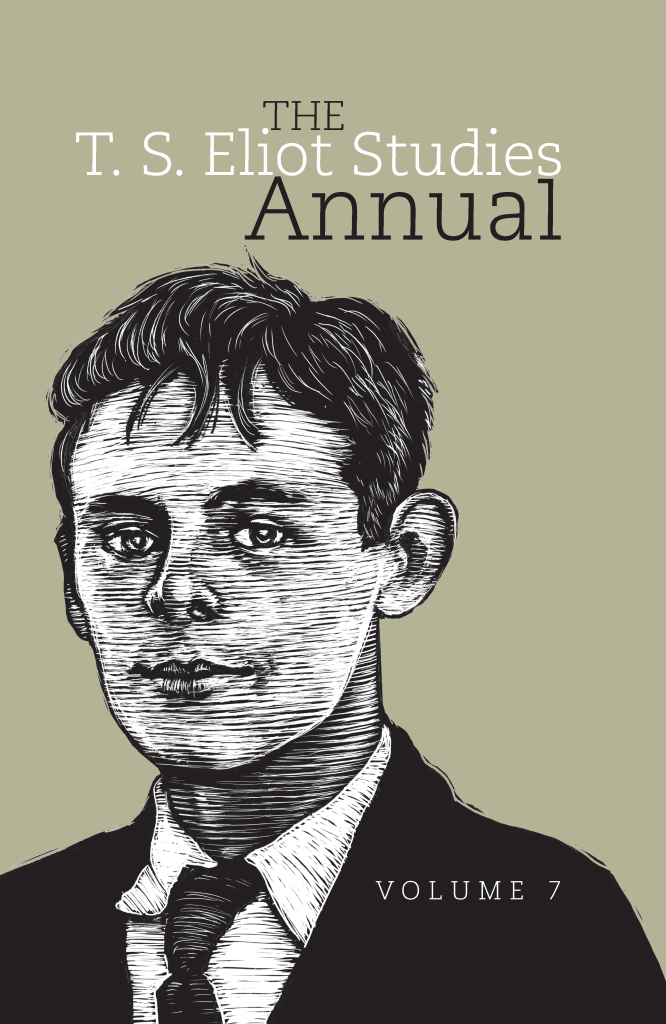
The T. S. Eliot Studies Annual is the leading venue for the critical reassessment of Eliot’s life and work in light of the ongoing publication of his letters, critical volumes of his complete prose, the 2015 edition of his complete poems, and the forthcoming critical edition of his plays. To celebrate the publication of Volume 7 of the Annual, and the International T.S. Eliot Summer School, we are making the following article free to read throughout September 2025:
‘Ecology and Voice: Non-Human Speech and Songs of the Earth in T. S. Eliot’s The Waste Land’ by Gabrielle McIntire.
In the article, Gabrielle McIntire listens carefully to Eliot’s environmental consciousness in The Waste Land to propose that, embedded in the poem, are multiple layers of creaturely and ecological voices, consciousnesses, songs and music. Here she delves further into the article to reflect on her work and its choice as the featured article in TSESA volume 7:
The past few years have seen a quickening of sorts in critical attention to the ecological dimensions of every discipline across the Arts and Sciences, with scholars finally reading and writing with a growing collective awareness that we live in a time of planetary environmental crisis. Many of the symptoms of this crisis—climate change; global warming; air, water, and land pollution; species extinctions; extreme deforestation; desertification; and drastic over-extraction—all feel increasingly urgent as we move from theories and probabilities to (accelerated) real-time witnessing in the present tense of our twenty-first century. Poetry seems to have a special relation to this crisis in that it offers a vehicle for articulating the aporias, contradictions, and emotional complexities of human responsivities to our world under threat in language and form set apart from the prose of reportage or science. As it happens, T.S. Eliot’s poem, The Waste Land, groundbreaking for its own avant-garde techniques and messages within the modernist literatures of the early 1920s, had spoken to me for a long time in registers of what I can only describe as whispers of ecology. The poem is, after all, titled for a wasted land, a topography, a topos, and a geopoetics that is under threat, that has lost its stabilized place within the sphere of the natural, and that is in danger of desiccation, wastefulness, and a failing fertility. But what were these whispers that I kept hearing through the imagery, figures, voices, questing, religio-sacred dimensions, and tropes of the poem’s complex intertextualities, literary histories, explorations of personal breakdown, portraiture of a post-World War One London, and fragments from emerging genres in music and film? What was I hearing through some of the “too-muchness” of the poem’s always-beguiling sounds and voices?
After striving to hear the rustle of this something “unheard”—to borrow the word Eliot uses to describe the wind near the beginning of “The Fire Sermon” (175)—I came to realize that it was the voices of the many animals and sounds of the natural in The Waste Land that I had been missing—or, only hearing momentarily. We hear non-human forms of expressiveness within the poem from gulls, crickets, cicada, a nightingale, a bat, grass, thunder, wind, a hermit thrush, bones, a sea current, and a cock. We should not forget the animal-qualities of the Sibyl at Cumae whom Eliot quotes from the opening of Petronius’s Satyricon, hanging in her cage, who gives the poem its epigraph: “‘Nam Sibyllam quidem Cumis ego ipse oculis meis vidi in ampulla pendere, et cum illi pueri dicerent: Σίβυλλα τί θέλεις; respondebat illa: άποθανεῖν θέλω’” (“I saw with my own eyes the Sibyl at Cumae hanging in a cage, and when the boys said to her: ‘Sybil, what do you want?’ she answered: ‘I want to die.’”).[1] Each of these speak, sound, sing, whisper, or carry vital silences, generating a cacophonic soundscape about and within our shared biome and ecology.
I had been warned my whole life, though, not to “anthropomorphize” non-human parts of the natural world. Giving animals “human” qualities or emotions was considered an ethical tort, a wrong, a complete mistake—an act of the imagination verging on violence to an Other. But this hermeneutics of proscription around anthropomorphization was not borne out by my experience across decades observing, with an intrigued amateur’s attentiveness, animals, sounds, and songs of the natural. I had been a tree planter during college and lived for many weeks at a time in the bush of northern Ontario, northern Alberta, and northern British Columbia, exposed to the elements and in proximity to countless species of birds, bears, foxes, rodents, reptiles, and insects. Over time I have come to believe that cats (in kinship with T.S. Eliot, perhaps!) really seem to evince emotions such as attachment, care, interest, irritation, anger, sadness, playfulness, curiosity, and even mourning. I also feel that I have caught my cats smiling; Lewis Carroll’s Cheshire Cat is alive and well amongst us. Then a 2024 New Yorker article introduced me to the term “anthropectomy,” which the author, Rivka Galchen, explains “describes a kind of error—that of baselessly assuming animals don’t share certain qualities with us.”[2] Anthropectomy (from the Greek, anthropos, meaning human, plus ektomia, to cut out) is not without its own pitfalls, and there is plenty of debate about its application across a range of fields in animal studies.[3] But encountering and being able to name this position helped me to see that the charge of anthropomorphization was too simple, too rigid and often incorrectly assumes that humans are judging themselves as superior to non-human forms of being by finding affinities. This helped me then to hear better Eliot’s animal, topographic, botanical, and meteorological sounds and songs that course through The Waste Land.
I have also come to understand The Waste Land as an exemplary literary artifact that was doing more political and even eco-critical work than Eliot may have intended, and was more ahead of his time than he could have known. I wrote about this in “The Waste Land as Ecocritique” (2015) and in this particular essay I have tried to listen more carefully to Eliot’s environmental consciousness in The Waste Land to propose that embedded in the poem are multiple layers of creaturely and ecological voices, consciousnesses, songs, music, and sounds that traverse the poem and which Eliot strove to articulate as forms of testimony to an earth, land, and its inhabitants that were and are under environmental stress. In the poem animals, the land itself, and other denizens or expressions of its topographies and geopoetics have something important to express about the natural. In reading the poem now, from the vantage-point of a twenty-first century characterized by yet more urgent environmental crises, we find ourselves interpellated to listen better, and harder, to these voices that also, then, call us to give a new attentiveness to the voices and songs of what remains of “the natural” in our own world.
[1] This is the translation Valerie Eliot gives in The Waste Land: A Facsimile and Transcript of the Original Drafts Including the Annotations of Ezra Pound. Ed. Valerie Eliot. New York: Harcourt, 1971, 126.
[2] Rivka Galchen, “How Scientists Started to Decode Birdsong,” The New Yorker, October 2024, 21.
[3] See, for example, Andrews, Kristin and Brian Huss, 2014, “Anthropomorphism, Anthropectomy, and the Null Hypothesis”, Biology & Philosophy, 29(5): 711–729. doi:10.1007/s10539-014-9442-2
To read all articles from the Annual, recommend a subscription of the journal to your institution >

Follow us for more updates
 Liverpool University Press Blog