
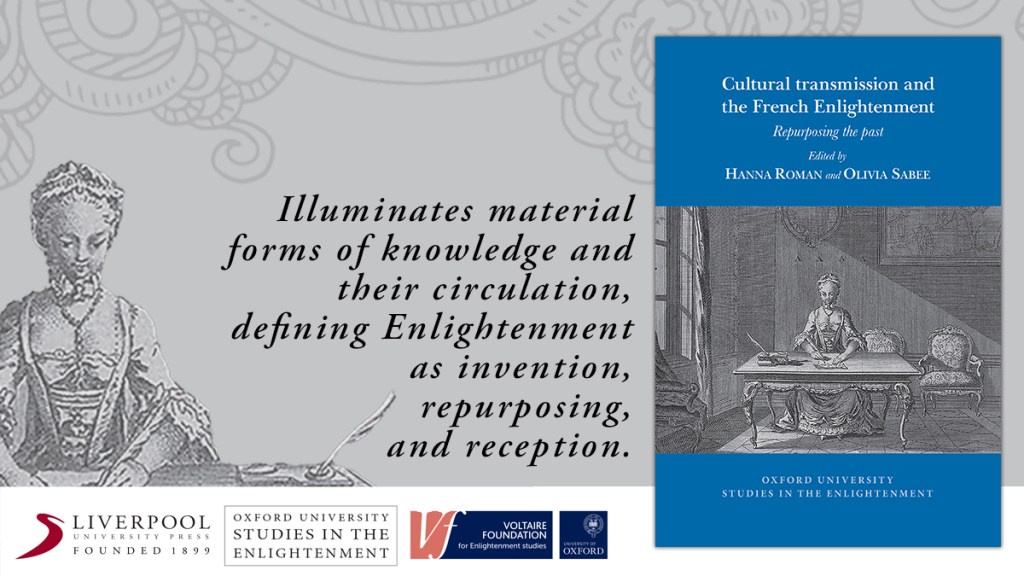
Cultural transmission and the French Enlightenment, edited by Hanna Roman and Olivia Sabee, has recently been published in the Oxford University Studies in the Enlightenment series. The volume illuminates material forms of knowledge and their circulation, defining Enlightenment as invention, repurposing, and reception. In this blog post, the editors return to the collection for the first time since its completion, offering fresh reflections on the essays and considering their resonance in the current political climate.
“We must try to proceed with the analysis of ourselves as beings who are historically determined, to a certain extent, by the Enlightenment.”
— Michel Foucault, What is Enlightenment?
By the time a book makes it to print, its authors or editors have read and reread it so many times that it can feel difficult to glean something new. Yet we were struck by how much has happened in politics and the world since 2021 (when many of the volume’s authors first shared their work at the American Comparative Literature Association conference) and the summer of 2025. In this blog post, we therefore wanted to take the chance to reflect on the essays and the book as a whole, and decided to read it from back to front, spurred in part by the troubling resonance of the final chapter.
The final essay in the volume, by Arvi Sepp, is haunting in this moment of profound anti-intellectualism, particularly in the United States, where we (the volume’s editors) are situated. The image of Victor Klemperer in Nazi Germany, a scholar persecuted and isolated from the academy, felt distant at the start of writing this book (and yet perfectly relevant to eighteenth-century studies in America, as Gregory Brown’s preface to the volume shows). But in this moment of challenges to academic freedom, civil rights, and freedom of speech, such an image underlines the importance of studying the eighteenth century and its continuing aftermaths.
Reading backwards helps us see that the current moment is not a pinnacle of liberal progress and scientific inquiry that began in the Enlightenment but rather that it can be interpreted as the strategic repurposing of terms and ideas. Sepp’s essay gives an example of how the deleterious repurposing of Enlightenment concepts happened. Next, Valentina Denzel and Tracy Rutlers’ piece problematizes the applications of human rights, and more specifically women’s rights, analyzing how western culture emanating from Enlightenment thought has become a benchmark by which to measure the treatment of women throughout the world. In her essay, Annelle Curulla shows that although publics today think of Voltaire as an emblem of ‘liberal’ thought, his treatment of the term “fanatisme,” or fanaticism, was complicated and historically marked, and that the term today has been manipulated in a way that also supports the political resurgence of the far right. As we approach Enlightenment thought in our classrooms, it remains worthwhile to consider how terms are historically defined and, in turn, manipulated. These three essays, taken together, demonstrate how legacies of eighteenth-century thought remain deeply relevant to social and political life in the twenty-first century.
The following essays address legacies of eighteenth-century thought during and immediately following the French Revolution of 1789, an event that forced thinkers to look back on the past, both to critique the society of the past and present, and to develop new social and political models for the future. Clovis Gladstone writes about the repurposing of Rousseau’s political thought by revolutionaries on both sides of the political spectrum during the beginning and more dictatorial parts of the Revolution. Gladstone shows how Rousseau himself formulated his writings such that they could be interpreted and applied in various contexts. This invitation for debate has allowed authors of founding political texts to claim that they speak for Rousseau, but the danger lies in forgetting that Rousseau’s ideas can be read in myriad ways and should not be held hostage in one ideology or another. In his essay, Joseph Harris describes Louis-Sébastien Mercier’s isolation as a writer. Mercier had been steeped in Enlightenment beliefs of social progress, but when the Revolution arrived and he was arrested during the Terror, he wrote of his dismay with society and sought refuge in the past, translating and adapting Shakespeare’s plays as a mirror of his own fears and experiences. Theater, associated throughout the eighteenth century with explorations of how liberty might be embodied, was a multifaceted tool that could be harnessed for personal, artistic, and political ends.
More generally, early modern theatrical works can be contentious because their ‘re-performance’ can serve as a validation of racist or derogatory elements within them. Amanda Danielle Moehlenpah examines the difficult process involved in reimagining and staging eighteenth-century ballets and operas that include racist depictions of non-Europeans. Staging works from this period allow spectators, researchers, and students to understand the period and to enjoy the works for their own sake; yet to see the past accurately it is important to criticize its romanticization and to make artistic choices that do not perpetuate stereotypes and that allow diverse publics to see themselves constructively included within the continued life of the artwork.
The next five essays focus on how the Enlightenment movement repurposed its own ideas and its own past. Two essays describe the specific actions taken by Enlightenment thinkers to navigate knowledge transfer between centers and peripheries. The French word for the Enlightenment—the Lumières—by nature traditionally lent itself to narratives that focus on diffusion from a central point outward. Both essays problematize this model of ‘rayonnement.’ Logan J. Connors examines how Enlightenment philosophers tried to impose morality and civic virtues upon military society through theater in the French periphery, primarily in Brest and in Saint Domingue. Clorinda Donato writes from the perspective of one periphery, Protestant Switzerland, showing how compilers and authors interpreted and reshaped ideas from Diderot and D’Alembert’s Encyclopédie. These essays demonstrate that French ideas did not spread naturally or organically, but as the direct result of actions by specific individuals.
The volume’s first three essays demonstrate two types of historical tensions: one between eighteenth-century authors’ repurposing of the past alongside their own rhetoric of rupture with older modes of thought, and the other between the discursive strategies of these eighteenth-century authors and how modern-day positivistic thinking portrays them. Kathleen Wellman discusses the use of ancient medical texts in Enlightenment-era medical treatises and philosophy, demonstrating that physicians during the period indeed relied heavily on the past in a way that has been neglected by today’s scholarship. This narrative contradicts the perception of the Enlightenment as a movement of scientific progress that purposely rejected older systems of knowledge. Célia Abele’s contribution examines the repurposing of social categories by the authors of the Encyclopédie, arguing that the role of the chemist is redefined in this historical moment as somewhere between that of an artisan and a philosopher. This study further demonstrates how the definition of disciplines and the social categories associated with them during the eighteenth century contradicts the idea that Enlightenment thinkers created new models based solely on ‘reason,’ rejecting tradition. Cynthia Laura Vialle-Giancotti’s essay examines how eighteenth-century male authors disparaged the socialite portrait-writing of seventeenth-century female authors while harnessing it to their own literary ends as a narrative device. This examination of repurposing allows both for a feminist rewriting of literary history and presents another example of the importance of the past even in moments deemed revolutionary.
We hope that teachers, scholars, and students of the Enlightenment will take away from this volume the idea that anything that appears simple, ideological, or monolithic is likely the product of many accretions over time and should be questioned and contextualized. As we write in the volume’s Introduction, “texts and ideas […] are made, intercepted, and circulated by people” both in the past and present. They do not magically transcend time; they do not remain universal throughout history. As scholars and teachers, we each play a role in a continuous process of cultural transmission, and decoding the rhetorics inherent in how this process is inscribed in history is particularly necessary when examining a movement that has been enshrined in our culture and mentalities. This is all the more important in a globalized world in which universalist ideas deriving from Enlightenment discourse have been presented as a panacea or apogee of progress whereas in reality some have been received and imposed in paradoxical or destructive ways. Despite these critiques, it remains foundational to how we think about history, politics, science, and society in the twenty-first century. As a result, the Enlightenment is something of a double-edged sword promoting both critical inquiry and belief or indignation in the face of its universalist values. As individual scholars approach it, however cautious or optimistic they might be, it has provided a source of both comfort and anger, especially in difficult times. Approaching these cases via the granular lens of cultural transmission helps to show the Enlightenment as an amalgamation of heterogeneous interpretations of it, and as a movement that is still in the making.
Hanna Roman & Olivia Sabee
Readers may also be interested in the blog post by series editor Gregory Brown, Oxford University Studies in the Enlightenment at 70: Celebrating the Legacy and Future of the Series, which reflects on this volume, marking the 70th anniversary of the series, as well as the series as a whole. Read the blog post >
Hanna Roman is an Assistant Professor of French at Dickinson College. Her first book, The Language of Nature in Buffon’s Histoire naturelle (Oxford University Studies in the Enlightenment/LUP, October 2018) examined the relationship between language and the natural sciences during the French Enlightenment. Her current research focuses on the influences of religious and mythological discourses on the scientific disciplines of geology, geography, and natural history in the French Enlightenment, and she is working on a second book project on the history of the ocean in the eighteenth century.
Olivia Sabee is Associate Professor of Dance at Swarthmore College, where she also contributes courses to the programs in French and Francophone Studies and Comparative Literature. Her first book, Theories of Ballet in the Age of the Encyclopédie (Oxford University Studies in the Enlightenment/LUP, 2022), examines how print culture shaped conceptions of eighteenth-century pantomime ballet. Her current research focuses on ballet between France, Saint-Domingue, and the eastern United States in the late eighteenth century.

Follow us for more updates
Sign up to our mailing list
OSE Bluesky | LUP Bluesky | Instagram
www.liverpooluniversitypress.co.uk
 Liverpool University Press Blog
Pingback: The making and remaking of the Enlightenment | Voltaire Foundation