
The editors of Addressing Tipping Points for a Precarious Future, Tim O’Riordan and Tim Lenton, readdress their landmark volume in the context of our contemporary world, in which we have arguably triggered our first major ‘tipping point’ in the extensive dieback of warm-water coral reefs (as reported in the Global Tipping Points Report 2025).
Their work is more timely today than ever.
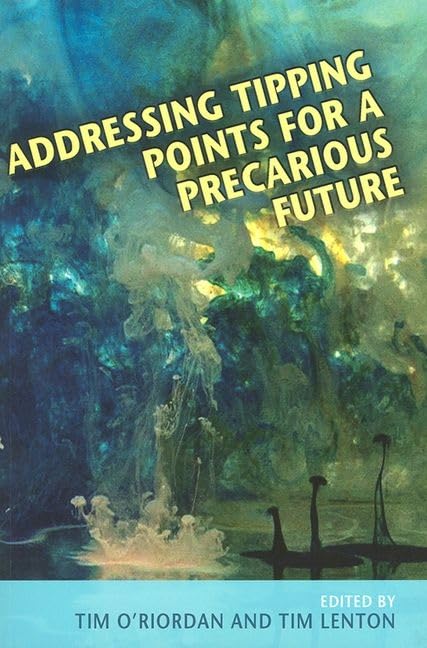
When we co-edited this publication, which appeared in mid-2013, we were proud to have assembled an impressive array of essays around the emerging theme of tipping points. The notion of disruptive shifts in planetary stabilizing forces emerged in the scientific literature some 25 years ago. ‘Tipping point’ captures the idea of a self-propelling and hard-to-reverse transformation of a system from one state to another. What was initially regarded as a somewhat distant but nevertheless threatening set of dangers to life on Earth is now being modelled as increasingly likely. Indeed, unprecedented temperature increases in the atmosphere and surface oceans in just the last two years have arguably triggered the first major tipping point: Over 80% of warm-water coral reefs have experienced extensive dieback. Step changes in the measurement and predictions of such convulsive patterns have pitched scientific and media focus on tipping points into the forefront of the climate change debate.
The ‘tipping point’ metaphor can engender confusion, despite its currency in contemporary scientific and political discourse. The scope for significant alterations in the interconnecting patterns of planetary processes, which heretofore have seemingly maintained an element of dynamic homeostasis in the biogeochemistry of the Earth, is becoming provably evident. Many take ‘tipping point’ to mean the whole climate undergoing a self-propelling change. But instead, it is critical sub-systems – including ice sheets, biomes and ocean and atmosphere circulations – that are currently at greatest risk. Others read ‘tipping point’ as necessarily rapid, but speed depends on the system: ice sheets may be irreversibly lost but can take many centuries to disappear. We do not yet know precisely when such disruptions will be triggered, how they may influence other disruptions, and just what may be the outcomes for economies, cultural resiliencies, and governments as they sweep into effect.
Accepting these challenges, our book deserves fresh attention given recent developments in the climate. We noted some of the most imminent risks over a decade ago and gave them coverage. One is the drying of the Amazon rainforest with enormous consequences for rainfall, temperatures and huge loss of biodiversity. Another was the weakening of the Atlantic ocean’s great overturning circulation, raising the spectre of extreme cold in northern European winters, overheated drought in southern European summers, and disrupted monsoons in the tropics.
Particularly relevant are the associations drawn between tipping points in literature, in media, in politics, in economics, and in theology. We put together a fascinating set of commentaries on how tipping points are conceived as metaphor, in storytelling, in media exploration, in the ethics of economies and politics, and in the maze of connections between science and theology. Tipping points are both feared and resisted. They are also challenged and denied. The contemporary currents of social relationships and philosophies are being shaken by tipping points.
But the book also pointed to the scope for beneficial processes which could give rise to a renaissance in technology, innovation, and enterprise. There is now much more attention given to new patterns of technological uplift notably in the low carbon arenas of renewable energy production and consumption in the form of electric vehicles and heating and cooling. This is creating a cascading effect, where successes in workable technologies beget new forms of employment, of prosperity and of social ethos. While the evidence for this is just emerging, such cascades cannot be dismissed, for one of the outcomes of tipping points is the stimulation of creative responses and fresh perspectives.
Nevertheless, even these optimistic visions may be mistaken. Patterns of political and economic power these days favour the wealthy, the commercial giants, and the engines of what keeps the comfortable minority contented. One of the disturbing features of the arc of tipping points is the reinforcing of privilege, of commercial globalism, and of geopolitical conflict. Inequality and injustice reinforce accelerated inequality and injustice. There may be an alarming fresh set of tipping points surrounding oppression, destitution, and despair.
Our book is even more timely today than when it was created. We envisaged three options. Humanity can progressively succumb to more and more pain, unfairly spread across the planet and over generations to come. Or we can mix and muddle and squeak by but with all sorts of collateral damage for those made most vulnerable, or still to be born in weakness. Or we can rise to the challenges and return to living and creating a marvellous world with our combined planetary and anthropogenic forces of creative stabilizing and exciting renewal, which our offspring will live to appreciate. The stakes are very high and at best we have a quarter of a century to get this right or wrong.
Our book suggests all three pathways are possible. Now is the time to tip onto the path to unifying flourishing.
Addressing Tipping Points for a Precarious Future, edited by Tim O’Riordan and Tim Lenton, is an Open Access publication. Read it here.
Tim O’Riordan is Emeritus Professor of Environmental Sciences at the University of East Anglia.
Tim Lenton is the founding Director of the Global Systems Institute at the University of Exeter, Chair in Climate Change and Earth System Science, and leader of Global Tipping Points.

Follow us for more updates
Sign up to our mailing list
Follow us on social media
www.liverpooluniversitypress.co.uk
 Liverpool University Press Blog