
Religion, Spirituality, and Public Health: Competing and Complementary Epistemes, edited by Karen O’Brien-Kop and Suzanne Newcombe, focuses on exploring the role of epistemes, particularly those found in religious and alternative health milieus.
Clashes of truth claims in global public health are on the rise. From US Health Secretary Robert F. Kennedy Jr’s policy assaults on vaccine science to the highest measles outbreak in England for more than a decade, stories of health science scepticism often have roots in minoritised groups and can include religious reasoning of different kinds. Meanwhile the global ‘complementary and alternative medicine market’ continues to grow, estimated at USD 193.36 billion in 2025, providing health treatments that are often derived from, or which support, traditional religious or spiritual worldviews.
Exploring how health and wellbeing decisions are always part of a multi-layered process, Religion, Spirituality and Public Health: Competing and Complementary Epistemes challenges assumptions of ‘culture wars’ between biomedicine and ‘alternatives’ and between biomedical scientific thinking and religious or ‘traditional’ ontologies. Real-life decisions are made not solely in reference to biomedical epistemes, but also systems of embodied rationality, systems of reasoning and negotiations with power and authority that can be understood and articulated as rational while also experiential. This book uses the tragic global crisis of Covid-19 to interrogate fundamental questions about how we can better handle personal and collective public health decisions. It explores the way the religious and scientific spheres of human activity can be understood as irreducibly connected and implicated in many decisions about health and wellbeing on both the individual and public policy levels.
Each chapter attempts to meet specific communities on their own terms, resisting the essentialising and belittling encounters more commonly found between public health and religion. The editors highlight a series of global case studies, exploring in depth the way pragmatic, pluralistic decisions were made within the context of apparently incompatible ontologies (e.g. Gods, ancestors, spirits, biomedical interventions and traditional frameworks for promoting health). Case studies of public health policy are interrogated at national or state level for Iran and Tamil Nadu in India, while individual, pragmatic navigations of pluralistic realities are explored with case studies set in the NHS in Britain (Ugba), Korean musok (Sarfati) and Afro-Brazilian religiosity (Bahia). Conversely, the potentially profound significance of ontological framing in health and healing is explored with reference to compliance with public health policy (Roussou; Deeley) and in the framings of increasingly popular ‘self-healing’ with psychedelics (Steavu).
Theoretical interventions include the development of a ‘Pluriversal Philosophy of Lived Religion’ (O’Brien-Kop) and rethinking epistemological assumptions about benchmarks, baselines and valid bases of truth. The volume questions the value of some of the standard assumptions of the biomedical episteme, including calling for a strong agnosticism about ontologies (Cheung) while maintaining focus on criteria of clinical efficacy, avoidance of harm, and more rigorously interrogating the experiential episteme of both patients and practitioners (Newcombe). Professor Chakravarthi Ram-Prasad (Fellow of the British Academy) concludes the volume by drawing attention to the way this volume contributes to a much-needed reworking of ‘the ecology of biomedicine through greater analytic as well as practical focuses on experiences of wellbeing’ (p. 277).
If we are going to design more inclusive policy and look at simple, practical ways to alleviate suffering, we must pay more attention to the pragmatic pluralities that more accurately describe how people navigate their life choices. And in relation to public health, we should also take seriously conspiracy-theorising as an epistemological act and system that is underpinned by persuasive reasoning and rationalities. Without understanding the functioning of such theorising, public health policy is weakened in its attempts to address the spread and appeal of counter-factual claims, particularly in minority or minoritized communities.
This book is a concentrated attempt to advance the conversation between biomedical science, religion and belief, as well as cultivate a more honest assessment about the types and value of specific knowledge-making practices that coexist in the contemporary world. This book offers a rich picture of multiple epistemic practices that are overlapping, touching, and sometimes sharply colliding. It invites us to consider more fully what a more radically plural, ontologically sensitive understanding of global society might encompass.
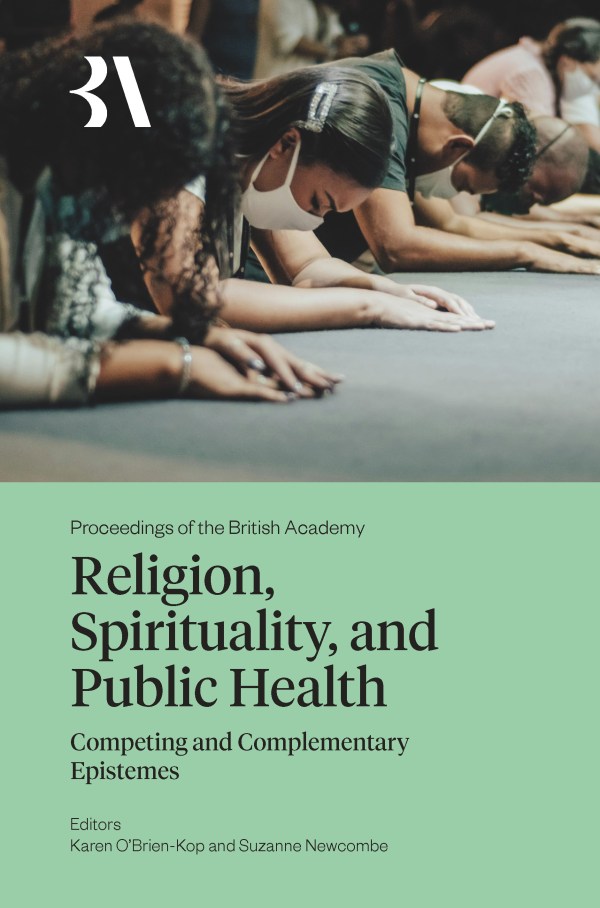
 Religion, Spirituality, and Public Health: Competing and Complementary Epistemes, edited by Karen O’Brien-Kop and Suzanne Newcombe, is now available to read Open Access.
Karen O’Brien-Kop is lecturer in Asian Religions at King’s College London.
Suzanne Newcombe is a Senior Lecturer in Religious Studies at the Open University (UK) and the director of Inform, based in Theology and Religious Studies at King’s College London.
[1] RFK uses religious reasoning of different kinds to justify his views, include likening vaccine administration to children like sexual abuse of children in the Catholic Church (NBC News 2024) https://www.nbcnews.com/health/health-news/rfk-jr-vaccines-cdc-fascism-abuse-catholic-church-autism-conferences-rcna181605.
[2] In 2025 the England measles epidemiology report of the UK Health Security Agency stated: ‘In 2024 there were 2,911 laboratory confirmed measles cases in England, the highest number of cases recorded annually, since 2012.’ (UK Health Security Agency 2025) https://www.gov.uk/government/publications/measles-epidemiology-2023/confirmed-cases-of-measles-in-england-by-month-age-region-and-upper-tier-local-authority-2025
[3] Precedence Research 2025, https://www.precedenceresearch.com/complementary-and-alternative-medicine-market

Follow us for more updates
Sign up to our mailing list
Follow us on social media
www.liverpooluniversitypress.co.uk
 Liverpool University Press Blog