
In this post, authors Renée Fox and Mary L. Mullen discuss the findings of their edited collection, Race, Violence, and Form: Reframing Nineteenth-Century Ireland. The second volume in the new Studies in the Global Nineteenth-Century series from Liverpool University Press, this book challenges assumptions about nineteenth-century Irish identity, exceptionalism, and literary conventions.
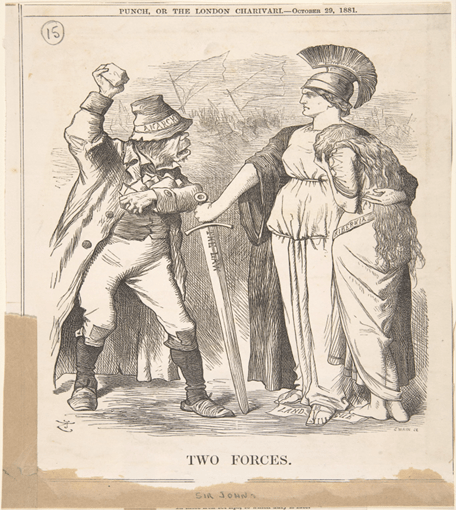
“Two Forces,” a political cartoon published in Punch in 1881, dramatizes a conflict between “the law”—an erect figure trampling the Irish Land League underfoot while comforting a faceless, feminine Hibernia—and “anarchy”—a racialized Irish figure throwing stones. This cartoon offers a clear visual manifestation of the ways race (in the rendering of the anarchist), violence (in the threat of the rock and the sword), and form (in the long, straight lines of the law and the damselized body of Hibernia) function together to tell a story of Ireland’s fraught and multifaceted relationship to empire, and confirm the ideas about barbarity, civility, and power that undergirded so much of Britain’s imperial project.
Race, Violence and Form: Reframing Nineteenth-Century Ireland teaches readers to see cartoons like “Two Forces” anew. While we can obviously recognize and censure the anti-Irish sentiment and patriarchal iconography extant in such images, this volume asks readers to reconsider how we know what we seem to obviously know about it: to put pressure on the cultural mechanisms that have taught us how to interpret what we see. What if ape-like figures, rocks, vulnerable female bodies, and mythological swords don’t actually mean what we think they mean, especially in relation to Ireland and to its larger global networks? The essays in this collection invite new ways of reading nineteenth-century Ireland by re-evaluating the histories, genres, relationships, and theoretical formations that have long framed our understanding of this deeply complicated century.
Patrick O’Malley’s contribution to the volume, for instance, helps us to question why we assume that the anarchical figure in the above cartoon is even Irish, at all. Tracking the anti-Black racism at work in responses to Oscar Wilde’s American lectures in 1882, O’Malley demonstrates how few of them even acknowledge Wilde’s Irishness—many newspapers refer to him as “Mr. Wilde of England” as they mock Wilde’s aestheticism. Moreover, O’Malley demonstrates that even apish caricatures of Irish people in the nineteenth century often understand Irish people to be white, which complicates any understanding of this cartoon as a fusion of anti-Irish sentiment and anti-Black racism in the threats it poses to a clearly fair-haired Irish damsel in distress.
In a different vein, Mary Mullen’s chapter takes up this specific cartoon to think about stone-throwing in nineteenth-century Ireland and twentieth-century Palestine. She argues that a cartoon that seems to trap us in deadening dichotomies—England and Ireland, law and anarchy, civilization and backwardness—can actually create connections between colonial locations. The cartoon might even function as an instance of what Katarzyna Bartoszyńska calls “the riotous” in her essay on Thomas Moore’s Memoirs of Captain Rock (1824)—an aesthetic category that merges violence and humor to impede the production of fellow-feeling.
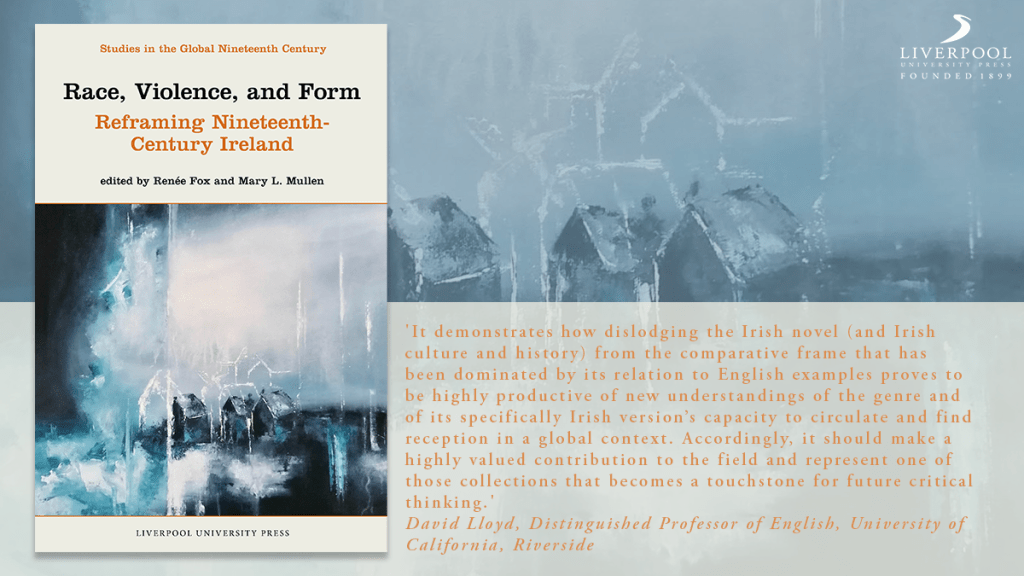
The essays of Race, Violence and Form address and complicate the intersections between these three terms by reflecting on what we have been taught to see, and not see, when we look at nineteenth-century cartoons, read nineteenth-century fiction, peruse exhibition guides from the 1893 Chicago World’s Fair, or contemplate Oscar Wilde’s Hellenism. As Renée Fox’s interpretation of Emma Donoghue’s The Wonder (2016) powerfully demonstrates, breaking through one’s own habits of reading to notice the violences they occlude can itself be a violent process. In Donoghue’s novel, a child nearly dies when characters get so lost in what they expect the genre of her story to be that they miss the very real suffering happening right before their eyes. Like these characters, it is our responsibility to question the stories we’ve been trained to find, and to recognize that our ways of using these stories have the power to produce great harm or to enable great insight.
Fox’s essay focuses on the former, but Amy Martin’s essay addresses the latter, arguing that sometimes empirical observation isn’t enough to show us the material realities of global suffering. She explains that Karl Marx’s critique of colonial capitalism required literary modes, especially the gothic, to produce connections between Ireland and other colonial spaces. Martin’s attention to the nuances of language and genre also appears in Simon Joyce’s essay, which looks closely at the ways Oscar Wilde’s early writing on Hellenism calls into question longheld associations between Wilde’s queerness and his training at Oxford. Tracing connections between Wilde’s writing and the writing of his mentor at Trinity College Dublin allows Joyce to unfurl the connections in Wilde’s Hellenism between queerness, Irish politics, and empire, rewriting the story of Wilde’s sexuality as one deeply imbricated with his Irish identity.
While we can’t address all of the volume’s essays in this post, together they reframe nineteenth-century Ireland by offering new theories of racialization, new approaches to colonial violence, and new understandings of Irish literary forms. And, as Talia Schaffer argues in her response essay in the collection, behind this reframing is a great deal of care. Most notably, the care of Sara Maurer, who first conceived of the collection and who demonstrated throughout her career that the best scholarship is collaborative, resulting from shared questioning and conversation. We dedicate this volume to her.
Renée Fox is Associate Professor of Literature and Jordan-Stern Presidential Chair for Dickens and Nineteenth-Century Studies at the University of California, Santa Cruz. Mary L. Mullen is Associate Professor of English at Villanova University. Race, Violence, and Form: Reframing Nineteenth-Century Ireland is available to buy via the LUP website here, with a 20% discount.
Follow us for more updates
Sign up to our mailing list
Follow us on social media
www.liverpooluniversitypress.co.uk
 Liverpool University Press Blog