
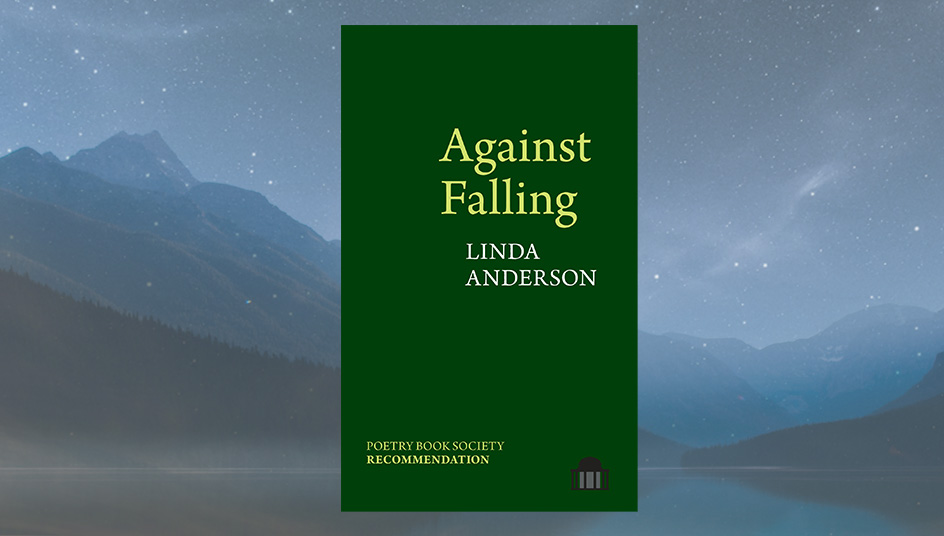
Each year our Pavilion Poetry students assist with the publishing of our new collections, dedicating their time to an individual poet. In this interview, Olivia Soper talks with author Linda Anderson about her new collection, Against Falling (Pavilion Poetry, 2026).
How would you describe your collection in three words?
Any three words I come up with inevitably seem far too general and remote from the collection. One of the things I love about poetry is how meaning radiates from a particular detail, word or connection. But I suppose the things I would highlight that I’m exploring in Against Falling are time, liminality, and perception.
What is your favourite poem from the collection and why?
I’m going to say Notebook 1, even though, as it’s in prose form, you can dispute whether it’s a poem. But this piece of writing took me quite a long time and was the place where the writing took over and surprised me and seemed to lead me, even push me, towards new ways of thinking. The idea of the writing process is important in this collection, the idea that poems are the result of other writing, and that behind every poem are unfinished poems, false starts, different beginnings, that go on existing as residues and traces within the finished poem. I’ve spent a lot of time as a researcher and academic reading writers’ diaries, drafts and notebooks and I’ve always been intrigued by D.W.Winnicott’s idea of an intermediate area or transitional space, which he equates with both play and creativity, where the provisional can be kept alive.
So far as Notebook 1 goes – and the other Notebook pieces– I began by thinking I would put together some fragments from my own notebooks to test whether they could make a poem. However, as I tried to do this, I realized that an essential part of what the notebooks were was being lost. Similarly, writing about the notebooks seemed to represent them in a falsely coherent way. What I then edged towards was incorporating some fragments from my notebooks into a process of thinking, or dialogue, letting connections occur, float up, almost without my agency, from the process itself.
What should readers expect from your book?
In my poem, ‘Garden’, I refer to the child ‘making up multiple selves’. That’s still part of the joy of creativity, that you’re not fixed in one place, and that, with poems, you can start from different places or points of view or use different voices. Of course, I also hope that there are connections. In the poems that are set in particular landscapes, for example, I’m aware that I’m also moving through different times, layers of remembering; or that, in other poems, perception or seeing begins with the body which is both unstable and fragile. It’s really a matter of what you do with uncertainty. It’s often surprising to find out how differently people read – it can open up new spaces for you as a writer, and certainly reading and writing do not necessarily coincide. As a writer you can’t prescribe how people read, nor should you want to.
Was there a particular inspiration behind this book? If so, please can you go into detail?
Yes, there’s a sense of urgency, which comes from the theme of ageing. It’s impossible as you get older, not to be aware that there is limited time left, however optimistic and healthy you are. I also think, with the climate emergency, that none of us can escape a fear for the planet, the sense that we could be moving towards disaster, even extinction. That said, there’s quite a lot in Against Falling about finding alternative, overlooked spaces, or ways of thinking about time. For instance, there’s the ‘meantime’ of the forest in ‘The Lady Vanishes’ or the ‘otherwise’ of ‘Nevertheless’ or even the ‘also’, the time of simultaneity, in ‘Whereabouts Unknown’. Memory, as something that goes on arriving in the present, changes our sense of time too, complicating our understanding of both the past and present.
Is there a poem that didn’t make it into this book that you wish did?
With my first collection, The Station Before, I had worked for years accumulating individual poems. It was then a learning curve, working with Deryn, to turn the poems into a book and to think about what that meant. With Against Falling, I’ve been aware from the start that I wanted to write a collection, and that there were certain ideas driving the poems. There was still a process at the end of arranging and editing and discarding poems. But I think this time there’s more of an arc to the book, of the poems being part of a larger work. It’s a privilege to be published by Pavilion alongside so many poets I admire. To have this second collection feels like quite a landmark for me and means that my career as a writer is as yet unfinished.
Linda Anderson is Emeritus Professor of English at Newcastle University where she founded the Newcastle Centre for the Literary Arts (2009) and the annual Newcastle Poetry Festival. She has written extensively about autobiography and feminist theory but more recently has published widely on Elizabeth Bishop, including the monograph, Elizabeth Bishop: Lines of Connection (Edinburgh University Press 2013), and has co-edited a collection of essays on poetry archives, The Contemporary Poetry Archive: Essays and Interventions (Edinburgh University Press, 2019), Originally from Scotland, she was an editor of Writing Women for many years, has worked to establish innovative poetry archives at Newcastle University, including the Bloodaxe Archive and has published a poetry pamphlet, Greenhouse, with Mariscat Press, 2013. She is currently Chair of Bloodaxe Books. Her first poetry collection, The Station Before (2020) was shortlisted for the Seamus Heaney first collection prize.
Follow @pavilionpoetrylup on Instagram and visit our website to pre-order Against Falling.
Pavilion Poetry Launch 2026
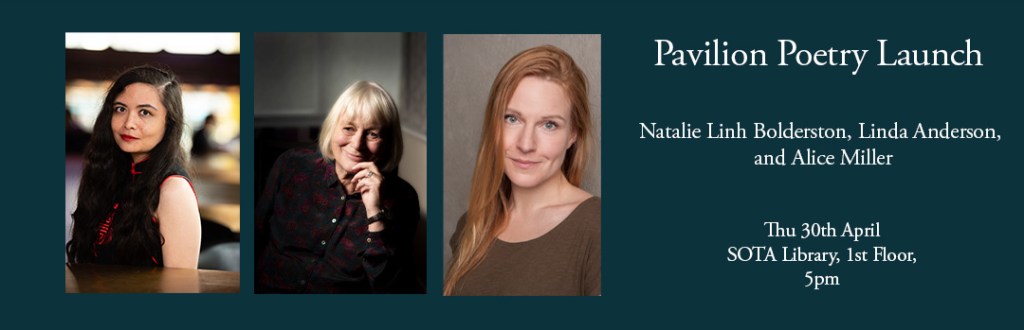
Join us in Liverpool on Thursday 30th April to launch our new collections from Natalie Linh Bolderston, Linda Anderson, and Alice Miller with the Centre for New and International Writing. Register for the free event here.

Follow us for more updates
Sign up to our mailing list
Twitter | Instagram
www.liverpooluniversitypress.co.uk

