
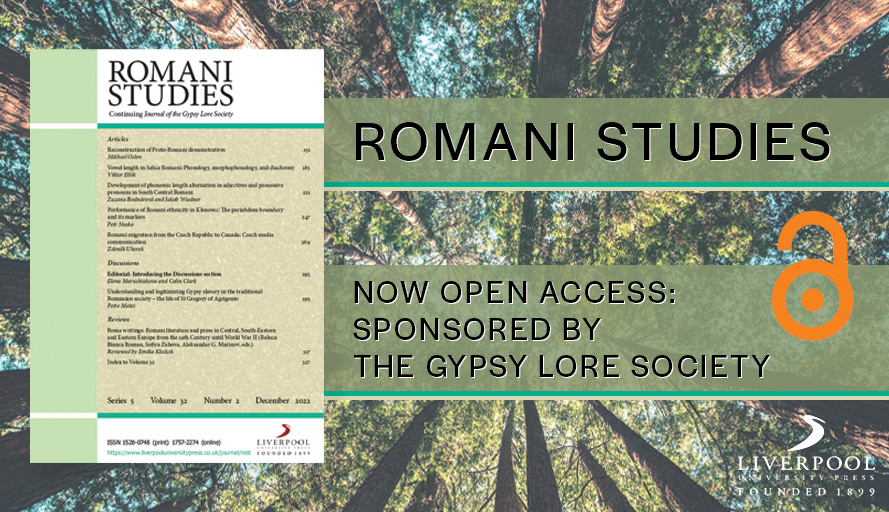
Liverpool University Press is delighted to announce that Romani Studies is now a fully Open Access journal thanks to sponsorship from the Gypsy Lore Society. As an international , interdisciplinary publication specialising in modern scholarship of all branches of Romani/Gypsy studies, the journal’s transition to Open Access marks an important step in increasing the accessibility of Gypsy/Romani studies research more broadly. Forthcoming issues of the journal will now be freely accessible to all via the LUP website.
About the Journal
Founded in 1888, the Journal of the Gypsy Lore Society was published in four series up to 1982. In 2000, the journal became Romani Studies. On behalf of the Gypsy Lore Society, Romani Studies features articles on many different communities which, regardless of their origins and self-appellations in various languages, have been referred to in English as Gypsies. These communities include the descendants of migrants from the Indian subcontinent which have been considered as falling into three large subdivisions, Dom, Lom, and Rom. The field has also included communities of other origins which practice, or in the past have practiced, a specific type of service nomadism. The journal publishes articles in history, anthropology, ethnography, sociology, linguistics, art, literature, folklore and music, as well as reviews of books and audiovisual materials.
Dr Petre Matei, Editor-in-chief of Romani Studies has said:
Romani Studies, a journal with a history that began in 1888, has taken a big step. Starting in June 2023, all articles published in Romani Studies will be fully open access. This change will allow Roma and Romani Studies scholars from around the world to read our journal for free. The move will benefit both readers and authors, leading to greater visibility of articles and better impact of scholarly research on and by Roma.
The journal publishes two issues per year, in December and June, and since 2020 one issue has been a monothematic volume. Volume 33 (1) 2023, published this month, is devoted to “Romani Women and Civic Emancipation in the Interwar Period” and has as guest editors Raluca Bianca Roman (Queen’s University Belfast) and Sofiya Zahova (University of Iceland). The next monothematic volume is 34 (1) 2024, with the theme “Romani People as Object and Subject of Scientific Inquiry: Scientification of Roma or Romanifying Science” proposed by Victoria Shmidt (Institute of History, University of Graz) and Bernadette Nadya Jaworsky (Faculty of Social Sciences, Masaryk University). Volume 33 (2) 2023, to be published in open access in December, addresses topics that have long been in historical debate and are now being answered, such as a linguistic study of the origin of the endonym Sinti, or subjects of great topicality that are being verified by new archival discoveries, such as the repressions against the Polish Gypsies carried out in the 1930s-1940s by the Soviet authorities with the help of the State Security organs of the USSR. We are convinced that this volume will be of interest not only to our dedicated readers, but also to academic and general readers outside the Romani Studies community.
Professor Colin Clark, editorial board member for Romani Studies and Associate Dean for Research and Innovation at the School of Education and Social Sciences, The University of the West of Scotland, said:
“The transition of Romani Studies to an open access journal with Liverpool University Press is to be warmly welcomed and celebrated. It will mark a new beginning in the academic life and impactful reach of the journal. Being open access will mean that the research published inside the pages of the journal will now have a much greater readership, from both inside and outside of universities. Papers can now be read, without charge, by all interested parties, not least individuals from the communities that Romani Studies is largely concerned with. In the wider context of sustained global efforts to decolonialise research and its published findings, this move to open access is symbolically, politically and intellectually very important. Future dialogue and discussions between researchers and community members will now be possible with this freedom of information and knowledge.”
Browse the latest issue of Romani Studies fully Open Access via the LUP website >

Browse the Table of Contents for the latest issue:
Editorial
Sofiya Zahova
Articles
Forgotten pioneers? The Karelian connection and the role of Kaale women in the mobilisation of Finnish Roma at the start of the twentieth century
Raluca Bianca Roman and Risto Blomster
The involvement of women in the Roma movement of the interwar period in Romania
Petre Matei
Women in the circle of the “royal” Kwiek family in the Second Polish Republic (1918-1939)
Alicja Gontarek
Women’s evangelical activities and church growth in Romani communities
Magdalena Slavkova
Roma women activism under Communist rule: The cases of the USSR (the 1920s and 1930s) and Bulgaria (1960s and 1970s)
Elena Marushiakova and Vesselin Popov
Discussion Forum
Title Women breadwinners in Gypsy socio-professional groups of pre-industrial Wallachia
Julieta Rotaru
FAQs
What does this change mean for readers?
You will read the journal in digital form. The journal will be available free of charge to everyone. The journal will not be available in paper form. It is hoped that the journal being Open Access will bring Romani Studies to a wider readership.
What does this change mean for contributors to Romani Studies?
From 2023, Romani Studies articles are Open Access immediately upon publication, whereby an author publication fee (APC) is charged after acceptance. The publication is fee is £1,250/$1500 USD for each published article. Authors who do not have the means to cover the publication fee may request a waiver after acceptance and are encouraged to request more information. All articles are published under a CC-BY license. Members of the Gypsy Lore Society will have priority for fee waivers. Please direct questions to romanistudies.authors@gmail.com.
What does this mean for Gypsy Lore Society members?
Membership dues will continue to support the activities of the Gypsy Lore Society — the Newsletter, the annual conference and Romani Studies. Members will continue to pay discounted conference fees. Members will have access to the Romani Studies electronic archive, 2000-2022. Members are eligible and are encouraged to vote for the Board of Directors, the governing body of the Gypsy Lore Society.
Membership fees
Membership dues have remained at $40 per year since 2012. Beginning with the 2023 membership year, dues will be $50. The Romani Studies archive (2000-2022) is available to individuals only through individual membership of the Gypsy Lore Society.
Where can I find out more about LUP’s Open Access policy?
More information on publishing Open Access with Liverpool University Press can be found on our Publishing Open Access Journal Articles page, which includes the Open Access Journal Article Contributor Agreement. This agreement outlines the agreed terms, whilst confirming that authors retain all rights in and to the article.
‘We are delighted that Romani Studies has been able to flip to Open Access from 2023, owing to the generous sponsorship of the Gypsy Lore Society. Benefits for the journal will include higher citation rates and usage as OA articles are viewed and cited more often, and greater public engagement as content is available to those who can’t access subscription content through an institution, like practitioners. As an interdisciplinary journal, Romani Studies will also benefit from increased reach as OA journals that cross multiple disciplines help researchers connect more easily by providing greater visibility of their research.‘
– Clare Hooper, Head of Journals, Liverpool University Press
Correspondence
Manuscripts should be sent to the editors at:
romanistudies.authors@gmail.com
Books for review should be sent to the book reviews editor:
Asst. Prof. Małgorzata Kołaczek
Instytut Studiów Międzykulturowych
Uniwersytet Jagielloński w Krakowie
Poland
Email: malgorzata.kolaczek@uj.edu.pl
For full details on submissions and editorial enquiries, download the Romani Studies Editorial Policies.
More in Romani Studies from LUP:
European Roma: Lives beyond Stereotypes edited by Eve Rosenhaft & María Sierra
This book presents new research on the Romani contribution to European culture and society since the nineteenth century. Illustrated studies from nine countries exemplify their creative presence – as writers, artists and performers, political activists and resistance fighters, traders and entrepreneurs, circus and cinema managers and purveyors of popular science.


Follow us for more updates
Sign up to our mailing list
Twitter | Instagram
www.liverpooluniversitypress.co.uk
 Liverpool University Press Blog