
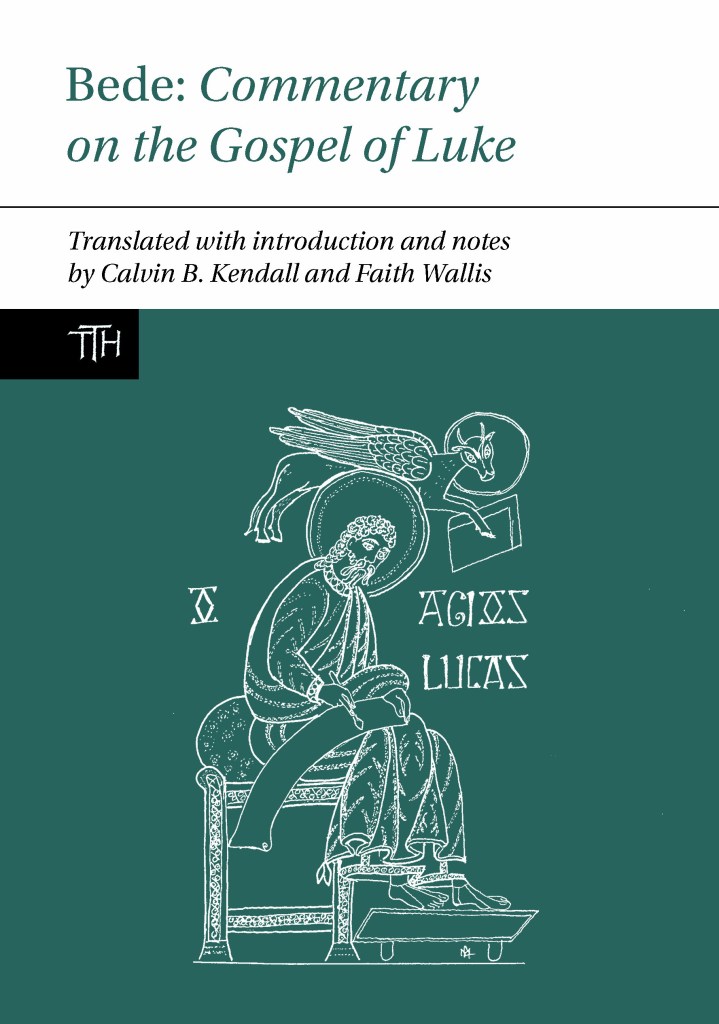
Best known as the author of The Ecclesiastical History of the English People, Bede (d. 735) also penned works on science, as well as sermons, poetry and hagiography. He wanted, however, to be remembered primarily as a commentator on the Bible – one who ‘followed in the footsteps of the Fathers’ to expound the sacred text. Bede’s numerous commentaries have previously not excited much interest among historians, but this has changed dramatically in recent years. Scholars like Scott DeGregorio and Rosalind Love – whose translations of Bede’s commentaries On Ezra and Nehemiah and On First Samuel were recently published in Liverpool University Press’s Translated Texts for Historians series – have demonstrated how Bede’s passionate commitment to the reform of the English church and ideas about the role of Christian kings structured his interpretation of Biblical narratives. Many of these concerns with reform and justice seep into the lines of his commentary on Luke’s Gospel, the latest addition to the LUP Bede bookshelf. But this commentary also features a unique autobiographical passage concerning exorcism – one which was used 150 years later to defend a repudiated Frankish queen, and to smear her husband’s mistress with charges of witchcraft.
Being a commentary, On Luke hangs all its contents on exegetical ‘hooks’. In this case, the hook is the account in Luke 8:30 of the exorcism of the Gadarene demoniac. Jesus first asks the demon possessing the man what his name is, and the demon replies ‘Legion’, because there were in fact many demons involved. Bede feels obliged to explain that the omniscient Son of God surely already knew the demon’s name; he only posed the question to enhance the revelation of his power to the surrounding multitudes. But then he continues:
But even the priests of our time, who know how to drive out demons by the grace of exorcism, are accustomed to say that sufferers cannot be healed unless they reveal openly by confession, as far as they can know, all that they suffered, waking or sleeping, from the unclean spirits through sight, hearing, taste, touch, or whatever other sense of body or soul. And especially when, appearing either to men in the shape of a woman or to women in the guise of a man, by an abominable miracle, incorporeal spirits, demons whom the Gauls call Dusii, pretend that they desire and perform sexual intercourse with the human body. And the priests order that the name of the demon by which he said he was called be made known as well as the terms of the oath by which they concluded either contract of love.
Gospel of Luke
The reference to the Dusii comes from Augustine’s City of God 15.23, and Augustine implies that sexual intercourse with demons actually takes place. Bede, though, is more cautious: to him, the demons ‘pretend’ desire and even coitus, to force their victim to enter into a contract.
Bede then goes on to recount a remarkable occurrence that happened to a friend:
An affair very like a fable, but still true, and which is very well known by the testimony of many, is that a certain priest close to me reported that he began to heal a nun from a demon, but that as long as the matter was concealed, he was able to make no progress with her. However, he said that once she had acknowledged the apparition by which she was molested, he immediately put it to flight with the necessary prayers and other kinds of purifications, and that he had healed the body of the same woman of the ulcers she had contracted from the touch of the demon by means of blessed medicinal salt which he applied with care. But he said that when he could not by any means close one of the ulcers which he found had pierced the upper part of her side without it immediately opening, he received the adviceby which she was healed from the very womanthat he wanted to heal. ‘If’, she said, ‘you sprinkle the holy oil for the sick as the same remedy, and so anoint me, I will immediately be restored. For in the spirit, I once saw a girl in a certain faraway city, which I never saw with my own eyes,
Gospel of Lukelabouring under the same adversity, and she was healed in this way by a priest’. He did as she had suggested, and immediately the ulcer consented to accept the remedy, which it had before rejected.
This anecdotal digression is unique in Bede’s Biblical commentaries, and perhaps seems more suitable to the Ecclesiastical History or one of Bede’s saints’ lives, or even a sermon. The thread that links it to Luke 8:30 is highly tenuous, and by including it, Bede has shifted the focus from the need to make the demon speak his own name, to the need for those seeking exorcism or spiritual healing to reveal the nature of their relationship with the demon. Moreover, he has re-directed our attention from the ravings of the (male) Gadarene demoniac, to female victims, one of them a nun. Unlike the man in Luke’s narrative, these women have agency. Bede suggest that their plight is the consequence of a contract; that the effect of possession is not so much mental disarray as bodily sickness; and that the victim herself can have preternatural insight into the means of cure.
The themes of women, sexuality, and (possibly) magic gave this unusual passage in the Commentary on the Gospel of Luke a significant after-life in the Carolingian period. In the middle of the ninth century, the Frankish kingdom was rocked by a royal divorce scandal: King Lothar II sought to repudiate Queen Theutberga so that he could marry his mistress. Many of Lothar’s ecclesiastical advisers were prepared to smooth his path, and Theutberga was condemned on charges of incest at a synod. But Hincmar, Archbishop of Reims and ally of Lothar’s uncle and rival Charles the Bald, opposed the King’s plan. Hincmar argued that the process in Theutberga’s trial was flawed on legal and theological grounds. In particular, he raised the possibility that the king’s mistress may have used magic to deceive him and bring about the queen’s downfall. It is at this juncture that Hincmar quotes the entirety of the passage above from Bede’s commentary on Luke, in order to illustrate women’s ambivalent vulnerability to demonic magic, especially sexual magic. In the end, Lothar’s case against Theutberga collapsed.
Hincmar’s message was certainly not one that Bede intended to convey: he was, as we said, sceptical about sex with demons, and never suggested that the women in his narratives were authors or victims of human magic. But we can speculate that in spite of this, Bede would have rejoiced to know that his writings contributed to securing justice for the queen. And those writings definitely suited Hincmar’s purpose not least because they came from the pen of Bede, that ‘candle of the Church’, whose reputation only a century after his death was compared with that of the Fathers.
Faith Wallis is Professor Emerita (Retired), Department of History and Classical Studies, McGill University. Her many books include Isidore of Seville: On the Nature of Things (2016), Bede: Commentary on Revelation (2013), and Bede: The Reckoning of Time (revised edition 2004), all in the Liverpool University Press Translated Texts for Historians series.
Bede: Commentary on the Gospel of Luke, edited by Faith Wallis and Calvin B. Kendall, is out now.

Follow us for more updates
Sign up to our mailing list
Twitter | Instagram
www.liverpooluniversitypress.co.uk
 Liverpool University Press Blog