
Prisoner of the Levant, a novel written by Darina Al Joundi and translated by Helen Vassallo, offers a moving account of the struggle for emancipation and enlightenment, condemning a world that restricts women’s freedom. In this blog post, Helen Vassallo explores the novel’s premise and reflects on her experience translating this impactful work.
Trigger Warning: This post contains graphic descriptions of gender-based violence, abuse, and wrongful imprisonment.
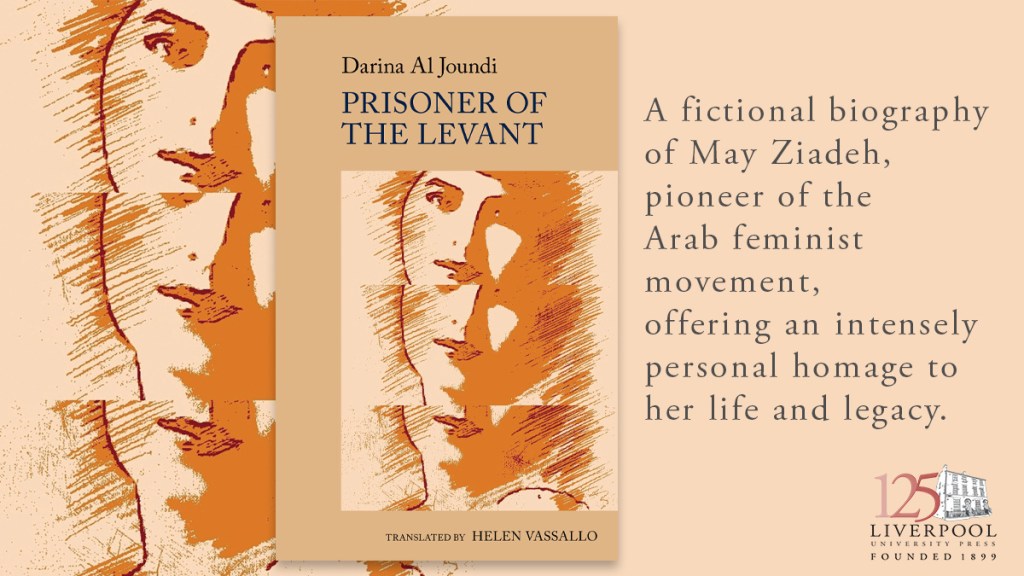
Prisoner of the Levant is a fictional biography of Arab feminist pioneer May Ziadeh, written by Darina Al Joundi, an author whose life experiences represent a tragic echo of May’s own. Darina is a stage and screen actor whose one-woman plays brought her national recognition in France. In these plays (The Day Nina Simone Stopped Singing, which premiered at the Avignon festival in 2007, and its sequel Marseillaise My Way, which saw her return to Avignon in 2012), Darina performs as Noun, a character she describes as “a part of her”. Noun recounts Darina’s own childhood and coming-of-age during the Lebanese civil war, and her attempts to carve out her identity as a “free woman” in a world that would not allow her to be free. It was Darina’s darkest moments that echoed May’s. After the death of May’s father, Elias Ziadeh, May was imprisoned in an asylum under false claims of madness from her male cousins who wanted to steal her inheritance. After the death of her own father, notorious journalist Assim Al Joundi, Darina was beaten violently and incarcerated in an asylum under similarly fallacious claims from the men in her family who deemed her behaviour shameful to their honour and who claimed to be fulfilling their duty to correct the behaviour of a “deviant woman”. In 2017, Darina wrote about May’s life for Éditions Grasset’s Nos héroïnes (“our heroines”) series, describing the process as writing May’s story to come to terms with her own. Prisoner of the Levant is my translation of this work.
May Ziadeh is, then, the “prisoner” of the title, though I omitted in the translation the subtitle that accompanied the French original (“La vie méconnue de May Ziadé”/ “The little-known life of May Ziadeh”). This rather prosaic sub-heading emphasises the biographical aspect of the text that, in my opinion, somewhat “undersells” it, detracting from the deeply personal investment that Darina has in May’s life. This is not, strictly speaking, a work of non-fiction, and nor is it focused on Ziadeh’s literary work as many academic studies have been. Rather, this is May’s life brought to life in the form of a short novel (a short novel which, it must be said, references a vast range of people and places; if I had included any “translator’s acknowledgements” in this book, chief among them would have been gratitude to Google Earth for my whistlestop tour of villages in North Africa and the Middle East). Prisoner of the Levant does not pretend to offer a full account of May’s life, but rather focuses on periods of her life and aspects of her experience that are most meaningful to Darina, prioritising May as a person rather than as a writer.
At the heart of Prisoner of the Levant is a love story: May’s epistolary relationship with Khalil Gibran, and particularly the intense connection they shared and commitment they made without ever meeting in person (May lived between Beirut and Cairo; Gibran was in exile in the USA). Translating the snippets of their letters was particularly challenging: the formality of French does not map easily onto a lover’s note in English (romance languages are more, well, romantic, and can easily turn to either archaisms or schmaltz in English), and so it was important to find a balance between the elegance of two acclaimed writers penning their thoughts and a realistic expression of intimate love. With my 21st-century feminist sensibilities, I confess I found it hard to translate terms of endearment that almost infantilised May (“my princess”, “my little one”), but I have always believed that my own ideological position should not influence the way I translate, and so they remain as Gibran intended and as May received them…
May’s story is a tragic one, yet here as in her writing about her own life, Darina determinedly eschews melodrama and instead uses a simple, matter-of-fact tone (often manifest in short sentences) to describe horrific events. This is particularly evident when May is incarcerated in an asylum: she goes on a hunger strike, and as a result is subjected to a series of degradations at the hands of her doctors. Tubes are inserted into her nose to pump nutrients into her; when May pulls them out, they try to feed them through her mouth. May clamps her mouth shut to refuse their reinsertion, and so the doctors knock out her teeth to make a hole big enough to pass the tubes through. When at night she forces herself to vomit up what has been pumped into her during the day, she is punished by being sent to the basement, imprisoned in an lightless underground cell infested by cockroaches. These sections might be hard to read, but I believe that we should never shy away from difficult texts – whether reading, teaching or translating – because often this can serve to further silence the experience of people who are already exposed to brutal silencing. So the translation of these emotionally upsetting sections becomes not only an exercise in linguistic possibility (how are we aware is this happening, how is it conveyed, how does that map onto English?) but also in responsibility. I am grateful to Liverpool University Press for recognising and sharing in this responsibility: publishing Prisoner of the Levant in translation is an act of solidarity that embodies the values of the World Writing in French series to promote marginalised or potentially silenced stories from a range of Francophone contexts. I am thankful too for the opportunity to amplify Al Joundi’s commitment to fighting against people and customs that deny women their autonomy, to bear witness to the tragedy of autonomy denied, and to contribute to the endurance of May’s legacy.
Helen Vassallo
Helen Vassallo is Associate Professor of French and Translation at the University of Exeter.
Find out more about Prisoner of the Levant on the Liverpool University Press website.
Follow us for more updates
Sign up to our mailing list
Twitter | Instagram
www.liverpooluniversitypress.co.uk
 Liverpool University Press Blog