
The Life of Rachel Speght, by Helen M. Stringer, has recently been published in the English Association Monographs: English at the Interface series. This blog post explores the biographical study of the boundary-pushing early modern polemicist Rachel Speght.
At a time when geo-political borders are hardening all around us at a disturbing rate, the work of crossing borders and pushing against entrenched boundaries in the realms of knowledge and ideas becomes ever more important.
The English Association’s ‘English at the Interface’ Series has been at the forefront of this work in literature and the humanities since 2019. A glance at recent titles – including Chantelle Bayes’s addition to the emerging field of ecocriticism from a post-humanist, Australasian perspective and John Culbert’s analysis of the political dimensions of travel discourse, from Edith Wharton to Behrouz Boochani – highlights the fruitfulness of this interdisciplinary approach, and its relevance to current concerns. Similarly, a new biographical study of the 17th-century proto-feminist (and puritan) Rachel Speght makes a distinctive but complementary contribution to this eclectic, evolving catalogue. For, as I argue in The Life of Rachel Speght: A Forward Woman, Speght’s life exemplified the work of challenging hard borders, in a highly unfamiliar context but in controversies that speak to the present moment in sometimes surprising ways.
Female voices as agents of change, questioning the status quo in politics and offering reinterpretations to accepted lore, have been a constant of our history. However, uncovering and analysing these voices from the early modern period, so often muted, obscured or even silenced at the time or in the record, is a work of painstaking academic collaboration. The Life, then, consciously builds on at least four decades of scholarship, from the ground breaking excavations of Barbara Kiefer Lewalski to recent new perspectives revealed by Christina Luckyj, Danielle Clarke, Jennifer Richards, and many others.
The term ’puritan’ seldom carries connotations of radical dissent. Sometimes, however, the most effective dissidence comes from the unlikeliest sources, and so it is with Speght, a 19-year-old minister’s daughter, who, in 1616, stepped out of the very heart of London’s godly community to deliver radical socio-political critique, which, challenging entrenched boundaries and venturing into no-go areas on gender, faith, and politics, marked her out as a dangerously ‘forward’ woman.
Defending her sex, as the first writer to muzzle ‘Blackmouth,’ the misogynist pamphleteer Joseph Swetnam, in the querelle des femmes debate (1616-17), she also dared to ‘preach’ in print on behalf of women to the leading godly preachers of the day. Her polemic, A Mouzell for Melastomus, launched a pamphlet war which quickly spread beyond the scope of Swetnam’s scurrilous railings. Amid the storm surrounding the Overbury Scandal, combining the sensations of cross-dressing and murder, the controversy began to probe deeper questions – about gender fluidity and the social order, for example, and the power of banter to denigrate – which continue to resonate with modern readers.
Speght’s bold step into this public arena brought her the most threatening kind of notoriety. A measure of this can be seen in an annotated copy of A Mouzell, now in the Beinecke Library, where an enraged reader poured out the contents of his mind. Against her self-identification as David taking on Goliath, for example, he wrote – ‘what? throwing stones? give mee her arse.’ Yet, undeterred, she went on to publish a second polemical work, pressing the claim for girls to gain an education on a par with boys, and asserting the right of an educated woman to debate with men on equal intellectual terms in a public forum.
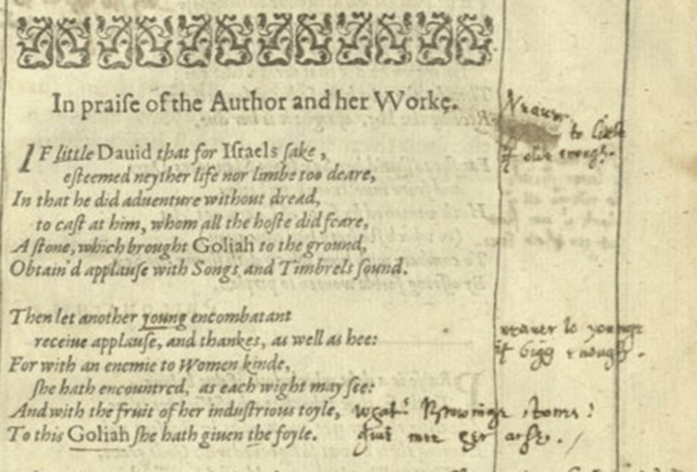
Contemporary annotations in a copy of A Mouzell for Melastomus (1617)
By kind permission of the Beinecke Rare Book & Manuscript Library
Though Speght’s publishing career ended with her marriage to a godly clergyman in 1621, The Life follows her into her later years to find, not the ‘virtual blank’ of quiet obscurity of traditional accounts, but a second phase of polemical action. Over 30 years after muzzling ‘Blackmouth,’ she stepped again into the spotlight, ‘fomenting faction’ against the religio-political enemies who had ejected her husband from his Suffolk parish. In the context of civil war violence and the excesses of the East Anglian witch-hunts (1645), she crossed the hard border of feminine propriety to challenge the powers-that-be. The deep latent socio-political anxieties she thereby ignited – of female access to privileged knowledge generating fears of male impotence, of female insubordination auguring a descent into anarchy – are not, we might say, matters of purely historical interest only. Moreover, the harsh reality of her experience – a woman suffering as collateral damage in a civil war – remains starkly relevant today.
In its methodology, too, The Life stays true to the core ethic of the EA series. Working at the point of convergence of English literature with multiple disciplines, it draws on scholarship in religious, political, social, gender, local, and book history, early modern cultural and literary studies, and biblical studies. Considering a wide array of evidence, from conventional written archival sources and contemporary published texts to the remnants of material life (including artefacts, such as recipe books and pewterware), it presents Speght, a bold and sophisticated writer and protagonist, in the complex and dynamic milieu in which she lived. Viewed in this light, we find Speght’s life challenging what, arguably, remains an enduring hard border of perception in current scholarship on early modern women and writing – between ‘puritanism’ and ‘feminism.
Helen M. Stringer
Helen M. Stringer is an independent scholar who holds a PhD in history from the University of Sussex. She was a teacher of history for many years and from 2015 until her retirement was a Head within the Girls’ Day School Trust.
English Association Monographs: English at the Interface explores English Studies at the interface with other languages, cultures, professions and disciplines from the medieval period to the present day.

Follow us for more updates
Sign up to our mailing list
OSE Bluesky | LUP Bluesky | Instagram
www.liverpooluniversitypress.co.uk
 Liverpool University Press Blog