Liverpool University Press is the UK's 3rd oldest university press and one of its fastest growing publishers. We publish humanities and social sciences.
Translated Texts from Antiquity is a sister series to the renowned Translated Texts for Historians series, published by Liverpool University Press for over thirty years, latterly also joined by Translated Texts for Byzantinists. With a broad geographical focus, including the Ancient Near East and Egypt as well as the Mediterranean world to c. AD 300, and a variety of languages in addition to Latin and Greek, Translated Texts from Antiquity will make valuable sources available to ancient historians and all those studying antiquity. Pomponius Mela: Geography of the World translated with a commentary by Georgia Irby, is the first volume in the series. Here, Georgia explains what she found intriguing about the ‘delightful’ and ‘quirky’ Pomponius Mela, and delves into the translation process.
Pomponius Mela—about whom we know practically nothing other than that he very proudly hailed from Tingentera, southern Spain —is such a delightful, quirky author whose Latin style extends from a boringly prosaic litany of toponym after toponym to the downright perplexing. The challenge when reading Mela is often trying to restore what he has left out from his narrative.
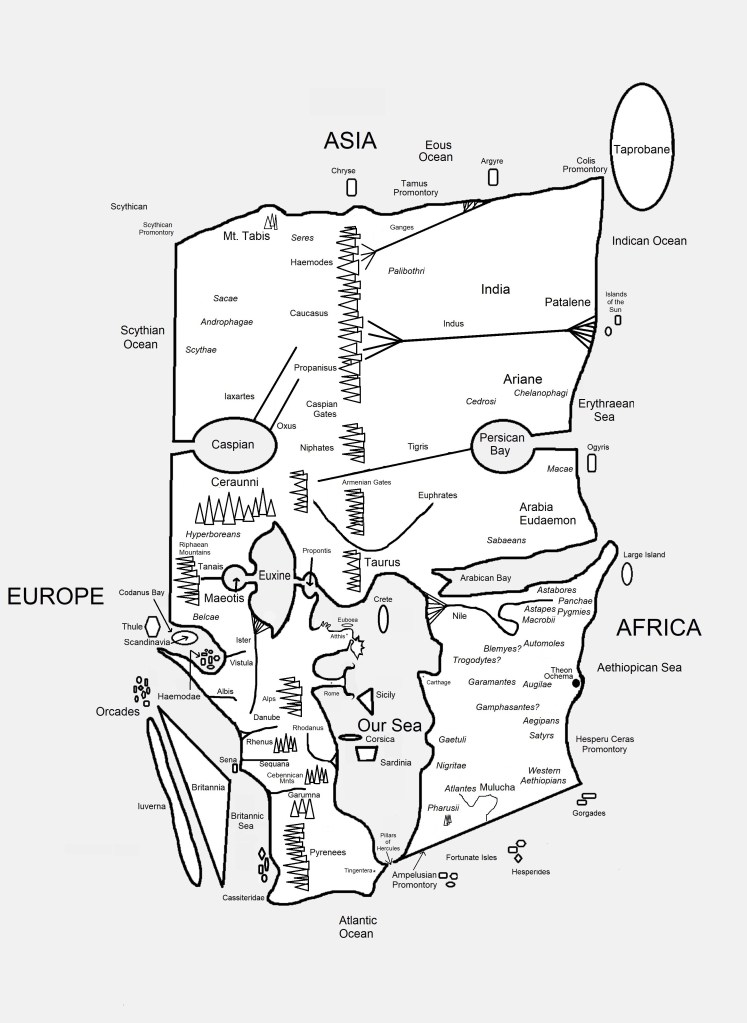
Quickly, Mela’s Geography of the World is a short book in Latin, about 16,500 words, dating to the mid 40s ce, and giving a description of the world known to the Romans at the time. As with many ancient works, the title does not survive, if it had one: most ancient “titles” are just the first few words or modern attributions. It is essentially a narrative map, tracing three paths through the inhabited world: 1) the coasts (and inland settlements) along Our Sea (the Mediterranean), spanning most of the first two books (1.25-2.96); 2) the islands within Our Sea (2.97-126); and 3) the lands beyond Our Sea (book 3: including the Atlantic, northern Europe, winding toward India and Taprobane (Sri Lanka), and then back toward Africa, where Mela completes an imagined circumnavigation of the continent).
A few words about the translation process. Translation is an act of interpretation: no language ever goes neatly into another one. Each language is its own individual way of thinking about the world and the culture that a language represents. My challenges in translating Mela included trying to stay as faithful as possible to the idiosyncrasies of Mela’s Latin within the confines of English idiom: to this end, I break many of the “rules” of good English grammar: I replicated Mela’s passive tense verbs (“where the sun is plunged…”) and his use of lots of participles (“the Nile, rising out… more contracted little by little”). The Latinless reader will hopefully then have some sense of Mela’s authentic style and authorial voice. Further, while Mela acknowledged the “dryness” of his material, he nonetheless had literary aspirations, which are evident in the (occasional and) artful arrangement of words into rhetorical devices (e.g., chiasmus: unum septentrione, a meridie duo, “one from the north, from the southtwo”); and intertextuality (textual echoes) of his Latin literary predecessors including Julius Caesar, Sallust, Livy, and even Vergil, all renowned for their elegant style. It’s all too easy to dismiss semi-technical writers as style slackers.
Translation is an act of interpretation: no language ever goes neatly into another one. Each language is its own individual way of thinking about the world and the culture that a language represents.
Many things really intrigued me as I delved deeper into this text. For example, Mela was a native of southern Spain, and thus the product of a rich multi-cultural society, including Phoenician, Greek, and Roman. And Mela often forefronted his North-African Phoenician heritage, including his deep interest in the myth of Hercules (identifiable with the Phoenician god Melqart) and his use of the Pillars of Hercules as a geographical frame: Mela’s world started and ended with the Pillars, and the reader is taken back to the Pillars close to the work’s midpoint. In addition, Mela’s view was of a world inhabited by peoples in a puzzling and tangled up order: the world is thus a puzzle to be unfolded and decoded. From time to time Mela was certain to remind the reader of the world’s puzzling arrangement. Furthermore, Mela’s landscape is a fully anthropomorphized and vilified personality. This “ethical landscape” can be nurturing or dangerous, and it sometimes accommodates human interests and elsewhere impedes them, aligning with the Greek and Roman prejudice that everything (land, flora, and fauna) exists in service to humankind. I was also fascinated by his use (and misuse) of his predecessors, including his artful allusions to great Latin and Greek writers, and his “adaptations” (to put it politely) of information recorded in those hoary sources. I wonder if this is a product of Mela working in several languages at once: Latin, Greek, and possibly even Phoenician. Moreover, like other writers of his time, Mela was fascinated by the paradoxical, and his prose sparkles when he describes paradoxical phenomena: Psammetichus’ labyrinth, the Corycian cave, the phoenix.
A reimagination of Mela’s map, created by author Georgia Irby.
Finally, a word about the commentary. Mela included over 1,000 individual toponyms of towns and cities, regions and provinces, harbors, ports, islands, mountains, promontories, caves, landmarks, as well as nearly 270 hydronyms (seas, oceans, bays, gulfs, straits, rivers and lakes, oases, fountains), and about 250 separate ethnonyms of peoples. This is a lot of raw data. So, I tried to include one interesting or peculiar thing about each place, the sort of information that Mela would want his readers to know, or the bizarre details that would have delighted him (i.e., the flowers at Henna in Sicily were so fragrant that they prevented hunting dogs from holding a scent on a trail). The commentary is intended as both a guidebook for the virtual traveler and as a collection of clues for those trying to solve the puzzle of Mela’s inhabited world. It is my hope that the reader will be both entertained and rewarded by a closer look at this eccentric author, with his interest in the paradoxical, deep topographical selectivity, and his unique (Iberian-Punic-Roman) view of the first c. CE Mediterranean world.
Georgia L. Irby is Professor of Classical Studies at William and Mary, where she works on the history of science, especially cartography, geography, and watery matters, Greek and Latin pedagogy, and mythology. You can purchase Pomponius Mela: Geography of the World here.


 Liverpool University Press Blog