
Black women writers and scholars have been engaged in the process of repairing and restoring history especially as it documents the experiences of Black women in America. This Black History Month, we spotlight Womb Work, a novel that powerfully asserts the importance of Black women’s stories in shaping a fuller, more critical understanding of American literary history.
Black women’s literature has always been more than art—it has been a refuge, a resistance, and a balm. Womb Work grew from this understanding, shaped not only by critical scholarship but by deep listening. I found myself in sacred conversations—with the texts, with the stories of women who trusted me with their truths, and with my own spirit.
Hearing these stories—spoken in quiet rooms, written in brave lines, or shared across generations—was a gift. But it was also, at times, emotionally overwhelming. There were moments during my research when I had to pause. To sit. To breathe. To cry. I often needed time to meditate on what I had read, heard, and seen. The weight of the trauma, the repetition of pain, and the resilience stitched into every word demanded care.
Art became my refuge. As a way to process my emotions and channel what felt like unspeakable frustration and sorrow, I turned to creating mixed-media collages. These pieces, made on canvas, became loving offerings to Black women—past, present, and future. Each collage includes layers of meaning and material: paint, dried flowers, buttons, textured paper, glitter, cloth, words of affirmation, definitions, and countless other embellishments. Every element was chosen with intention, crafted with love.
These collages appear at the beginning of each chapter in Womb Work. They are visual preludes—meditations that honor the stories that follow. In many ways, they came before the words. They held what I couldn’t always articulate yet needed to express. Through them, I found a way to alchemize pain into beauty, testimony into tribute.
The Womb as a Contested Space
My research led me back to the brutal origins of this struggle. In 1662, colonial laws determined that children born to enslaved Black women would inherit their mother’s status—legally binding Black women’s wombs to the machinery of slavery.
Hortense Spillers’ Mama’s Baby, Papa’s Maybe: An American Grammar Book, gave language for what I was beginning to see across these stories: the severing of Black women from their own bodies, reduced to objects of labor and reproduction. That rupture didn’t end with slavery. It continues in the maternal mortality crisis, in the silencing of pain, in the erasure of Black women’s health needs. Through Womb Work, I argue that Black feminist illness narratives respond to this history with a powerful reclamation—restoring agency through the act of storytelling.
The Reparative Power of Storytelling
Again and again, I found myself held by the voices of women who refused to be erased. From Harriet Jacobs’ Incidents in the Life of a Slave Girl to Sojourner Truth’s enduring question, “Ain’t I a Woman?”, Black women have used narrative as a form of survival and resistance.
What emerged in these illness narratives was something profoundly sacred: a space where wounds became words and words became healing. These stories, often centered around womb-related illnesses, don’t simply describe pain—they transform it. They speak to isolation and offer community. They bear witness and build solidarity.
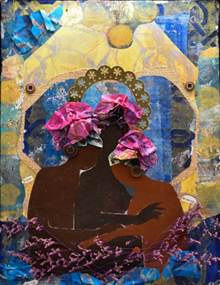
“The Communal Womb” | Womb Work by B. Waller-Peterson
Reimagining Wellness Through Literature
Another deep current that runs through this work is a redefinition of what it means to be well. Wellness, in these texts, is not just the absence of illness—it’s the presence of care, community, and choice. Black women’s health concerns have long been ignored or dismissed by institutional medicine. Yet in literature, I found a different kind of diagnostic—a spiritual, cultural, and communal understanding of healing.
Toni Cade Bambara’s The Salt Eaters opens with a question I kept returning to: “Are you sure, sweetheart, that you want to be well?” It reminded me that wellness is not passive—it is a choice, a struggle, a journey. Toni Morrison’s Paradise reveals the power of collective healing through the women at the Convent, who use storytelling and ritual to recover from trauma. These works reminded me that healing happens not only in the body but in community, in ritual, and in story.
Lucille Clifton’s Intimate Conversations with the Womb
Lucille Clifton’s poems were like whispers of encouragement along the way. In poem to my uterus and to my last period, she speaks to her body with tenderness, grief, and pride. Her work gave me permission to name the losses and changes I’ve experienced in my own body, and helped me see how poetic language can hold what medical language cannot.
Clifton normalizes what so many are told to hide—menstruation, hysterectomy, aging. Her poetry affirms that there is power in naming, and healing in being seen. Her work embodies the very spirit of Womb Work: to make the invisible visible, and to do so with love.
The Enslaved Mother as Wounded Storyteller: Dessa Rose
Sherley Anne Williams’ Dessa Rose brought me to tears more than once. The story of a pregnant fugitive refusing to be defined by her enslavement felt like the embodiment of everything Womb Work hopes to illuminate. Pregnancy here is not just biological—it is symbolic. It’s resistance.
Through Dessa, Williams transforms pregnancy—so often marked by trauma in these historical contexts—into a symbol of resistance. Her survival is not only physical, but narrative. She survives by telling her story, and in doing so, she rewrites the meaning of her body and her future.
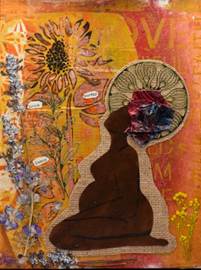
“Worthy” | Womb Work by B. Waller-Peterson
Reparative Reading and Writing as Liberation
At the heart of Womb Work is a belief in the radical potential of storytelling. This is not just literary analysis—it is a call to witness, to listen, and to feel. Reparative reading means looking for the ways these narratives mend, heal, and restore what oppression tried to destroy.
For many Black women, storytelling is a lifeline. Whether through poetry, fiction, memoir, or visual art, we keep showing up for ourselves and for each other. This work is an offering to that tradition.
The Legacy of Womb Work
The women whose words and stories shape Womb Work—Jacobs, Truth, Morrison, Bambara, Clifton, Williams—have gifted us with more than books. They’ve given us mirrors, maps, and medicine. Their narratives do not end with the final page. They live on, reshaping how we think about the body, illness, and healing.
By centering the womb as a space of struggle and resilience, Womb Work affirms that Black women’s health is worthy of care, study, and reverence. And by pairing each chapter with a visual piece born from my own emotional and creative labor, I hope to offer readers not only knowledge, but connection—an invitation to feel, to reflect, and to heal.
Reading these stories through a reparative lens is more than an academic act—it’s a ritual of love, remembrance, and reparation. Because, as Womb Work insists, storytelling itself is a kind of medicine. And Black women have always been master healers.
This blog post was made in partnership with Clemson University Press. Find out more about the Clemson University Press blog here.
Dr. Belinda Waller-Peterson is Associate Dean for Equity and Inclusion at Moravian University and an Associate Professor of English. She teaches courses in African American literature and culture and the Health Humanities. She specializes in women’s health issues, maternity and illness narratives. She is also a licensed Registered Nurse in the state of Pennsylvania. Her nursing experience and English literature background allow her to explore multiple intersecting areas of study including the health humanities, women, gender, and sexuality, and Africana studies. She is currently lead editor on “The Handbook of African American Literature in the Twenty-First Century” book project.


Follow us for more updates
Sign up to our mailing list
OSE Bluesky | LUP Bluesky | Instagram
www.liverpooluniversitypress.co.uk
 Liverpool University Press Blog