
Voltaire and the Sirven affair (1762-1772) by John Renwick has recently been published in the Oxford University Studies in the Enlightenment series. The book offers a fresh and more nuanced assessment of Voltaire’s involvement in the Sirven Affair – a miscarriage of justice that exposed religious intolerance of 18th-century France.
The case concerned the Protestant Pierre-Paul Sirven, whose daughter was forcibly taken by Catholic authorities in an attempt to convert her. Suffering with mental illness, she was later found drowned near the family home. Local officials, motivated by anti-Protestant prejudice, falsely accused the family of her murder, and when they fled, the authorities sentenced them in absentia. Voltaire became involved and campaigned on their behalf, and the affair has often been presented as a personal triumph for him, similar to the Calas case.
In this blog post, Renwick highlights the key arguments from his new book, re-evaluating Voltaire’s involvement and showing that, unlike the famous Calas affair, his role in the Sirvens’ eventual exoneration was limited.
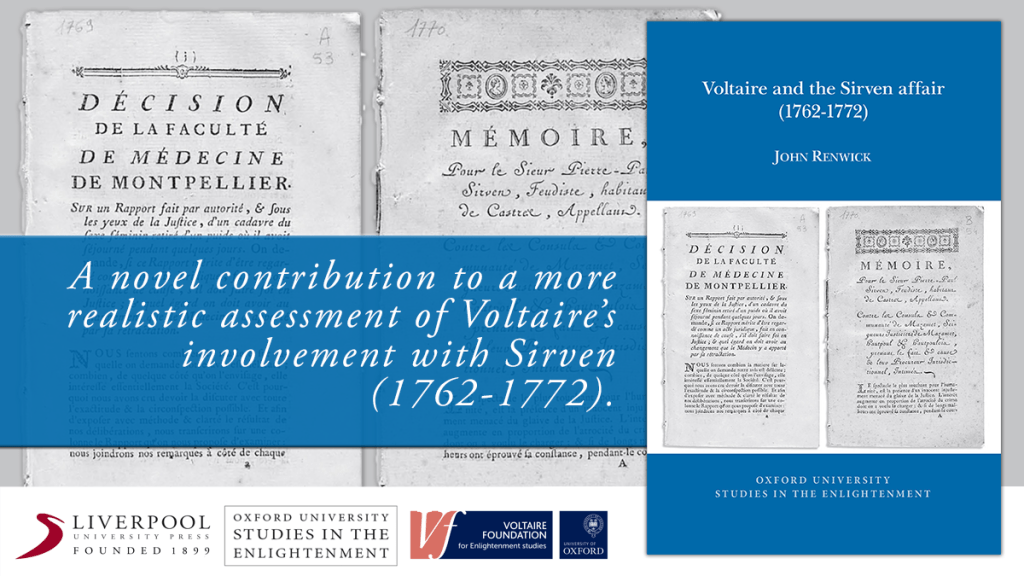
Though long overshadowed by the campaign to exonerate the memory of Jean Calas, the Sirven affair has nonetheless been bracketed with it, and has moreover been, both consistently and conveniently, presented as a Calas bis. It has also, just as misleadingly, been hailed as an equally important success for Voltaire. Hence those fulsome, and curious judgements of the following kind : ‘Voltaire avait une fois encore gagné’; ‘He secured a complete victory’; ‘Sirven was in one important respect the most successful of Voltaire’s human rights campaigns’. Such assertive conclusions are, however, not consonant with a good knowledge of such a complex affair that has, so far, not attracted the attention that it deserves. Voltaire and the Sirven affair (1762-1772) is hence the first ever study in English to evaluate the exact nature of Voltaire’s involvement with Sirven. It was penned moreover in response to those facile and mistaken assumptions, made in French language pronouncements, which consistently cast Voltaire in the self-same mould as the irrepressible, all-conquering Homme aux Calas.
It was the resounding success of the Calas campaign that, in March 1765, emboldened Voltaire – struck by the disturbing parallels that the authorities had ‘identified’ between the ‘crimes’ of both Calas and Sirven – to alert the public to another serious miscarriage of justice. It was launched in an understandable spirit of optimism. His Lettre de M. de Vol…à M. d’Am…which was the confident espousal of a cause that he believed could not fail (his self-satisfied forecast was found displeasing), set the tone, however, for an endeavour that was to gain for him little true satisfaction and much repetitive disappointment because his comprehensible faith in a brighter future for Sirven was to be relentlessly counterbalanced in a bewildering variety of ways. Conservative opinion immediately contrived to complicate the gathering of relevant information; more seriously, Elie de Beaumont, retained for the defence of Sirven, variously proved to be uncooperative, unproductive and, above all, unreceptive to Voltaire’s strategic injunctions. The latter found himself obliged therefore to compose (April-October 1765) the factual background to Beaumont’s Mémoire à consulter […] pour Pierre-Paul Sirven. Despite these and other anguished attempts to galvanise Beaumont’s essential activity it was only in February 1767 that the document finally appeared. However, its progress to the Conseil du roi, given secret opposition to the cause, was then annoyingly delayed for a year. In the interim, Voltaire variously attempted to keep the attention of the public focused on the hatred and the intolerance to which Sirven had been a victim. When finally the appeal reached the Conseil du roi (29 January 1768), it failed despite the combined rhetoric of Beaumont, Cassen and Chardon. Voltaire was so outraged and spectacularly discouraged by the setback that – for more than a year and a half – he remained silent on such a reversal. His savage, personal revenge, however, came quickly in the form of Les Guèbres ou la tolérance (March 1768-January 1769) which was a blunt denunciation of intolerant, obnoxious priests. It gave him, however, a ‘success’ in the shape of an edict of toleration, suggested by an old Ghebr farmer (Voltaire), which is complacently granted by the Emperor (Louis XV). Once it was decided (mid-March 1769) that Sirven – who had been tried in absentia – should return to Mazamet and face his original judges, staging of Les Guèbres, for the essential purposes of publicity (i.e. contextualising the problem in a highly dramatic form), became for Voltaire a total obsession (April-November 1769). His laborious initiative, given the obstinate lack of support afforded him by his intimates of standing, proved to be an ignominious, demoralising failure.
More positive in its results, however (though only temporarily), was Voltaire’s continuing commitment to ensuring that Sirven’s interests, now displaced back to Mazamet, should be looked after by sympathetic supporters. Thanks to the efforts of the abbé philosophe Joseph Audra, a fervent disciple resident in Toulouse, who worked to enrol the advocate Pierre-Firmin de La Croix as counsel to Sirven, Voltaire seems to have decided that he could place utter confidence in their oversight of the latter’s interests. Though they were to play a significant role in his cause, they did so (deliberately it would seem) at the expense of Voltaire. Throughout the period leading up to the trial and during its various hearings (March-November 1769), their own hurtful silence, coupled with that of Sirven himself which was to last from November 1769 until December 1771, worked to confirm Voltaire’s assessment of his own lack of both importance and influence. Though, in the early stages, he had played a noticeable role in the conduct of Sirven’s defence (3 pamphlets ; March 1765; June 1766; March 1767), in securing active support for him, and in continuing to alert the public to the dangers of intolerance and persecution, his endeavours thereafter were to be constantly fruitless. One identifies henceforth a would-be champion of a just cause who is almost constantly dejected : his unstinting efforts had not been treated with all due respect, while his continuing help was no longer being solicited. It could moreover not have helped his frame of mind to learn that Sirven, with no reference to him at all, conducted himself before the Court in Mazamet with commendable skill and determination. It could likewise not increase the self-esteem of this aggressively active opponent of the infâme to discover that the appeal that Sirven (seeking a verdict that he was innocent of murder) had lodged against the non-proven verdict, gave rise to an accomplished argument fashioned by La Croix to which he had been in no way privy. When the Parlement de Toulouse finally granted Sirven victory (25 November 1771), the despondent Voltaire, amazingly silent between November 1769 and December 1771, knew perhaps only too well the cause of his dejection : victory had undeniably gone to others. The previous four years had forced him to recognise that he had been unable (not even been allowed!) to contribute, even tangentially, to the exoneration of Sirven. Setting great store by his jealously guarded autonomy which had allowed him to produce those powerful pamphlets that had made for the glories of the Calas campaign, it was surely the complete absence of the self-same possibilities for action, for the opportunity to play the essential combative role in this good fight for Sirven, that pained him greatly. The Voltaire who took note of the final victory with a signal lack of exuberance was surely the Voltaire who had, since 1767, really been playing but a walk-on part in this essential confrontation between enlightenment and prejudice.
Since the above analyses derive indisputably from a careful study of the affair in all its complexity, small wonder that I am still unable to fathom what exactly justifies the proud assessment that, with Sirven, Voltaire ‘secured a complete victory’.
John Renwick
John Renwick, Fellow of the Royal Society of Edinburgh, the John Orr Professor of French (Edinburgh University, 1980-2006), long collaborated with the Voltaire Foundation (1970-2022), producing for the OCV numerous editions. In parallel he worked to secure a re-evaluation of Jean-François Marmontel (1723-1799) : in March 2021, he was awarded the Prix littéraire Auvergne-Rhône-Alpes de la Francophonie for his ‘pioneering rehabilitation’ of Jean-François Marmontel; in July 2021, he was awarded the Royal Society of Edinburgh’s Senior Career Medal (the Sir Walter Scott Medal) for his ‘monumental and ground-breaking’ contribution to the critical edition of the OCV’ and his key role in the ‘resurrection of the highly significant figure, Jean-François Marmontel’.

Follow us for more updates
Sign up to our mailing list
OSE Bluesky | LUP Bluesky | Instagram
www.liverpooluniversitypress.co.uk
 Liverpool University Press Blog