
Peter J. Koehler’s The Life of Philippe Fermin: Nature, Medicine and Law in Suriname and the Netherlands, recently published in the Oxford University Studies in the Enlightenment series, brings into focus a figure long neglected by historians of medicine and the Republic of Letters. The book reconstructs Fermin’s life and career across Europe and Suriname, from his surgical training in Berlin, Suffolk and Amsterdam to his involvement with slavery, scientific societies and the Republic of Letters.
In this blog post, Professor Laurence Brockliss, emeritus professor of Early Modern French history at the University of Oxford and historian of the Republic of Letters, explores how Koehler’s study reshapes our understanding of this scholarly network, and reflects on both the difficulties and the rewards of bringing overlooked figures back into focus.
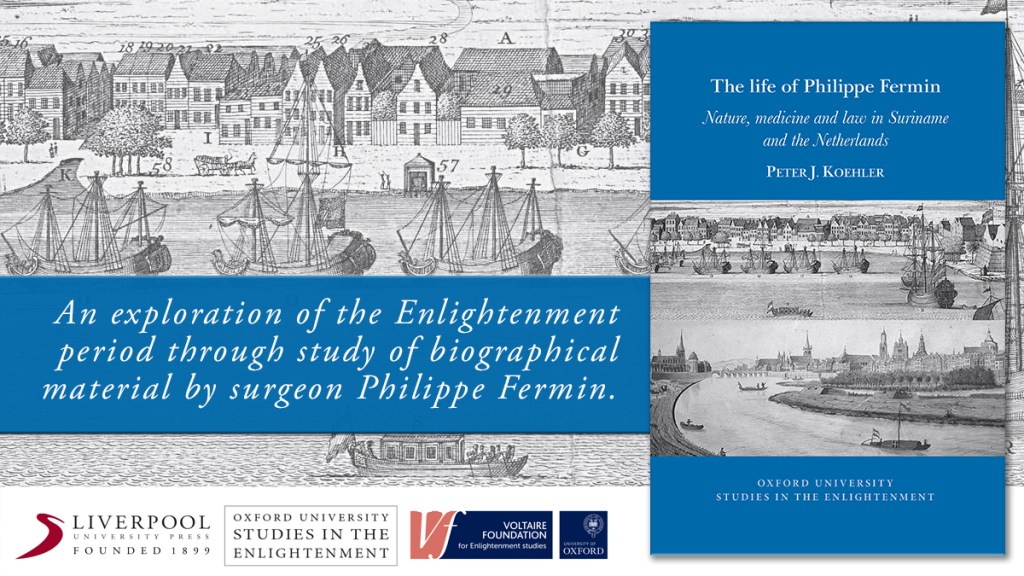
The Life of Philippe Fermin. Nature, medicine and law in Suriname and the Netherlands is an intellectual biography of a Dutch naturalist, medical practitioner and judge-administrator who was born in Berlin in 1730, lived for a time in the Dutch colony of Suriname, then settled in Maastricht, where he died in 1813. Fermin’s books and articles on the history, flora and fauna of Suriname, written in French, were translated into English, German and Italian and appear to have had a wide circulation. He was also well known to members of the Berlin Academy, especially its secretary Samuel Formey. Today, though, Fermin is a forgotten figure whose name is never mentioned in the works of historians of science and medicine or historians of the Republic of Letters.
Herein lies the book’s fascination. Koehler’s biography is a significant contribution to our understanding of the reality of that virtual Republic. Much more than a community of stellar minds, the Republic of Letters comprised thousands of interconnected scholars and researchers, who believed that each in their small way was helping to build a world of enlightenment. Their existence was all but neglected by intellectual historians until the turn of this present century. Now, however, the lives of a cross-section about whom sufficient evidence survives are beginning to be reconstructed. Each biography which appears reveals how much these forgotten members of the Republic shared in common but also that they were very much individuals with their own trajectories determined by birth, income, inclination and chance. As Fermin’s biography confirms, every study throws up something new and unexpected.
We know there were several ways of belonging to the Republic. One way was to be content with provincial renown, be part of a correspondence circle, and publish next to nothing. Another way was to have a provincial base but use the ubiquity of the prize essay competition to gain an international reputation. Yet another was to decamp to a capital city in search of a salaried post in the branch of the sciences an individual was interested in. Fermin is a different kettle of fish. He may have wanted to become an internationally respected naturalist through his publications, but what he wanted primarily was to use them as currency to obtain administrative office. Patrons – royal and not-so royal – were targeted, and Formey, whose contacts were formidable, was asked to write letters of recommendation to them singing Fermin’s praises as a man of science worthy of promotion. Once done, Fermin would approach the individual directly sending a copy of his latest work and asking the patron’s help in getting the administrative post he coveted. Fermin was spectacularly unsuccessful most of the time but he aimed high: Catherine the Great was lobbied on one occasion. So, for Fermin membership of the Republic of Letters was not a passion: at different moments of his life, he did not to think twice about selling his natural-history collection or parting with most of his library. Membership was not even a hobby. For Fermin, it was the means to an end, which arguably reflected the fact that by background – he was the son of a wigmaker, not a professional or noble – he did not fit the membership profile.
Koelher is to be congratulated on adding another subject to the pantheon of the forgotten. The book, moreover, is a masterclass in how material can be pulled together to reconstruct such a life. The study is principally based on Fermin’s long-lasting correspondence with Samuel Formey, which survives in the Formey archive in Berlin’s Staatsbibliothek. But the author uses many other sources to flesh out his account. While unable to identify many other Fermin letters, he has uncovered nuggets of information about the naturalist-physician and his family from a wide variety of national and local libraries and archives, such as the Paris Bibliothèque Nationale (on Fermin’s masonic activities). The author has also made good use of the paratexts of Fermin’s published works to dig deeper into his web of literary and political connections. This is an impressive and very careful piece of historical detective work.
Professor Laurence Brockliss
Professor Laurence Brockliss is an emeritus professor in Early Modern French history at the University of Oxford. His most recent publications on the Republic of Letters are: edited (with Ritchie Robertson), Isaiah Berlin and the Enlightenment (Oxford University Press, 2016); edited and introduced, From Provincial Savant to Parisian Naturalist: the recollections of Pierre-Joseph Amoreux (1741-1824) (Oxford University Studies in the Enlightenment, 2017); edited (with Floris Verhaart), The Latin Language and the Enlightenment (Oxford University Studies in the Enlightenment, 2023).
Peter J. Koehler is a retired neurologist who focused on neuro-oncology and headaches. He obtained his PhD on a medical history topic (1989) and is co-editor of the Journal of the History of the Neurosciences (1997). He published numerous articles and several books including Neurological Eponyms and The Stone of Madness: Art and History.
Follow us for more updates
Sign up to our mailing list
OSE Bluesky | LUP Bluesky | Instagram
www.liverpooluniversitypress.co.uk
 Liverpool University Press Blog