
The editors of International Development Planning Review (IDPR) have selected the following paper as the Featured Article in IDPR 48.3.
‘Informal rental housing in the global South: managing soft densification for sustainable neighbourhoods’ by Andreas Scheba, Ivan Turok and Andrew Charman.
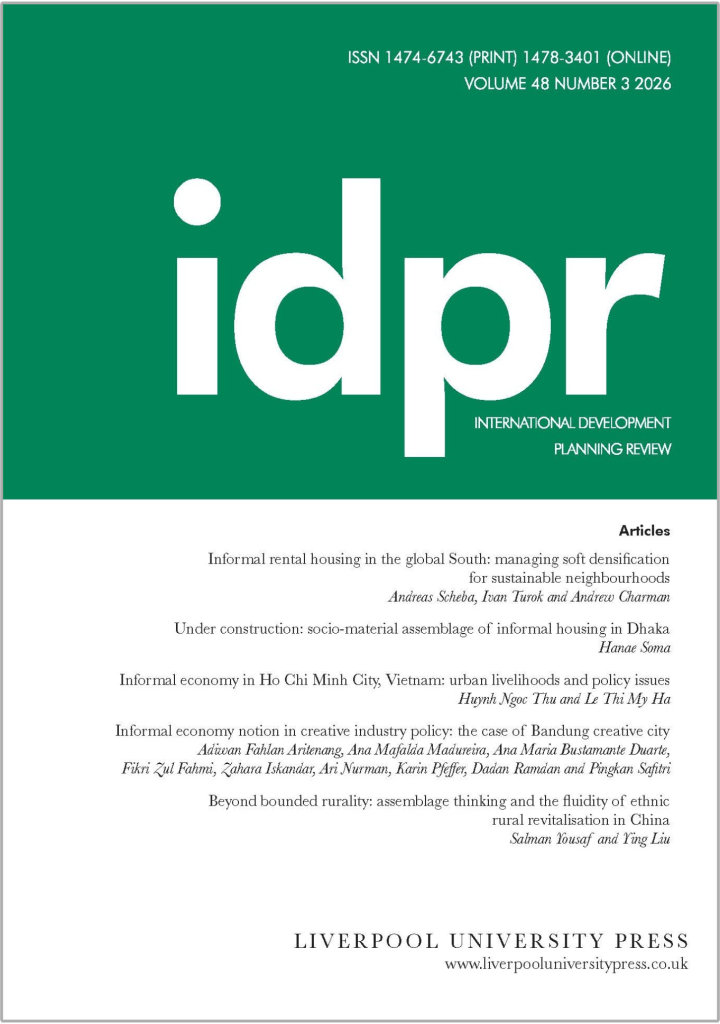
This article will be free to read for a limited time.
To mark this Featured Article, we invited the authors to share their thoughts on the piece and its importance.
……………………………………………………………………
Our paper argues that informal rental housing is transforming many neighbourhoods in cities of the global South. The impact on densification requires a fundamental shift in governance to support sustainable urban development. In a case study from Cape Town, South Africa, we demonstrate the enormous scale and diversity of informal rental housing investments and describe their influence on the ‘soft densification’ of a low-income settlement. In addition to advancing scholarship on densification, informality and planning, our article offers a novel framework, outlining seven spheres of action to assist policy makers in better managing and delivering these bottom-up processes for collective benefit.
While a growing body of literature has highlighted the significance of informal and small-scale rental housing markets and practices, studies examining this phenomenon at the neighbourhood level are rare, especially in rapidly urbanising contexts. Our paper draws on quantitative, qualitative and geospatial data to reveal the vast scale, density and diversity of these practices and their cumulative impacts.
Our research offers new insights into the key features, spatiality and financing of different rental sub-markets. These include a qualitative transformation of residential homes from rudimentary single dwellings to more solid micro-flats and apartment blocks. Though soft densification has resulted in a proliferation of rental units, many of high quality, we found a gulf between people’s building practices and the regulatory regime governing land use and property development in the city. In some cases, this informalisation has contributed to health and safety risks, encroachments, and pressure on social amenities. Business as usual on the part of government that ignores, neglects or punishes bottom-up densification could take neighbourhoods down a low road of overcrowding, instability and infrastructure collapse.
Building on previous calls for urgent governance reforms to address informal densification, our article contributes to policy debates by putting forward a more complete framework comprising seven spheres of action: i) legal recognition, ii) land-use planning, iii) building regulations, iv) housing policies, v) development finance, vi) infrastructure capacity, and vii) precinct management. We discuss four of these in detail and call for further research and policy attention on how informal rental housing markets drive the soft densification of neighbourhoods in different geographical contexts. In offering a policy framework with concrete suggestions for practical actions, our article contributes to wider debates about planning for informal urbanism.

IDPR is part of LUP Open Planning, Liverpool University Press’s Subscribe to Open initiative.
With the support of subscribing institutions LUP Open Planning can provide:
✔ Immediate open access to the latest content for readers everywhere
✔ No open access fees for authors
✔ Greater visibility and impact for published research
✔ Subscribing institutions gain exclusive access to the IDPR archive from 1979
If you would like to support open access please use our online form to recommend a subscription to your librarian.

Follow us for more updates
Sign up to our mailing list
Follow us on social media
www.liverpooluniversitypress.co.uk


Pingback: Developer or land owner contributions? Land value capture, creation, conservation and compensation | Town Planning Review 97.4 Featured Article | Liverpool University Press Blog