
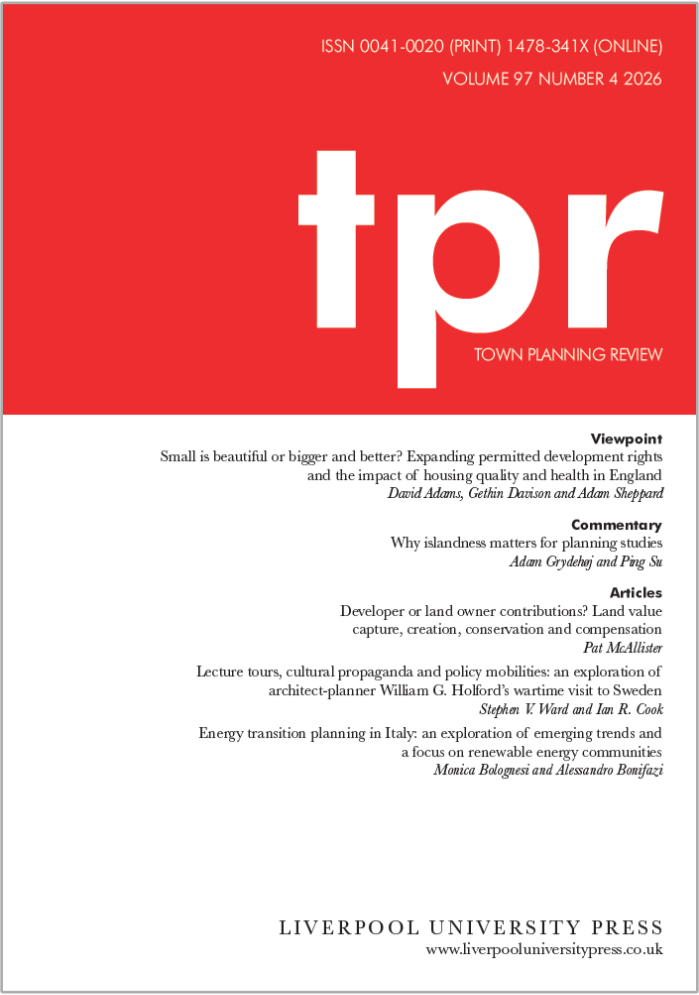
The editors of Town Planning Review (TPR) have selected the following paper as the Featured Article in TPR 97.4.
Developer or land owner contributions? Land value capture, creation, conservation and compensation, by Pat McAllister.
This article will be Free to Read for a limited time.
We invited the author to share his thoughts on the piece and its importance:
Writing the paper was motivated by a degree of personal frustration that, in both academic and policy discussions, labels such as “land value capture” and “developer contributions” are often used rather loosely and can become conflated, despite referring to different concepts. While the paper does not offer new empirical evidence, it synthesises existing theory and research in an attempt to bring greater clarity to what can be a surprisingly muddled area.
The primary focus is on developer contributions, typically consisting of cash payments or in-kind provisions linked to planning consent, and the seemingly straightforward question of when they actually capture land value. The starting point is that this question cannot be answered in isolation. Land value is captured in many different ways across fiscal and planning systems: through general taxation, real estate transaction taxes, recurrent property taxation, regulatory decisions, and even compulsory acquisition. Developer contributions are therefore only one element within a much broader and often opaque landscape of value capture mechanisms.
Building on this wider perspective, the paper develops a framework that classifies developer contributions as enabling, commercial, compensatory, supplementary, redistributive, or subsidised, according to their effects on land values and the degree of additionality. A central argument is that not all developer contributions involve land value capture. Some are simply normal development costs, some are effectively passed forward to end users (home buyers in the residential sector), and others may even increase land values. Land value capture occurs only under more specific conditions, particularly where contributions reduce the price developers are willing to pay for land, thereby shifting the cost back to landowners.
The paper also highlights how complex and context-dependent these processes can be. The incidence of developer contributions can fall on landowners, developers, buyers, neighbouring property owners, or some combination of these, depending on market conditions, policy design and timing. This makes it inherently difficult to assess how much value is actually being captured.
The paper aims to provide a clearer conceptual framework for thinking about this highly topical policy issue, as governments increasingly look to land and development as a means of funding infrastructure and affordable housing. This isn’t just a ‘nice to have’ – getting the categories right is a precondition for knowing what is actually being achieved.
Support Open Access to TPR and IDPR

LUP Open Planning is a Subscribe to Open initiative for TPR and IDPR, which succeeded in making the latest content from both journals open access for four consecutive years.
When the annual subscription threshold is met, the latest content becomes open access for scholars worldwide, helping to build a more inclusive global research community.
Each subscription plays a vital role in reaching this goal. With the support of subscribing institutions LUP Open Planning will provide:
✔ Immediate open access to the latest content for readers everywhere
✔ No open access fees for authors
✔ Greater visibility and impact for published research
✔ Subscribers gain exclusive online access to journal archives dating back 1910
To help us achieve open access for 2027, we invite you to complete our online form to recommend TPR and IDPR to your librarian using the buttons below.
Also of interest: Informal rental housing in the global South: managing soft densification for sustainable neighbourhoods | IDPR 48.3 Featured Article

Follow us for more updates

